Normal distribution
One of the simplest pivotal quantities is the z-score. Given a normal distribution with mean  and variance
  , and an observation 'x', the z-score:

has distribution  – a normal distribution with mean 0 and variance 1. Similarly, since the 'n'-sample sample mean has sampling distribution
  , the z-score of the mean

also has distribution  Note that while these functions depend on the parameters – and thus one can only compute them if the parameters are known (they are not statistics) — the distribution is independent of the parameters.
Given  independent, identically distributed (i.i.d.) observations
  from the normal distribution with unknown mean and variance , a pivotal quantity can be obtained from the function:
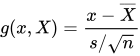
where
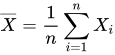
and
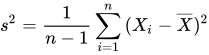
are unbiased estimates of and , respectively. The function  is the Student's t-statistic for a new value
  , to be drawn from the same population as the already observed set of values
  .
.
Using  the function
  becomes a pivotal quantity, which is also distributed by the Student's t-distribution with
  degrees of freedom. As required, even though appears as an argument to the function
  , the distribution of does not depend on the parameters or
  of the normal probability distribution that governs the observations
  .
.
This can be used to compute a prediction interval for the next observation  see Prediction interval: Normal distribution.
Bivariate normal distribution
In more complicated cases, it is impossible to construct exact pivots. However, having approximate pivots improves convergence to asymptotic normality.
Suppose a sample of size of vectors  is taken from a bivariate bivariate normal distribution with unknown correlation
  .
.
An estimator of is the sample (Pearson, moment) correlation
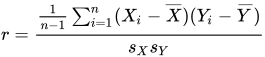
where  are sample variances of and
  . The sample statistic
  has an asymptotically normal distribution:
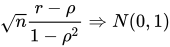 .
.
However, a variance-stabilizing transformation
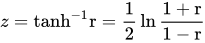
known as Fisher's 'z' transformation of the correlation coefficient allows creating the distribution of  asymptotically independent of unknown parameters:

where  is the corresponding distribution parameter. For finite samples sizes , the random variable will have distribution closer to normal than that of . An even closer approximation to the standard normal distribution is obtained by using a better approximation for the exact variance: the usual form is
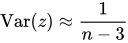 .
.


