In statistics, the Bayesian information criterion (BIC) or Schwarz information criterion (also SIC, SBC, SBIC) is a criterion for model selection among a finite set of models; models with lower BIC are generally preferred. It is based, in part, on the likelihood function and it is closely related to the Akaike information criterion (AIC).
When fitting models, it is possible to increase the maximum likelihood by adding parameters, but doing so may result in overfitting. Both BIC and AIC attempt to resolve this problem by introducing a penalty term for the number of parameters in the model; the penalty term is larger in BIC than in AIC for sample sizes greater than 7.[1]
The BIC was developed by Gideon E. Schwarz and published in a 1978 paper,[2] as a large-sample approximation to the Bayes factor.
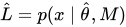
= the maximized value of the likelihood function of the model , i.e. , where are the parameter values that maximize the likelihood function and is the observed data;
= the number of data points in , the number of observations, or equivalently, the sample size;
= the number of parameters estimated by the model. For example, in multiple linear regression, the estimated parameters are the intercept, the slope parameters, and the constant variance of the errors; thus, .
Derivation
The BIC can be derived by integrating out the parameters of the model using Laplace's method, starting with the following model evidence:[5][6]:217
where is the prior for under model .
The log-likelihood, , is then expanded to a second order Taylor series about the MLE, , assuming it is twice differentiable as follows:
where is the average observed information per observation, and denotes the residual term. To the extent that is negligible and is relatively linear near , we can integrate out to get the following:
As increases, we can ignore and as they are . Thus,
where BIC is defined as above, and either (a) is the Bayesian posterior mode or (b) uses the MLE and the prior has nonzero slope at the MLE. Then the posterior
The above arguments are heuristic, but can be made mathematically rigorous under the technical assumptions of Lipschitz continuity and strong convexity, as follows.
Lemma. (Lemma 2.82 [7])
Define . If
the sequence of gradients is Lipschitz continuous, uniformly in , and every is strongly convex with a common parameter (independent of ), then as :
where is the maximum a posteriori (MAP) estimate of .
Note that it is always possible to select a prior density such that every is strongly convex (with the same parameter ). Such a prior ensures that the MAP estimate exists, even in cases where the MLE estimate itself does not exist.
Use
When picking from several models, ones with lower BIC values are generally preferred. The BIC is an increasing function of the error variance and an increasing function of k. That is, unexplained variation in the dependent variable and the number of explanatory variables increase the value of BIC. However, a lower BIC does not necessarily indicate one model is better than another. Because it involves approximations, the BIC is merely a heuristic. In particular, differences in BIC should never be treated like transformed Bayes factors.
It is important to keep in mind that the BIC can be used to compare estimated models only when the numerical values of the dependent variable[b] are identical for all models being compared. The models being compared need not be nested, unlike the case when models are being compared using an F-test or a likelihood ratio test.[citation needed]
To compare two different models, simply compute the BIC for each model and compare according to the table below:
the above approximation is only valid for sample size much larger than the number of parameters in the model.
the BIC cannot handle complex collections of models as in the variable selection (or feature selection) problem in high-dimension.[8]
Gaussian special case
Under the assumption that the model errors or disturbances are independent and identically distributed according to a normal distribution and the boundary condition that the derivative of the log likelihood with respect to the true variance is zero, this becomes (up to an additive constant, which depends only on n and not on the model):[9]
where is the error variance. The error variance in this case is defined as
↑The AIC, AICc and BIC defined by Claeskens and Hjort[4] are the negatives of those defined in this article and in most other standard references.
↑A dependent variable is also called a response variable or an outcome variable. See Regression analysis.
References
↑See the review paper: Stoica, P.; Selen, Y. (2004), "Model-order selection: a review of information criterion rules", IEEE Signal Processing Magazine (July): 36–47, doi:10.1109/MSP.2004.1311138, S2CID17338979.