ENSIKLOPEDIA
NGC 4945
| NGC 4945 | |
|---|---|
 NGC 4945 image taken by the MPG/ESO 2.2-metre telescope at La Silla Observatory | |
| Observation data (J2000 epoch) | |
| Constellation | Centaurus |
| Right ascension | 13h 05m 27.279s[1] |
| Declination | −49° 28′ 04.44″[1] |
| Redshift | 0.001868±0.00002[2] |
| Heliocentric radial velocity | 563±3 km/s[3] |
| Distance | 10.96 ± 0.55 Mly (3.36 ± 0.17 Mpc)[4] |
| Group or cluster | Centaurus A/M83 Group[5] |
| Apparent magnitude (V) | 9.3[3] |
| Characteristics | |
| Type | SB(s)cd?edge[4] |
| Mass | 1.4+1.4 −0.7×10¹¹[6] M☉ |
| Size | 165,185 ly (50.67 kpc) (estimated)[3] |
| Apparent size (V) | 20.0′ × 3.8′[3] |
| Notable features | Seyfert 2 galaxy[7] |
| Other designations | |
| ESO 219- G 024, IRAS 13025-4911, LEDA 45279, PGC 45279, C 83[3][8][4] | |
NGC 4945 is a widely-studied[7] barred spiral galaxy in the constellation Centaurus, visible near the optical double star Xi Centauri.[9] It is also known as Caldwell 83. The galaxy was discovered by Scottish astronomer James Dunlop in 1826.[10] It is located at a distance of approximately 11.0 million light-years (3.36 Mpc) from the Milky Way.[4] NGC 4945 hosts one of the closest active galactic nuclei to Earth and is classified as a Seyfert 2 galaxy.[7]
NGC 4945 is one of the brightest galaxies of the Centaurus A/M83 Group, a large, nearby group of galaxies. The galaxy is the second brightest galaxy in the subgroup centered on Centaurus A.[5] [11]
Observations
The morphological classification of NGC 4945 is SB(s)cd?edge,[4] indicating this is a barred spiral galaxy (SB) with no inner ring structure (s) and possibly loosely-wound spiral arms (cd?). It is inclined at an angle of 90° to the plane of the sky, which means the galactic plane is being viewed edge-on.[4] NGC 4945 is thought to be similar to the Milky Way Galaxy, although the maximum rotation rate of ~ 180 km/s is lower.[12] It has a combined estimated mass of 1.4+1.4
−0.7×10¹¹ M☉.[6] The stellar mass of the galaxy is 3.8×10¹⁰ M☉, or 38 billion times the mass of the Sun.[12]
In 1964, this galaxy was classified as a radio source at the Parkes Observatory.[13] The nucleus was obscured in the optical band but was found to be a quite prominent source of infrared emission.[14] It is the third brightest galaxy in the IRAS point source catalogue, with most of the emission coming from the core.[15] Most of the Galaxy shows a linear rotation curve, although the southwest region showed an infall suggestive of a bar.[16]
.jpg)
In 1979, strong H2O maser emission was detected from the central region.[17] The properties of the nuclear region are suggestive of both a Seyfert type galaxy and an intense starburst region with a complex structure.[18] The active nucleus is heavily obscured by dust. These dust lanes approach the nucleus, forming a tightly-wound structure in the inner 650 ly (200 pc).[7] X-ray emission from the nuclear region indicates a Type 2 Seyfert galaxy. It is a strong emitter of hard X-rays, second only to NGC 4151,[15] and likely harbors a supermassive black hole.[19]
The starburst region is thought to be at least 5×10⁶ years old and contributes at least half of the luminosity coming from the core.[20] It is concentrated in the central 330 ly (100 pc) and includes a conical cavity likely produced by supernovae-driven winds.[21] This is taking place in a region of dense molecular clouds,[22] forming a disk of dust and gas, along with many rich star clusters.[23][24] A hot wind of gas from the nuclear region is carrying away 1.6 M☉ per year.[25]
NGC 4945 was the first galaxy outside the Local Group to have stars resolved within its galactic halo. The halo mass is relatively large at ~ 3.5×10⁹ M☉ and it is metal-rich, both of which are typical for a Milky Way-like galaxy. It appears to be counter-rotating compared to the main disk, suggesting the halo has been accreted. The mass of the dominant satellite accreted into the halo is ~ 1.5×10⁹ M☉, which is roughly the same as the Large Magellanic Cloud.[12]
In October 2023, researchers using ALMA discovered an unknown object around 200 light years from the center of the galaxy. This object, named Punctum (Latin for "point" or "dot"), is a highly-polarized millimeter continuum source of synchrotron radiation. Punctum has a high non-visible luminosity, with archive data from Chandra reporting a 1×1037 erg s−1 X-ray luminosity in the 3–6 keV range and ATCA data reporting a radio luminosity of 5×1035 erg s−1 at 23 GHz. In a paper published in July 2025 about the object, the researchers said it most resembles a magnetar due to its polarization of 50%±14%, however the millimeter luminosity of said objects is usually much lower.[26]
Supernovae
Two supernovae have been observed in NGC 4945:
- SN 2005af (Type II-P, mag. 12.8) was discovered by CEAMIG/REA Supernovae Search on 8 February 2005, reaching a peak magnitude of 12.5 on 12 February.[27][28][29]
- SN 2011ja (Type II-P, mag. 14) was discovered by Libert "Berto" Monard on 18 December 2011, and achieved a maximum magnitude of 11.7 on 9 January 2012.[30][31][32] The progenitor star for 2011ja may have been massive at 25 M☉ and located within a massive stellar cluster.[33]
In popular culture
"NGC 4945" is the title of a song by Brett Domino on the album Funk.
Image gallery
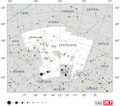 The location of NGC 4945 (labelled in red)

References
- 1 2 Skrutskie, Michael F.; et al. (February 1, 2006). "The Two Micron All Sky Survey (2MASS)". The Astronomical Journal. 131 (2): 1163–1183. Bibcode:2006AJ....131.1163S. doi:10.1086/498708. ISSN 0004-6256. S2CID 18913331.
- ↑ de Vaucouleurs, G.; et al. (2016). Third Reference Catalogue of Bright Galaxies. 9. New York: Springer-Verlag. Retrieved 2025-03-08.
- 1 2 3 4 5 "NASA/IPAC Extragalactic Database". Results for NGC 4945. Retrieved 2006-11-25.
- 1 2 3 4 5 6 Crowther, Paul A. (January 2013). "On the association between core-collapse supernovae and H II regions". Monthly Notices of the Royal Astronomical Society. 428 (3): 1927–1943. arXiv:1210.1126. Bibcode:2013MNRAS.428.1927C. doi:10.1093/mnras/sts145.
- 1 2 Karachentsev, I. D.; Sharina, M. E.; Dolphin, A. E.; Grebel, E. K.; et al. (2002). "New distances to galaxies in the Centaurus A group". Astronomy and Astrophysics. 385 (1): 21–31. Bibcode:2002A&A...385...21K. doi:10.1051/0004-6361:20020042.
- 1 2 Graham, Alister W. (November 2008). "Populating the Galaxy Velocity Dispersion – Supermassive Black Hole Mass Diagram: A Catalogue of (Mbh, σ) Values". Publications of the Astronomical Society of Australia. 25 (4): 167–175. arXiv:0807.2549. Bibcode:2008PASA...25..167G. doi:10.1071/AS08013. S2CID 89905.
- 1 2 3 4 Gaspar, G.; et al. (May 2022). "An Infrared View of the Obscured AGN Environment in NGC 4945". The Astronomical Journal. 163 (5). id. 230. arXiv:2203.03678. Bibcode:2022AJ....163..230G. doi:10.3847/1538-3881/ac5ea4.
- ↑ "NGC 4945", SIMBAD, Centre de données astronomiques de Strasbourg, retrieved 2025-03-08.
- ↑ "NGC 4945". DOCdb :Deep Sky Observer's Companion – the online database. Retrieved 2025-03-08.
- ↑ "Caldwell 83". science.nasa.gov. NASA. 10 September 2020. Retrieved 2025-03-12.
- ↑ Karachentsev, I. D. (2005). "The Local Group and Other Neighboring Galaxy Groups". Astronomical Journal. 129 (1): 178–188. arXiv:astro-ph/0410065. Bibcode:2005AJ....129..178K. doi:10.1086/426368. S2CID 119385141.
- 1 2 3 Beltrand, Camila; et al. (October 2024). "First resolved stellar halo kinematics of a Milky Way-mass galaxy outside the Local Group: The flat counter-rotating halo in NGC 4945". Astronomy & Astrophysics. 690. id. A115. arXiv:2406.17533. Bibcode:2024A&A...690A.115B. doi:10.1051/0004-6361/202450626.
- ↑ Bolton, J. G.; et al. (September 1964). "The Parkes catalogue of radio sources, declination zone −20° to −60°". Australian Journal of Physics. 17 (3): 340. Bibcode:1964AuJPh..17..340B. doi:10.1071/PH640340.
- ↑ Shobbrook, R. R.; Shaver, P. A. (August 1967). "The nucleus of the southern spiral NGC 4945". The Observatory. 87: 169–170. Bibcode:1967Obs....87..169S.
- 1 2 Done, C.; et al. (June 1996). "NGC 4945: The brightest Seyfert 2 galaxy at 100 keV". Astrophysical Journal Letters. 463 (2): L63. Bibcode:1996ApJ...463L..63D. doi:10.1086/310056.
- ↑ Peterson, C. J. (August 1980). "Observations of the kinematics of the excited gas in the late-type spiral galaxy NGC 4945". Publications of the Astronomical Society of the Pacific. 92: 397–408. Bibcode:1980PASP...92..397P. doi:10.1086/130685.
- ↑ Moorwood, A. F. M.; Glass, I. S. (June 1984). "Infrared activity in Circinus and NGC 4945 : two galaxies containing luminous H2 O masers". Astronomy and Astrophysics. 135: 281–288. Bibcode:1984A&A...135..281M.
- ↑ Whiteoak, J. B. (1986). "NGC 4945 – a galaxy with a nucleus full of surprises". Publications of the Astronomical Society of Australia. 6 (4): 467–471. Bibcode:1986PASA....6..467W. doi:10.1017/S1323358000018403.
- ↑ "Milky Way's Not-So-Distant Cousin Likely Harbors Supermassive Black Hole". Science Daily. Retrieved 2025-03-08.
- ↑ Spoon, H. W. W.; et al. (May 2000). "Mid-infrared ISO spectroscopy of NGC 4945". Astronomy and Astrophysics. 357: 898–908. arXiv:astro-ph/0003457. Bibcode:2000A&A...357..898S.
- ↑ Wang, M.; et al. (August 2004). "Dense gas in nearby galaxies. XVI. The nuclear starburst environment in NGC 4945". Astronomy and Astrophysics. 422 (3): 883–905. arXiv:astro-ph/0405346. Bibcode:2004A&A...422..883W. doi:10.1051/0004-6361:20035722.
- ↑ Cunningham, M. R.; Whiteoak, J. B. (November 2005). "The nuclear molecular clouds of NGC4945". Monthly Notices of the Royal Astronomical Society. 364 (1): 37–46. Bibcode:2005MNRAS.364...37C. doi:10.1111/j.1365-2966.2005.09502.x.
- ↑ Gaspar, G.; et al. (2022). "An Infrared View of the Obscured AGN Environment in NGC 4945". The Astronomical Journal. 163 (5): 230. arXiv:2203.03678. Bibcode:2022AJ....163..230G. doi:10.3847/1538-3881/ac5ea4. S2CID 247315251.
- ↑ Emig, Kimberly L.; et al. (November 2020). "Super star clusters in the central starburst of NGC 4945". The Astrophysical Journal. 903 (1). id. 50. arXiv:2009.05154. Bibcode:2020ApJ...903...50E. doi:10.3847/1538-4357/abb67d.
- ↑ Porraz Barrera, Natalia; et al. (June 2024). "Hot Gas Outflow Properties of the Starburst Galaxy NGC 4945". The Astrophysical Journal. 968 (2). id. 54. arXiv:2312.08444. Bibcode:2024ApJ...968...54P. doi:10.3847/1538-4357/ad4606.
- ↑ E., Shablovinskaia; C., Ricci; C-S., Chang; R., Paladino; Y., Diaz; D., Belfiori; S., Aalto; M., Koss; T., Kawamuro; E., Lopez-Rodriguez; R., Mushotzky; C., Privon, G. (2025). "ALMA discovery of Punctum, a highly polarized millimeter source in the nuclear starburst galaxy NGC 4945". Astronomy & Astrophysics. 703: A110. arXiv:2507.13014. Bibcode:2025A&A...703A.110S. doi:10.1051/0004-6361/202554285.
{{cite journal}}: CS1 maint: multiple names: authors list (link) - ↑ Jacques, C.; Pimentel, E. (2005). "Possible Supernova in NGC 4945". International Astronomical Union Circular (8482): 1. Bibcode:2005IAUC.8482....1J.
- ↑ "SN 2005af". Transient Name Server. IAU. Retrieved 8 December 2024.
- ↑ Pereyra, A.; et al. (August 2006). "Optical polarimetric monitoring of the type II-plateau SN 2005af". Astronomy and Astrophysics. 454 (3): 827–831. arXiv:astro-ph/0604511. Bibcode:2006A&A...454..827P. doi:10.1051/0004-6361:20065207.
- ↑ Monard, L. A. G.; et al. (2011). "Supernova 2011ja in NGC 4945 = PSN J13051112-4931270". Central Bureau Electronic Telegrams (2946): 1. Bibcode:2011CBET.2946....1M.
- ↑ Bishop, David. "Supernova 2011ja in NGC 4945". Rochester Astronomy. Retrieved 14 July 2025.
- ↑ "SN 2011ja". Transient Name Server. IAU. Retrieved 8 December 2024.
- ↑ Andrews, J. E.; et al. (April 2016). "Early dust formation and a massive progenitor for SN 2011ja?". Monthly Notices of the Royal Astronomical Society. 457 (3): 3241–3253. arXiv:1509.06379. Bibcode:2016MNRAS.457.3241A. doi:10.1093/mnras/stw164.
Further reading
- Bellocchi, E.; et al. (February 2023). "Positive feedback, quenching, and sequential super star cluster (SSC) formation in NGC 4945". Monthly Notices of the Royal Astronomical Society: Letters. 519 (1): L68–L73. arXiv:2211.17268. Bibcode:2023MNRAS.519L..68B. doi:10.1093/mnrasl/slac154.
- Ianjamasimanana, Roger; et al. (June 2022). "The extended H I halo of NGC 4945 as seen by MeerKAT". Monthly Notices of the Royal Astronomical Society. 513 (2): 2019–2038. arXiv:2204.00637. Bibcode:2022MNRAS.513.2019I. doi:10.1093/mnras/stac936.
- Bolatto, Alberto D.; et al. (December 2021). "ALMA imaging of a galactic molecular outflow in NGC 4945". The Astrophysical Journal. 923 (1). id.83. arXiv:2109.10437. Bibcode:2021ApJ...923...83B. doi:10.3847/1538-4357/ac2c08.
- Henkel, C.; et al. (July 2018). "Molecular line emission in NGC 4945, imaged with ALMA". Astronomy & Astrophysics. 615. id. A155. arXiv:1802.09852. Bibcode:2018A&A...615A.155H. doi:10.1051/0004-6361/201732174.
- Bendo, G. J.; et al. (November 2016). "Free-free and H42α emission from the dusty starburst within NGC 4945 as observed by ALMA". Monthly Notices of the Royal Astronomical Society. 463 (1): 252–269. arXiv:1607.02304. Bibcode:2016MNRAS.463..252B. doi:10.1093/mnras/stw1659.
- Pesce, D. W.; et al. (August 2016). "Submillimeter H2O Megamasers in NGC 4945 and the Circinus Galaxy". The Astrophysical Journal. 827 (1). id. 68. arXiv:1604.03789. Bibcode:2016ApJ...827...68P. doi:10.3847/0004-637X/827/1/68.
- Puccetti, Simonetta; et al. (September 2014). "The variable hard X-Ray emission of NGC 4945 as observed by NuSTAR". The Astrophysical Journal. 793 (1). id. 26. arXiv:1407.3974. Bibcode:2014ApJ...793...26P. doi:10.1088/0004-637X/793/1/26.
- Yaqoob, Tahir (July 2012). "The nature of the Compton-thick X-ray reprocessor in NGC 4945". Monthly Notices of the Royal Astronomical Society. 423 (4): 3360–3396. arXiv:1204.4196. Bibcode:2012MNRAS.423.3360Y. doi:10.1111/j.1365-2966.2012.21129.x.
- Marinucci, A.; et al. (June 2012). "The X-ray reflector in NGC 4945: a time- and space-resolved portrait". Monthly Notices of the Royal Astronomical Society: Letters. 423 (1): L6–L10. arXiv:1202.1279. Bibcode:2012MNRAS.423L...6M. doi:10.1111/j.1745-3933.2012.01232.x.
- Spoon, H. W. W.; et al. (May 2003). "Detection of strongly processed ice in the central starburst of NGC 4945". Astronomy and Astrophysics. 402 (2): 499–507. arXiv:astro-ph/0302568. Bibcode:2003A&A...402..499S. doi:10.1051/0004-6361:20030290.
- Ott, M.; et al. (June 2001). "Atomic and molecular gas in the starburst galaxy NGC 4945". Astronomy and Astrophysics. 372 (2): 463–476. arXiv:astro-ph/0109190. Bibcode:2001A&A...372..463O. doi:10.1051/0004-6361:20010505.
- Curran, S. J.; et al. (February 2001). "Molecular gas conditions in NGC 4945 and the Circinus galaxy". Astronomy and Astrophysics. 367 (2): 457–469. Bibcode:2001A&A...367..457C. doi:10.1051/0004-6361:20000462.
- Marconi, A.; et al. (May 2000). "The elusive active nucleus of NGC 4945". Astronomy and Astrophysics. 357: 24–36. arXiv:astro-ph/0002244. Bibcode:2000A&A...357...24M.
- Greenhill, L. J.; et al. (May 1997). "The distribution of H2O maser emission in the nucleus of NGC 4945". The Astrophysical Journal. 481 (1): L23–L26. arXiv:astro-ph/9702220. Bibcode:1997ApJ...481L..23G. doi:10.1086/310643.
- Henkel, C.; et al. (April 1994). "Dense gas in nearby galaxies. VII. The active nucleus of NGC 4945". Astronomy and Astrophysics. 284: 17–27. Bibcode:1994A&A...284...17H.
- Dahlem, M.; et al. (March 1993). "The distribution of CO in NGC 4945". Astronomy and Astrophysics. 270: 29–42. Bibcode:1993A&A...270...29D.
- Koornneef, Jan (February 1993). "NGC 4945: a postburst infrared galaxy". Astrophysical Journal. 403: 581. Bibcode:1993ApJ...403..581K. doi:10.1086/172229.
- Nakai, Naomasa (1989). "Large optical filaments of the galaxy NGC 4945". Publications of the Astronomical Society of Japan. 41 (6): 1107–1115. Bibcode:1989PASJ...41.1107N. doi:10.1093/pasj/41.6.1107.
External links

- NGC 4945 on WikiSky: DSS2, SDSS, GALEX, IRAS, Hydrogen α, X-Ray, Astrophoto, Sky Map, Articles and images
- APOD: Nearby Spiral Galaxy NGC 4945 (7/21/02)
- ESO: The milkyway's nearby cousin (2/10/09)
| List |
|
|---|---|
| See also | |


New General Catalogue 4001 to 5000 | |
|---|---|
| 4001 to 4100 | |
| 4101 to 4200 | |
| 4201 to 4300 | |
| 4301 to 4400 | |
| 4401 to 4500 |
|
| 4501 to 4600 | |
| 4601 to 4700 | |
| 4701 to 4800 | |
| 4801 to 4900 | |
| 4901 to 5000 | |
| Stars |
| ||||||||||||
|---|---|---|---|---|---|---|---|---|---|---|---|---|---|
| |||||||||||||
| Star clusters |
| ||||||||||||
| Nebulae |
| ||||||||||||
| Galaxies |
| ||||||||||||
| |||||||||||||
| |||||||||||||
