The wildlife of Spain includes the diverse flora and fauna of Spain. The country located at the south of France has two long coastlines, one on the north on the Cantabrian Sea, another on the East and South East on the Mediterranean Sea, and a smaller one on the west and south west on the Atlantic Ocean, its territory includes a big part of the Iberian Peninsula, the Canary Islands, the Balearic Islands and two enclaves in North Africa, Ceuta and Melilla. (rivers, mountains, coastlines, deserts, basins, oceans, etc.) and the different climate zones, Spain is one of the countries in Europe with the greatest biodiversity.
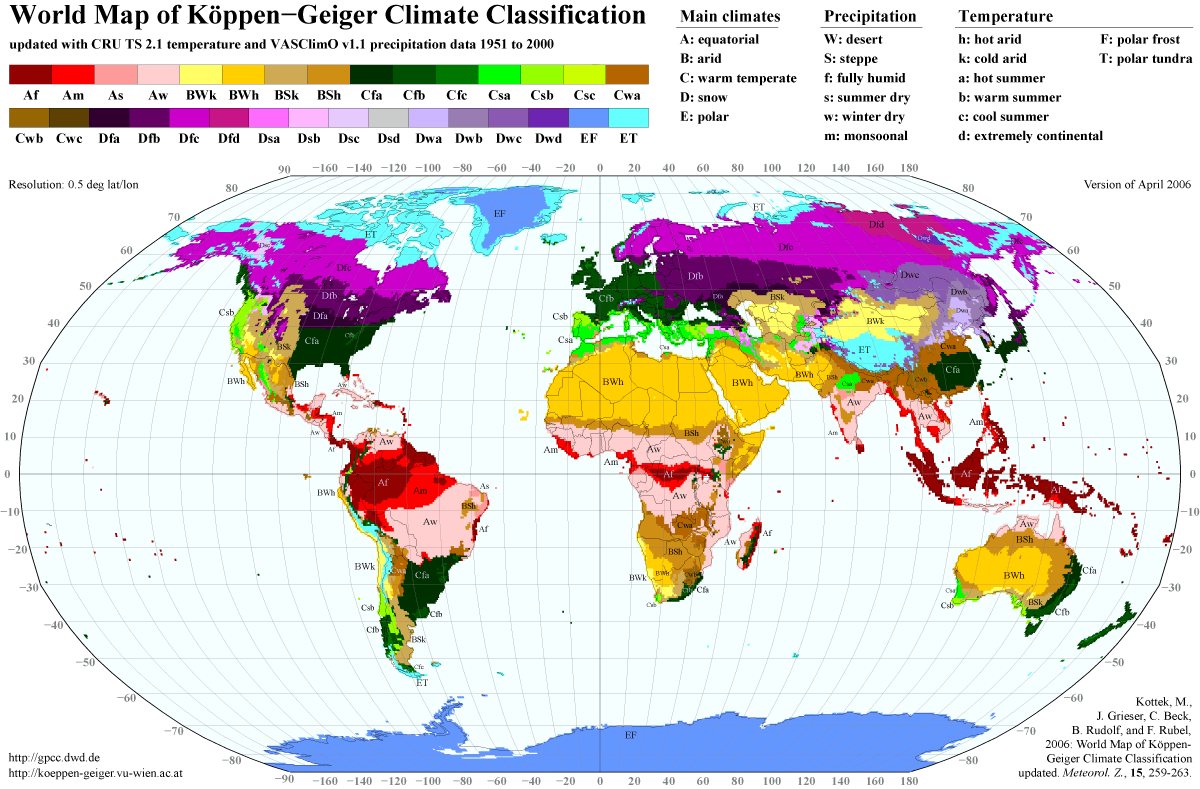
Much of the country experiences a Mediterranean climate with warm or hot, dry summers and the rainfall falling in winter. A semi-arid climate occurs in the southeastern part of Spain, but is also found in other parts of the country such as the Ebro basin. Here the summers are hot and the winters cool, but there is limited precipitation at any time of year. The northern part of the country experiences an oceanic climate (called as well Cantabrian climate) with both winter and summer temperatures influenced by the proximity to the Cantabrian Sea and rainfall spread throughout the year. The Balearic Islands have a Mediterranean climate, and the Canary Islands are influenced by their oceanic surroundings and proximity to Africa.[2]
Biodiversity
Among European countries, Spain has one of the highest degrees of biodiversity; this is because of its four varied, major biogeographic regions, Atlantic, Alpine, Mediterranean and Macaronesian, and the country is considered to be one of the world's biodiversity hotspots. In connection with Natura 2000, a European Union initiative, 27% of the country is included in national parks, wildlife reserves and other protected areas.[3]
Flora
Cork oak woodland in AndalusiaThe Mediterranean coast of Spain
Including the mainland and the island groups, Spain has eight to nine thousand species of vascular plants, more than any other country in Europe.[4] Between 20 and 25% of these are endemic to the country and a higher proportion of these are threatened than in any other European country.[4] Although there are no endemic plant families mainland Spain has 822 endemic species, and the Balearic Islands 103.[5]
Most of the plateaus, valleys and plains of the interior used to be clad in sclerophyllous and semi-deciduous forests. These were dominated by holm oak and cork oak, with wild olive and carob in the south, but only remnants of this natural vegetation remain. Much of this terrain is now covered with dense shrubland known as maquis, with scattered low trees, bushes and herbaceous plants. Stone pine and maritime pine are dominant on sandy soils, and Aleppo pine, Kermes oak and juniper in limestone areas.[6]
At higher altitudes, the Pyrenean oak is dominant up to about 1,500m (5,000ft) above which Scots pine and juniper take over. In the river valleys, only remnants remain of the natural deciduous woodland of willow, poplar, alder, ash and elm. The coastal part of northwestern Spain has plentiful deciduous forests dominated by common oak, lime, chestnut, elm, ash, maple and hazel, and where the tree cover is lacking, heather and gorse. Some parts in the southeast of the country have a form of subtropical steppe vegetation.[7]
Including the mainland and the island groups, Spain has an estimated 60 to 70,000 animal species. Of these, about seven hundred are vertebrates (excluding marine fish) and the remainder are invertebrates. The highest degree of endemism occurs among freshwater fish and in the mountainous areas, the coastal areas, and among the Canary Island fauna. About 30% of the vertebrates in Spain are threatened.[4]


_male_found_under_a_stone_by_Jean_NICOLAS_(14166347788).jpg)