Linac and RF Cavities
In case of an acceleration parallel to the longitudinal axis ( ), the radiated power can be calculated as below
![{\displaystyle {\frac {dp_{\parallel }}{dt}}=\gamma ^{3}{\frac {v{\dot {v}}}{c^{2}}}m_{0}v+\gamma m_{0}{\dot {v}}=\gamma ^{3}m_{0}{\dot {v}}\left[{\frac {v^{2}}{c^{2}}}+{\frac {1}{\gamma ^{2}}}\right]=\gamma ^{3}m_{0}{\dot {v}}}](https://wikimedia.org/api/rest_v1/media/math/render/svg/7e14d040e71ce2544074d7597349a2fe0ee6b06f)
Where  ,
,  are the respective coordinates along the longitudinal axis of
  ,
,  .
.
Inserting in Larmor's formula gives

Bending
In case of an acceleration perpendicular to the longitudinal axis ( )
)
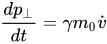
Inserting in Larmor's formula gives (Hint: Factor  and use
  )
)

where  is the classical electron radius,
  the rest energy, and
  the energy.
Using magnetic field perpendicular to velocity


where  is the norm of the projection of
  on the transverse plane.
![{\displaystyle {\begin{aligned}P_{\gamma }&={\frac {e^{2}\gamma ^{2}}{6\pi \varepsilon _{0}{m_{0}}^{2}c^{3}}}\left(e\beta cB\right)^{2}\\[1ex]&={\frac {e^{4}\beta ^{2}\gamma ^{2}B^{2}}{6\pi \varepsilon _{0}{m_{0}}^{2}c}}\\[1ex]&={\frac {e^{4}}{6\pi \varepsilon _{0}{m_{0}}^{4}c^{5}}}\beta ^{2}E^{2}B^{2}\end{aligned}}}](https://wikimedia.org/api/rest_v1/media/math/render/svg/d791d80878134f31c885452297848a32a3da0216)
Using radius of curvature  and inserting
  in
in  gives
gives

Electron
Here are some useful formulas to calculate the power radiated by an electron accelerated by a magnetic field perpendicular to the velocity and  .[3]
.[3]

where  ,
,  is the perpendicular magnetic field,
  the electron mass.

Using the classical electron radius
![{\displaystyle {\begin{aligned}P_{\gamma }&={\frac {2}{3}}{\frac {r_{e}c}{(m_{e}c^{2})^{3}}}{\frac {E^{4}}{\rho ^{2}}}\\[1ex]&={\frac {2}{3}}{\frac {r_{e}c}{m_{e}c^{2}}}{\frac {\gamma ^{2}E^{2}}{\rho ^{2}}}={\frac {2}{3}}r_{e}c{\frac {\gamma ^{3}E}{\rho ^{2}}}\\[1ex]&={\frac {2}{3}}r_{e}m_{e}c^{3}{\frac {\gamma ^{4}}{\rho ^{2}}}\end{aligned}}}](https://wikimedia.org/api/rest_v1/media/math/render/svg/2659ce04ae6f85cee733484ccece0e3794364f59)
where  is the radius of curvature,
can also be derived from particle coordinates (using common 6D phase space coordinates system x, x′, y, y′, s, Δp/p0) , Δp/p0 is the fractional momentum deviation [4]:
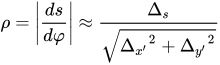
Note: The transverse magnetic field is often normalized using the magnet rigidity:[5]
![{\displaystyle B\rho ={\frac {10^{9}}{c}}E_{\text{[GeV]}}\approx 3.3356E_{\text{[GeV]}}{\text{[Tm]}}}](https://wikimedia.org/api/rest_v1/media/math/render/svg/766380761c434bfae6554e9e0c50623d5a3c7d52)
Field expansion (using Laurent series): 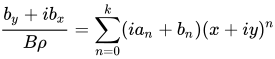 where
where  is the transverse field expressed in [T],
  the multipole field strengths (skew and normal) expressed in
 ![{\displaystyle [m^{-n+1}]}](https://wikimedia.org/api/rest_v1/media/math/render/svg/e4161f7d2395536b6a8577455f9a2cc630bb973b) ,
,  the particle position and
  the multipole order, k=0 for a dipole, k=1 for a quadrupole, k=2 for a sextupole, etc...
![{\displaystyle P={\frac {e^{2}}{6\pi \varepsilon _{0}c^{3}}}\gamma ^{6}\left[\left|{\dot {\mathbf {v} }}\right|^{2}-{\frac {\left|\mathbf {v} \times {\dot {\mathbf {v} }}\right|^{2}}{c^{2}}}\right],}](https://wikimedia.org/api/rest_v1/media/math/render/svg/27d9f5da6c92c95c837862befa7cb6cd9c6a91fc)


