ENSIKLOPEDIA
Magnetic field
 | This article may be too technical for most readers to understand. Please help improve it to make it understandable to non-experts, without removing the technical details. (September 2010) (Learn how and when to remove this message) |


In electromagnetism, magnetic field is a physical property of space that quantifies the magnetic strength at a given location. Magnetic fields deflect moving electric charges (including electric currents), apply torques on magnets to twist them in the direction of the magnetic field, and attract or repel magnets and magnetic material such as iron. In addition, a time varying magnetic field induces electrical currents.
Magnetic fields are created by magnetic materials and by moving electric charges (including electrical current). The latter is important in creating electromagnets: devices that precisely control magnetic fields by changing the current through the electromagnet.
Since both strength and direction of a magnetic field may vary with location, it is described mathematically by assigning a vector to each point of space, making it a vector field.[note 1]
Magnetic fields are used throughout modern science and technology. In electrical engineering and electromechanics it is important in the design and use of electric motors, generators, transformers, electromagnets, and inductors among many other devices. In material science, magnetic forces give information about the charge carriers in a material through the Hall effect in addition to other uses. In geology and geophysics, Earth's magnetic field gives information about earth's interior while local magnetic field measurements are used in mineral exploration and other measurements. In astronomy, magnetic fields are produced by many astronomical objects including planets, stars, white dwarfs, neutron stars, etc. Too, Earth's magnetic field creates a magnetosphere which shields the Earth's ozone layer and the rest of the planet from the solar wind. In physics the relationship between the magnetic and electric fields forms the field of electrodynamics which is important to understand a wide range of phenomena including light (also known as electromagnetic radiation) and the properties of antenna and transmission lines.
Introduction
There are two different, but closely related vector fields which are called "magnetic field". These are written as B and H.[note 2] While the best names for these fields is the subject of long running debate, the underlying physics is uncontested.[1] Historically, the term "magnetic field" was reserved for H while using other terms for B, but many recent textbooks use the term "magnetic field" to describe B as well as or in place of H.[note 3] There are many alternative names for both (see sidebars in the corresponding sections).
The B-field
| Alternative names for B[2] |
|---|
Also known as magnetic flux density, the magnetic B field is the "magnetic field" responsible for magnetic forces, magnetic torques and electromagnetic induction. Therefore, it can be defined by any equation that describes these phenomena.
For example, the magnetic field vector B at any point can be defined as the vector field that, when used in the Lorentz force law, correctly predicts the force on a moving charged particle at that point:[5][6]

Here F is the force on the particle, q is the particle's electric charge, E is the external electric field, v, is the particle's velocity, and × denotes the cross product.
In other words,[7]
[T]he command, "Measure the direction and magnitude of the vector B at such and such a place," calls for the following operations: Take a particle of known charge q. Measure the force on q at rest, to determine E. Then measure the force on the particle when its velocity is v; repeat with v in some other direction. Now find a B that makes the Lorentz force law fit all these results—that is the magnetic field at the place in question.
For more details see Lorentz Force or the #Magnetic force on a charged particle section below.
The SI unit of B is tesla (symbol: T).[note 4] The Gaussian-cgs unit of B is the gauss (symbol: G).[8] (The conversion is 1 T ≘ 10000 G.[9][10]) One nanotesla corresponds to 1 gamma (symbol: γ).[10]
The H-field
| Alternative names for H[2] |
|---|
While B creates magnetic forces and torques on objects and induces currents in conducting wires, it is not always easy to calculate. The main problem is that B necessarily includes the magnetic field induced in nearby magnetic material. It is more convenient to have a quantity that only depends on the currents that are directly controlled by the experimenter (or electrical device). This is achieved (in many cases) by defining the magnetic H field[note 5] such that[12]:

where 
Defined this way, H can in many circumstance[note 6] be treated as if it is only due to electrical currents. While not strictly true in all cases, it is often treated this way in practice with corrections accounting for H due to nearby magnetic material.[note 7] In any case, the B-field still needs to be calculated from the H-field if forces, torques, induced currents, or energy changes need to be calculated.
The SI unit of the H-field is the ampere per metre (A/m),[13] and the Gaussian unit is the oersted (Oe).[9]
Measurement
Instruments used to measure the local magnetic B-field are known as a magnetometers. Important classes of magnetometers include induction magnetometers (or search-coil magnetometers) which measure only varying magnetic fields, rotating coil magnetometers, Hall effect magnetometers, NMR magnetometers, SQUID magnetometers, and fluxgate magnetometers. The magnetic fields of distant astronomical objects are measured through their effects on local charged particles. For instance, electrons spiraling around a field line produce synchrotron radiation that is detectable in radio waves. The finest precision for a magnetic field measurement was attained by Gravity Probe B at 5 aT (5×10⁻¹⁸ T).[14]
The H-field cannot be directly measured but can be inferred from the currents that create it.
Magnetic field lines


Right: compass needles point in the direction of the local magnetic field, towards a magnet's south pole and away from its north pole.
Magnetic field can be visualized by a set of magnetic field lines, that follow the direction of the field at each point. The direction of the magnetic field at any point is parallel to the direction of nearby field lines, and the local density of field lines can be made proportional to its strength. Magnetic field lines are like streamlines in fluid flow, in that they represent a continuous distribution, and a different resolution would show more or fewer lines.
Magnetic field lines have the following properties:[15]
- The direction of the magnetic field is tangent to the field line at any point. A small compass points in the direction of the field line.
- The strength of the field is proportional to the closeness of the lines.
- Magnetic field lines never cross.
- Magnetic field lines form closed loops enclosing electrical currents.
- Magnetic field lines are directed from the north pole to the south pole.
An advantage of using magnetic field lines as a representation is that many laws of magnetism (and electromagnetism) can be stated completely and concisely using simple concepts such as the "number" of field lines through a surface. These concepts can then be "translated" to their mathematical form. For example, the number of field lines through a given surface is the surface integral of the magnetic field.[16]
Different unit systems
This article uses almost entirely the SI unit system. But other unit systems, most importantly the Gaussian unit system (which is the most used system of cgs units for electromagnetism), are still being used in some disciplines, countries, and textbooks. It is important to note that the equations for each unit system can and often are different for different unit system. This article, unless stated otherwise, uses equations that are only valid for the SI unit system.
Interactions with electric currents and moving electric charges
Currents of electric charges both generate a magnetic field and feel a force due to magnetic B-fields.
Force on moving charges and current
Magnetic force on a charged particle

A charged particle moving in a B-field experiences a sideways force that is proportional to the strength of the magnetic field, the component of the velocity that is perpendicular to the magnetic field and the charge of the particle. This force is known as the Lorentz force, and is given by:[5][6]

where F is the force, q is the electric charge of the particle, v is the instantaneous velocity of the particle, and B is the magnetic field (in teslas). The direction of force on the charge can be determined by the right-hand rule (see the figure).
The Lorentz force is always perpendicular to both the velocity of the particle and the magnetic field that created it. When a charged particle moves in a static magnetic field, it traces a helical path in which the helix axis is parallel to the magnetic field, and in which the speed of the particle remains constant.
Force on current-carrying wire
When a wire carrying a steady electric current is placed in an external magnetic field, each of the moving charges in the wire experience the Lorentz force. Together, these forces produce a net macroscopic force on the wire. This force (on a macroscopic current) is often referred to as the Laplace force.
For a straight, stationary wire in a uniform magnetic field, this force is given by:[17]

where I is the current and ℓ is a vector whose magnitude is the length of the wire, and whose direction is along the wire, aligned with the direction of the current.
If the wire is not straight or the magnetic field is non-uniform, the total force can be computed by applying the formula to each infinitesimal segment of wire 

This force creates an attractive/repulsive force between 2 parallel wires as the current through each produces a magnetic field that pushes/pulls on the other. Too, a loop of current in a magnetic field will experience a torque due to the different direction of the force on different sides of the loop as describe in the next section.
Net force and torque on current loops

A magnetic field acting on a current carrying loop produces both a torque and a net force (if the magnetic field is non-uniform).[19] This effect is important for driving certain types of motors and in modeling forces and torques on atoms.
Calculating the torque on a rectangular loop is straightforward. The diagram to the right shows a rectangular loop of current in a uniform magnetic B field (with a direction indicated by the green arrows). For simplicity the loop is aligned so that it is along the direction of the magnetic field. The magnetic force on opposite sides of the loop are equal and opposite producing no net force on the loop. The forces on the short sides (here shown as violet arrows), though, produce a net torque equal to the product of the force and the perpendicular distance between them. Denoting the short side length as b, the magnitude of that force is F = IBb using the equation for the magnetic force on a straight wire given in the previous section. The magnitude of the net torque (along dashed axis) is therefore N = IabB. Using the fact that the area A = ab and generalizing for all angles gives[20]

Here the direction of the area A is the normal to the area as determined by the right hand grip rule of the current loop. While derived for a rectangular loop this equation is valid for a flat loop of any shape and orientation.[21] As described above, there is no net force on a loop in a uniform magnetic field. However, non-uniform magnetic fields do produce a net force. This net force tends to pull the object in direction of the stronger magnetic field.
Net force and torque on a magnetic dipole
Since the net force on a loop is proportional to the current of the loop times it area, it is natural to define a quantity m called the magnetic dipole moment such that[22]

For a sufficiently small current loop, the details of the current loop such as it shape, area, orientation, and current around the loop are all hidden in m and otherwise do not matter. Such loops are called magnetic dipoles. All magnetic dipoles with the same dipole moment m are affected the same way.
Applying the Lorentz force to a (sufficiently small) current loop of arbitrary shape produces a torque N on the magnetic dipole of:[23]

and a force F on the magnetic dipole of[24]

where 
Magnetic field due to electrical currents

All moving charged particles produce magnetic fields. Moving point charges, such as electrons, produce complicated but well known magnetic fields that depend on the charge, velocity, and acceleration of the particles.[25] These equations become much simpler when the moving charges form a steady state electrical current, the study of which is called magnetostatics.
In general, magnetic field lines form concentric circles around a current-carrying wire. The direction of such a magnetic field can be determined by using the "right-hand grip rule" (see figure at right). The strength of the magnetic field decreases with distance from the wire. (For an infinite length wire the strength is inversely proportional to the distance.)
Magnetic field of a long straight wire
The magnetic field of a steady current I through a sufficiently long straight wire is:[26]

where r is the perpendicular distance to the wire. The direction 
Magnetic field of an arbitrarily shaped thin wire
More specifically, the magnetic field generated by a steady current I (a constant flow of electric charges, in which charge neither accumulates nor is depleted at any point)[note 8] is described by the Biot–Savart law:[29][30]

where the integral sums over the wire length where vector dℓ is the vector line element with direction in the same sense as the current I, μ0 is the magnetic constant, r is the distance between the location of dℓ and the location where the magnetic field is calculated, and r̂ is a unit vector in the direction of r.
Magnetic field of a solenoid

Bending a current-carrying wire into a loop concentrates the magnetic field inside the loop while weakening it outside. Bending a wire into multiple closely spaced loops to form a coil or 'solenoid' enhances this effect. A device so formed around an iron core may act as an electromagnet, generating a strong, well-controlled magnetic field.
An infinitely long solenoid has a uniform magnetic field inside, and no magnetic field outside. The magnetic field only exists inside of the solenoid and is[31]

where n is the number of turns per unit length of the solenoid and the direction of H is along the length of the solenoid. A finite length solenoid produces a more complicated magnetic field that can be evaluated mathematically.
For other examples of using the Biot-Savart law to calculate the magnetic fields for other common current configurations see #Common formulæ below.
Magnetic field of a flat loop of current (magnetic dipole)
The magnetic field of a circular current loop of radius R and carrying a current I can be calculated straightforwardly from the Biot-Savart law for locations a distance z directly above the center of the loop:[32][33]

where 

Calculating the magnetic field at a arbitrary location r (not just on-axis) from an arbitrarily shaped current loop involves advanced math.[34] But, for sufficiently long distances, the result depends only on the magnetic moment m of that loop and simplifies to:[35]
![{\displaystyle \mathbf {H} _{dip}={\frac {1}{4\pi }}\left[{\frac {3\mathbf {\hat {r}} (\mathbf {m} \cdot \mathbf {\hat {r}} )-\mathbf {m} }{r^{3}}}\right]={\frac {\mathbf {B} _{dip}}{\mu _{0}}}.}](https://wikimedia.org/api/rest_v1/media/math/render/svg/8e53be424ef2a1f424039b3f7be153ebfd09aebf)
While this equation has some utility in calculating the long distance force between magnets. The main importance of this equation, though, is that it demonstrates that at sufficiently long distances the detailed geometry of a magnet can be replaced by a single quantity, the magnetic dipole moment m. This equation, therefore makes a good model for the magnetic field of atoms and can be extended to describe magnetic material.
Ampere's law
A slightly more general[36][note 9] way of relating the current 

where the line integral is over any arbitrary loop and 
In a modified form that accounts for time varying electric fields, Ampère's law is one of four Maxwell's equations that describe electricity and magnetism.
Interactions with magnets and magnetic material
Magnets are objects that both create their own magnetic field and respond to the magnetic field of other magnets and magnetized materials. The interaction between magnets and their interaction with magnetic field is extremely complicated. The correct description involves describing each magnet as being made of many small volumes of magnetic material each of which creates its own magnetic field and responds to the magnetic field of the other volumes. Such models are often extremely complex. Fortunately, in many cases, it is sufficient to understand magnets as objects that have 2 equal but opposite magnetic poles: the magnetic north and south poles. Opposite poles attract with a force that increases with smaller distances while like poles repel in the same way. Such a model is called a magnetic pole model and it, in some cases described below, can be used to make good quantitative predictions.
Force between magnets
Specifying the force between magnets is quite complicated because it depends on the strength and orientation of both magnets and their distance and direction relative to each other. The force is particularly sensitive to rotations of the magnets due to magnetic torque. The force on each magnet depends on its magnetic moment and the magnetic field[note 11] of the other. For short distances (small r the forces can be quite strong but it decreases quite rapidly (1/r4) for large distances.
Force between magnets at long distances (dipole–dipole interaction)
For 2 sufficiently small magnets, such as 2 atoms far enough away from each other, the magnetic force can be represented as that of two infinitesimally small dipoles. Using vector notation, the force, F of a magnetic dipole m1 on the magnetic dipole m2 is:
![{\displaystyle \mathbf {F} ={\frac {3\mu _{0}}{4\pi r^{5}}}\left[(\mathbf {m} _{1}\cdot \mathbf {r} )\mathbf {m} _{2}+(\mathbf {m} _{2}\cdot \mathbf {r} )\mathbf {m} _{1}+(\mathbf {m} _{1}\cdot \mathbf {m} _{2})\mathbf {r} -{\frac {5(\mathbf {m} _{1}\cdot \mathbf {r} )(\mathbf {m} _{2}\cdot \mathbf {r} )}{r^{2}}}\mathbf {r} \right]}](https://wikimedia.org/api/rest_v1/media/math/render/svg/88a82aa67d79d330ce71a8a371ddb57be27315be)
where r is the distance-vector from dipole moment m1 to dipole moment m2, with r = ‖r‖. The force acting on m1 is in the opposite direction.
Force between magnets at moderate distance (Coulomb's law for magnetism)
For moderate distances it is often to sufficient model the force between magnets as the H-field of one magnet pushes and pulls on both poles of a second magnet. If this H-field is the same at both poles of the second magnet then there is no net force on that magnet since the force is opposite for opposite poles. If, however, the magnetic field of the first magnet is nonuniform (such as the H near one of its poles), each pole of the second magnet sees a different field and is subject to a different force. This difference in the two forces moves the magnet in the direction of increasing magnetic field and may also cause a net torque.
If both poles are small enough to be represented as single points then they can be considered to be point magnetic charges. Classically, the force F between two magnetic poles is given by:[39]

where qm1 and qm2 are the magnetic pole strengths of each magnet (SI unit: ampere-meter), μ is the permeability of the intervening medium, and r is the separation distance between the 2 poles. Note that for 2 magnets (each having 2 poles) the sum of 4 forces is needed: each of the 2 poles of one magnet exerts a separate force on each of the 2 poles of the second magnet.
The pole description is useful to practicing magneticians who design real-world magnets, but real magnets have a pole distribution more complex than a single north and south. Therefore, implementation of the pole idea is not simple. In some cases, one of the more complex formulas given below will be more useful.
Magnetic force at small distances (pull force)
The mechanical force between two nearby magnetized surfaces can be calculated with the following equation. The equation is valid only for cases in which the effect of fringing is negligible and the volume of the air gap is much smaller than that of the magnetized material, the force for each magnetized surface is:[40][41][42]
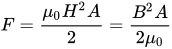
where A is the surface area of the magnetic pole and μ0 is the permeability of free space. This equation is also valid for the force of a magnetic pole on iron that is either almost touching or touching the magnetic pole.
Magnetic torque on permanent magnets
If two like poles of two separate magnets are brought near each other, and one of the magnets is allowed to turn, it promptly rotates to align itself with the first. In this example, the magnetic field of the stationary magnet creates a magnetic torque on the magnet that is free to rotate. This magnetic torque τ tends to align a magnet's poles with the magnetic field lines. A compass, therefore, turns to align itself with Earth's magnetic field.

Mathematically, the torque τ on a small magnet is proportional both to the applied magnetic field and to the magnetic moment m of the magnet:

where × represents the vector cross product. This equation includes all of the qualitative information included above. There is no torque on a magnet if m is in the same direction as the magnetic field, since the cross product is zero for two vectors that are in the same direction. Further, all other orientations feel a torque that twists them toward the direction of magnetic field.
Magnetic field due to magnetized material
Most materials respond to an applied magnetic field by becoming magnetized (at least temporarily) which causes them to produce their own magnetic field. Typically, the response is weak and exists only when the magnetic field is applied. There are many different types of material that respond differently to the applied magnetic field.
Types of magnetic materials
The term magnet is typically reserved for objects that produce their own persistent magnetic field even in the absence of an applied magnetic field. Only certain classes of materials can do this. Most materials, however, produce a magnetic field in response to an applied magnetic field – a phenomenon known as magnetism. There are several types of magnetism, and all materials exhibit at least one of them.
The overall magnetic behavior of a material can vary widely, depending on the structure of the material, particularly on its electron configuration. It can also vary with temperature, pressure, and magnetic field strength such that a given material may have more than one magnetic phase. Several forms of magnetic behavior have been observed in different materials, including:
- Diamagnetism[43] produces a magnetization that opposes the magnetic field.
- Paramagnetism[43] produces a magnetization in the same direction as the applied magnetic field.
- Ferromagnetism and the closely related Ferrimagnetism and Antiferromagnetism[44][45] can produce a magnetization independent of the applied magnetic field with a complicated and often hysteretic relationship. Materials in these states can be used to make permanent magnets.
- Superconductivity (and ferromagnetic superconductors)[46][47] is characterized by perfect conductivity below a critical temperature and magnetic field. They also are highly magnetic and can be perfect diamagnets below a lower critical magnetic field. Superconductors often have a broad range of temperatures and magnetic fields (the so-named mixed state) under which they exhibit a complicated and often hysteretic relationship between how the material is magnetized and the applied magnetic field.
In the case of paramagnetism and diamagnetism, the relationship between the applied magnetic field and the magnetization is often linear. However, superconductors and ferromagnets have a more complicated relation between the applied magnetic field and magnetization produced (see magnetic hysteresis). Permanent magnets are objects that produce their own persistent magnetic fields. They are made of ferromagnetic[note 12] materials, such as iron and nickel, that have been magnetized.
Magnetic dipole moment


The magnetic field of magnetized material is created at the atomic level. The proper description of this effect involves quantum mechanics. Fortunately, the net effect of adding up these magnetic interactions can often be calculated using much simpler models for the magnetic field created by the constituent atoms in the magnetic material. This occurs because at large enough distance (or equivalently for small enough magnets) all the magnetic properties of any magnetic object can be described by a single (vector) quantity, the magnetic dipole moment, m. (See #Magnetic field of a flat loop of current (magnetic dipole) and #Net force and torque on a magnetic dipole above). Objects that can be modeled this way, for example atoms, are called magnetic dipoles.
Magnetic dipoles, therefore, are the building blocks of magnetization. The magnetic field produced by magnetized material then is the net magnetic field of these dipoles. Too, the net force (and torque) on a magnetized material is a result of adding up the forces and torques on the individual dipoles that make up the magnetized material.
Magnetization
The magnetization vector field M represents how strongly a region of material is magnetized. It is defined as the net magnetic dipole moment per unit volume of that region.[48] The magnetization of a uniformly magnetized magnet is therefore a constant, equal to the magnetic moment m of the magnet divided by its volume. Since the SI unit of magnetic moment is A⋅m2, the SI unit of magnetization M is ampere per meter, identical to that of the H-field.
The magnetization M field of a region points in the direction of the average magnetic dipole moment in that region. Magnetization field lines, therefore, begin (inside the magnetized material) near the magnetic south pole and ends (inside the magnetized material) near the magnetic north pole. (Magnetization does not exist outside magnetized material.)
In the Amperian loop model, the magnetization is due to combining many tiny magnetic dipole loops to form a resultant current called bound current. This bound current, then, is the source of the magnetic B field due to the magnet. Given the definition of the magnetic dipole, the magnetization field follows a similar law to that of Ampere's law:[49]

where the integral is a line integral over any closed loop and Ib is the bound current enclosed by that closed loop.
Unlike the magnetic B field-lines which cannot begin nor end, magnetization field lines can begin and end. Indeed they must begin and end where they intersects the boundary of the magnetized material (at magnetic poles) because the magnetization field only exists inside of a material. This is analogous to electric field-lines which begin and end at electrical charges. It is therefore possible to define a 'magnetic charge' qm such that for a given region the net 'magnetic charge' is:[50]

where the integral is a closed surface integral over the closed surface S and qM is the "magnetic charge" (in units of magnetic flux) enclosed by S. (A closed surface completely surrounds a region with no holes to let any field lines escape.) The negative sign occurs because the magnetization field moves from south to north. It is important to note that no such magnetic charge exists; rather it is a convenient analogy that allows the use of much of the machinery developed for electrostatics with electric charge to be applied to magnetization with its fictitious magnetic charge. For example the net magnetic charge of a pole is defined as a magnetic pole strength qm.
Relation between B, H, and M

Using the above definition of M it is now possible to define the magnetic H field[51]
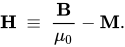
In terms of the H-field, Ampere's law is:[52]

where If represents the 'free current' enclosed by the loop so that the line integral of H does not depend at all on the bound currents.[53]
Similarly, a surface integral of H over any closed surface is independent of the free currents and picks out the "magnetic charges" within that closed surface:

which does not depend on the free currents.
The H-field, therefore, can be separated into two[note 13] independent parts: 
Constitutive relation between B and H
For many materials (particularly diamagnetic and paramagnetic materials) the relationship between B and H is linear:

where μ is a material dependent parameter called the permeability. In some cases the permeability may be a second rank tensor so that H may not point in the same direction as B. These relations between B and H are examples of constitutive equations.
Boundary conditions for B and H
In many real world applications such as small magnetic object inside of an extended applied magnetic field, the constitutive relation is not sufficient even if the material is linear. This is because the H-field that the material experiences is not the same as the H applied. In such cases, the magnetic field can still be calculated but care must be taken to distinguish the change of the magnetic field across the boundary of the magnetic object. These relations are:

where Js is the surface free current density and the unit normal 


which is equivalent to:[56]

where the subscript t represents the tangential component of H and n represents its normal component.
Electrodynamics
For time varying magnetic fields (and more generally changing electrical currents or accelerating electrical charges), the magnetic and electric fields become linked such that a change in one induces the other. Together, the electric and magnetic fields form an electromagnetic field. The study of how the electric and magnetic fields interact in this way is called electrodynamics and includes many phenomenon that are important in physics and electrical engineering. It underlies transformers, and the generation and transmission of electrical power through wires and through space in the form of electromagnetic radiation of which light is one form. Too, it allow magnetic fields to store and transmit energy.
Magnetic flux rule
A time varying magnetic field through a loop of wire induces a current (more properly an EMF) through that loop. This is known as electromagnetic induction and is important for many electronic devices such as inductors, transformers, and electrical generators. The equation governing this is known as the flux rule or Faraday's law of induction:[57]

where 
Stored energy
Energy is needed to generate a magnetic field both to work against the electric field that a changing magnetic field creates and to change the magnetization of any material within the magnetic field. The energy density of just creating the field at a given region is:[59]

For non-dispersive materials, the energy used to magnetize the material is released when the magnetic field is destroyed so that the energy can be modeled as being stored in the magnetic field. If the non-dispersive material is also linear (such that B = μH where μ is frequency-independent), then the total energy density stored in the magnetic field and in magnetizing the material at a location is:[60]

The above equation cannot be used for nonlinear materials, though. In general, the incremental amount of work per unit volume δW needed to cause a small change of magnetic field δB is:[61]

Once the relationship between H and B is known this equation is used to determine the work needed to reach a given magnetic state. For hysteretic materials such as ferromagnets and superconductors, the work needed also depends on how the magnetic field is created. For linear non-dispersive materials, though, the general equation leads directly to the simpler energy density equation given above.
Poynting vector

Magnetic field, together with the electric field, transmit electrical power. The amount of electrical power (per unit area) transmitted this way is called the poynting vector, S, which depends on the magnetic field as the cross product:[62][63]

where E is the electric field. Note that this power includes both the power transmitted by the electric and magnetic fields and the energy absorbed and emitted by magnetizing and polarizing the material. Too, this equation only works for linear non-dispersive materials. This equations is also valid in a vacuum where H = B/μ0.
The time average of the poynting vector is known as irradiance and is an important quantity in optics that describes how intense light is at a given point.
Maxwell's equations
It is sometimes useful to calculate the magnetic field for a given set of time varying charges and currents, without having to use the complicated equations used to directly calculate it. An example of this is calculating the magnetic field of a light wave as it reflects and refracts at a surface. In such cases Maxwell's equations are used to solve for both the magnetic and electric fields. (In electrodynamics the electric and magnetic fields are coupled.)
Maxwell's equations are a powerful set of differential equations that allows the calculation of the magnetic and electric fields for simple (and complex using computers and Finite Element Analysis) geometries. Maxwell's Equations together with the Lorentz force law form a complete description of classical electrodynamics including both electricity and magnetism.
Maxwell's equations takes advantage of the fact that all vector fields (such as the electric and magnetic fields) can be expressed in terms of 2 types of sources and an appropriate set of boundary conditions.[note 14] The first type of source (an outflow source) causes the vector field to flow out (or in for a sink) to a given point. The second (or circulation) source causes the vector field to rotate around a given point (forming vortices). Both of these sources have well defined definitions and can be calculated from the vector field they create using a well-understood vector operator.
The divergence of a vector field A, ∇ · A is defined such that applying the divergence operator to a given vector field will yield the outflow sources. The curl is defined such that ∇ × A yields the circulation source. An example of the power of these vector operators is: since it is an experimental fact that magnetic charges do not exist (and therefore there are no source nor sinks of B) the divergence of B must be zero, ∇ · B = 0, which is one of Maxwell's equations.
Maxwell's equation has 2 major versions: a microscopic version which necessitates knowing all of the charges and currents (including the complex ones at the atomic level) and the macroscopic version which depends only on the know 'free' charge and 'free' currents. Here the term 'free' means any charge or current that is directly controlled by the experiment and does not include the atomic level 'bound' charges and currents in a material which happen as a response to the electric and magnetic fields present in that material.
Maxwell's macroscopic equations are written as:

In these equations, 


The first of Maxwell's equations is known as Gauss' Law but does not involve magnetic field so does not warrant further discussion here. The second equation is Gauss' law for magnetism which reflects the non-existence of magnetic charge and allows B to be determined as the curl of a vector potential A. The third equation is Faraday's law of induction. And, the fourth equation is Ampère's law with Maxwell's correction.
Uses and examples
Uses in advanced physics
Magnetic vector potential
In deriving advanced equations and in advanced topics such as quantum mechanics and relativity, it is often easier to work with a potential formulation of electrodynamics rather than in terms of the electric and magnetic fields. In this representation, the magnetic vector potential A, and the electric scalar potential φ, are defined such that:[64]
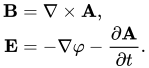
The vector potential, A given by this form may be interpreted as a generalized potential momentum per unit charge[65] just as φ is interpreted as a generalized potential energy per unit charge. There are multiple choices one can make for the potential fields that satisfy the above condition. However, the choice of potentials is represented by its respective gauge condition.
Maxwell's equations when expressed in terms of the potentials can be cast into a form[66] that explicitly agrees with special relativity.[67] Together, A and φ form the four-potential. Using the four potential instead of electric and magnetic fields is much simpler—and it can be easily adapted to work with quantum mechanics.
Magnetic and electric fields are different aspects of the same phenomenon
Magnetic field is inherently a relativistic phenomena. More specifically, both electric and magnetic fields are the same phenomenon as seen in different reference frames: An electric force perceived by one observer may be perceived by another (in a different frame of reference) as a magnetic force, or a mixture of electric and magnetic forces. (Here different reference frames means one reference frame is moving relative to the other.) For relativistic phenomena, a lorentz transformation must be used to move (or transform) from one reference system to another.
It is a straightforward task[68] to show how the electric and magnetic fields transform from one reference frame to another. The transformation rules, however are quite messy. One simple example is to examine how Coulomb's Law (which is a pure electric field of a charged particle in it own rest frame) transforms to a moving reference frame. A point in the moving reference frame will experience a magnetic field of:[69]: 29–42

where 


Formally, special relativity combines the electric and magnetic fields into a rank-2 tensor, called the electromagnetic tensor. Changing reference frames mixes these components. This is analogous to the way that special relativity mixes space and time into spacetime, and mass, momentum, and energy into four-momentum.[70] Similarly, the energy stored in a magnetic field is mixed with the energy stored in an electric field in the electromagnetic stress–energy tensor.
Magnetic field of arbitrarily moving point charge
The solution of maxwell's equations for electric and magnetic field of a point charge is expressed in terms of retarded time or the time at which the particle in the past causes the field at the point, given that the influence travels across space at the speed of light. The retarded time for a point particle is given as solution of:[71]

where the retarded time 


![{\displaystyle {\begin{aligned}\mathbf {B} (\mathbf {r} ,\mathbf {t} )&={\frac {\mu _{0}}{4\pi }}\left[{\frac {qc({\boldsymbol {\beta }}_{s}\times \mathbf {n} _{s})}{\gamma ^{2}{\left(1-\mathbf {n} _{s}\cdot {\boldsymbol {\beta }}_{s}\right)}^{3}{\left|\mathbf {r} -\mathbf {r} _{s}\right|}^{2}}}+{\frac {q\mathbf {n} _{s}\times \left(\mathbf {n} _{s}\times \left(\left(\mathbf {n} _{s}-{\boldsymbol {\beta }}_{s}\right)\times {\dot {{\boldsymbol {\beta }}_{s}}}\right)\right)}{{\left(1-\mathbf {n} _{s}\cdot {\boldsymbol {\beta }}_{s}\right)}^{3}\left|\mathbf {r} -\mathbf {r} _{s}\right|}}\right]_{t=t_{r}}\\[1ex]&={\frac {\mathbf {n} _{s}(t_{r})}{c}}\times \mathbf {E} (\mathbf {r} ,\mathbf {t} \,,)\end{aligned}}}](https://wikimedia.org/api/rest_v1/media/math/render/svg/50768a8c7da290e20f5213d262f993bd0bc9c75c)
where q is the charge of the point source, 


Quantum electrodynamics
The classical electromagnetic field incorporated into quantum mechanics forms what is known as the semi-classical theory of radiation. However, it is not able to make experimentally observed predictions such as spontaneous emission process or Lamb shift implying the need for quantization of fields. In modern physics, the electromagnetic field is understood to be not a classical field, but rather a quantum field; it is represented not as a vector of three numbers at each point, but as a vector of three quantum operators at each point. The most accurate modern description of the electromagnetic interaction (and much else) is quantum electrodynamics (QED),[73] which is incorporated into a more complete theory known as the Standard Model of particle physics.
In QED, the magnitude of the electromagnetic interactions between charged particles (and their antiparticles) is computed using perturbation theory. These rather complex formulas produce a remarkable pictorial representation as Feynman diagrams in which virtual photons are exchanged.
Predictions of QED agree with experiments to an extremely high degree of accuracy: currently about 10−12 (and limited by experimental errors); for details see precision tests of QED. This makes QED one of the most accurate physical theories constructed thus far.
All equations in this article are in the classical approximation, which is less accurate than the quantum description mentioned here. However, under most everyday circumstances, the difference between the two theories is negligible.
Uses in geology
Earth's magnetic field

The Earth's magnetic field is produced by convection of a liquid iron alloy in the outer core. In a dynamo process, the movements drive a feedback process in which electric currents create electric and magnetic fields that in turn act on the currents.[74]
The field at the surface of the Earth is approximately the same as if a giant bar magnet were positioned at the center of the Earth and tilted at an angle of about 11° off the rotational axis of the Earth (see the figure).[75] The north pole of a magnetic compass needle points roughly north, toward the North Magnetic Pole. However, because a magnetic pole is attracted to its opposite, the North Magnetic Pole is actually the south pole of the geomagnetic field. This confusion in terminology arises because the pole of a magnet is defined by the geographical direction it points.[76]
Earth's magnetic field is not constant—the strength of the field and the location of its poles vary.[77] Moreover, the poles periodically reverse their orientation in a process called geomagnetic reversal. The most recent reversal occurred 780,000 years ago.[78]
Uses in Engineering
Rotating magnetic fields
The rotating magnetic field is a common design principle in the operation of alternating-current motors. A permanent magnet in such a field rotates so as to maintain its alignment with the external field.
Magnetic torque is used to drive electric motors. In one simple motor design, a magnet is fixed to a freely rotating shaft and is subjected to a magnetic field from an array of electromagnets. By continuously switching the electric current through each of the electromagnets, thereby flipping the polarity of their magnetic fields, like poles are kept next to the rotor; the resultant torque is transferred to the shaft.
A rotating magnetic field can be constructed using two coils at right angles with a phase difference of 90 degrees between their AC currents. In practice, three-phase systems are used where the three currents are equal in magnitude and have a phase difference of 120 degrees. Three similar coils at mutual geometrical angles of 120 degrees create the rotating magnetic field. The ability of the three-phase system to create a rotating field, utilized in electric motors, is one of the main reasons why three-phase systems dominate the world's electrical power supply systems.
Synchronous motors use DC-voltage-fed rotor windings, which lets the excitation of the machine be controlled—and induction motors use short-circuited rotors (instead of a magnet) following the rotating magnetic field of a multicoiled stator. The short-circuited turns of the rotor develop eddy currents induced by the rotating field of the stator, and these currents in turn produce a torque on the rotor through the Lorentz force.
The Italian physicist Galileo Ferraris and the Serbian-American electrical engineer Nikola Tesla independently researched the use of rotating magnetic fields in electric motors. In 1888, Ferraris published his research in a paper to the Royal Academy of Sciences in Turin and Tesla gained U.S. patent 381,968 for his work.
Magnetic circuits
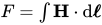
An important use of H is in magnetic circuits where B = μH inside a linear material. Here, μ is the magnetic permeability of the material. This result is similar in form to Ohm's law J = σE, where J is the current density, σ is the conductance and E is the electric field. Extending this analogy, the counterpart to the macroscopic Ohm's law (I = V⁄R) is:

where 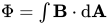
Uses in material science
Hall effect
The charge carriers of a current-carrying conductor placed in a transverse magnetic field experience a sideways Lorentz force; this results in a charge separation in a direction perpendicular to the current and to the magnetic field. The resultant voltage in that direction is proportional to the applied magnetic field. This is known as the Hall effect.
The Hall effect is often used to measure the magnitude of a magnetic field. It is used as well to find the sign of the dominant charge carriers in materials such as semiconductors (negative electrons or positive holes).
Largest magnitude magnetic fields
The largest magnitude magnetic field produced over a macroscopic volume outside a lab setting is 2.8 kT (VNIIEF in Sarov, Russia, 1998).[79] The largest magnitude magnetic field produced in a laboratory over a macroscopic volume was 1.2 kT by researchers at the University of Tokyo in 2018.[80] The largest magnitude microscopic magnetic fields produced in a laboratory occur in particle accelerators, such as RHIC, inside the collisions of heavy ions, where microscopic fields reach 1014 T.[81][82] Magnetars have the strongest known macroscopic magnetic fields of any naturally occurring object, ranging from 0.1 to 100 GT (108 to 1011 T).[83]
Common formulae
| Current configuration | Figure | Magnetic field | |
|---|---|---|---|
| Finite beam of current |  |

where | |
| Infinite wire |  |

where | |
| Infinite cylindrical wire |  |
outside the wire carrying a current |

inside the wire carrying a current |
| Circular loop |  |

along the axis of the loop, where | |
| Solenoid |  |

along the axis of the solenoid carrying current | |
| Infinite solenoid |  |

outside the solenoid carrying current |

inside the solenoid carrying current |
| Circular Toroid |  |

along the bulk of the circular toroid carrying uniform current | |
| Magnetic Dipole |  |

on the equatorial plane, where |

on the axial plane (given that |


Additional magnetic field values can be found through the magnetic field of a finite beam, for example, that the magnetic field of an arc of angle 


History

Early developments
While magnets and some properties of magnetism were known to ancient societies, the research of magnetic fields began in 1269 when French scholar Petrus Peregrinus de Maricourt mapped out the magnetic field on the surface of a spherical magnet using iron needles. Noting the resulting field lines crossed at two points he named those points "poles" in analogy to Earth's poles. He also articulated the principle that magnets always have both a north and south pole, no matter how finely one slices them.[84][note 15]
In 1600 (almost three centuries later), William Gilbert of Colchester published De Magnete. In De Magnete, Gilbert replicated Petrus Peregrinus' work and was the first to state explicitly that Earth is a magnet.[85]: 34 Too, he argued that electricity and magnetism were separate phenomenon.
Magnetostatics

In 1750, John Michell stated that magnetic poles attract and repel in accordance with an inverse square law[85]: 56 Charles-Augustin de Coulomb experimentally verified this in 1785 and stated explicitly that north and south poles cannot be separated.[85]: 59 Building on this force between poles, Siméon Denis Poisson (1781–1840) created the first successful model of the magnetic field, which he presented in 1824.[85]: 64
Three discoveries in 1820 challenged this foundation of magnetism. Hans Christian Ørsted demonstrated that a current-carrying wire is surrounded by a circular magnetic field.[note 16][86] Then André-Marie Ampère showed that parallel wires with currents attract one another if the currents are in the same direction and repel if they are in opposite directions.[85]: 87 [87] Finally, Jean-Baptiste Biot and Félix Savart announced empirical results about the forces that a current-carrying long, straight wire exerted on a small magnet, determining the forces were inversely proportional to the perpendicular distance from the wire to the magnet.[88][85]: 86 Laplace later deduced a law of force based on the differential action of a differential section of the wire,[88][89] which became known as the Biot–Savart law, as Laplace did not publish his findings.[90]
Extending these experiments, Ampère published his own successful model of magnetism in 1825. In it, he showed the equivalence of electrical currents to magnets[85]: 88 and proposed that magnetism is due to perpetually flowing loops of current instead of the dipoles of magnetic charge in Poisson's model.[note 17] Further, Ampère derived both Ampère's force law describing the force between two currents and Ampère's law, which, like the Biot–Savart law, correctly described the magnetic field generated by a steady current.
Electrodynamics
Also in his 1825 work, Ampère introduced the term electrodynamics to describe the relationship between electricity and magnetism.[85]: 88–92
In 1831, Michael Faraday discovered electromagnetic induction when he found that a changing magnetic field generates an encircling electric field, formulating what is now known as Faraday's law of induction.[85]: 189–192 Later, Franz Ernst Neumann proved that, for a moving conductor in a magnetic field, induction is a consequence of Ampère's force law.[85]: 222 In the process, he introduced the magnetic vector potential, which was later shown to be equivalent to the underlying mechanism proposed by Faraday.[85]: 225 In 1850, Lord Kelvin, then known as William Thomson, distinguished between two magnetic fields now denoted H and B. The former applied to Poisson's model and the latter to Ampère's model and induction.[85]: 224 Further, he derived how H and B relate to each other and coined the term permeability.[85]: 245 [91]
Between 1861 and 1865, James Clerk Maxwell developed and published Maxwell's equations, which explained and united all of classical electricity and magnetism. The first set of these equations was published in a paper entitled On Physical Lines of Force in 1861. These equations were valid but incomplete. Maxwell completed his set of equations in his later 1865 paper A Dynamical Theory of the Electromagnetic Field and demonstrated the fact that light is an electromagnetic wave. Heinrich Hertz published papers in 1887 and 1888 experimentally confirming this fact.[92][93]
Modern developments
In 1887, Tesla developed an induction motor that ran on alternating current. The motor used polyphase current, which generated a rotating magnetic field to turn the motor (a principle that Tesla claimed to have conceived in 1882).[94][95][96] Tesla received a patent for his electric motor in May 1888.[97][98] In 1885, Galileo Ferraris independently researched rotating magnetic fields and subsequently published his research in a paper to the Royal Academy of Sciences in Turin, just two months before Tesla was awarded his patent, in March 1888.[99]
The twentieth century showed that classical electrodynamics is already consistent with special relativity, and extended classical electrodynamics to work with quantum mechanics. Albert Einstein, in his paper of 1905 that established relativity, showed that both the electric and magnetic fields are part of the same phenomena viewed from different reference frames. Finally, the emergent field of quantum mechanics was merged with electrodynamics to form quantum electrodynamics (or QED). QED mathematically describes all phenomena involving electrically charged particles interacting by means of exchange of photons and represents the quantum counterpart of classical electromagnetism giving a complete account of matter and light interaction.[100][101]
See also
General
- Magnetohydrodynamics – the study of the dynamics of electrically conducting fluids
- Magnetic hysteresis – application to ferromagnetism
- Magnetic nanoparticles – extremely small magnetic particles that are tens of atoms wide
- Magnetic reconnection – an effect that causes solar flares and auroras
- Magnetic scalar potential
- SI electromagnetism units – common units used in electromagnetism
- Orders of magnitude (magnetic field) – list of magnetic field sources and measurement devices from smallest magnetic fields to largest detected
- Upward continuation
- Moses Effect
Mathematics
- Magnetic helicity – extent to which a magnetic field wraps around itself
Applications
- Dynamo theory – a proposed mechanism for the creation of the Earth's magnetic field
- Helmholtz coil – a device for producing a region of nearly uniform magnetic field
- Magnetic field viewing film – Film used to view the magnetic field of an area
- Magnetic pistol – a device on torpedoes or naval mines that detect the magnetic field of their target
- Maxwell coil – a device for producing a large volume of an almost constant magnetic field
- Stellar magnetic field – a discussion of the magnetic field of stars
- Teltron tube – device used to display an electron beam and demonstrates effect of electric and magnetic fields on moving charges
Notes
- ↑ More precisely, magnetic field is a pseudovector field due to its properties under inversion.
- ↑ The letters B and H were originally chosen by Maxwell in his Treatise on Electricity and Magnetism (Vol. II, pp. 236–237). For many quantities, he simply started choosing letters from the beginning of the alphabet. See Ralph Baierlein (2000). "Answer to Question #73. S is for entropy, Q is for charge". American Journal of Physics. 68 (8): 691. Bibcode:2000AmJPh..68..691B. doi:10.1119/1.19524.
- ↑ Edward Purcell, in Electricity and Magnetism, McGraw-Hill, 1963, writes, Even some modern writers who treat B as the primary field feel obliged to call it the magnetic induction because the name magnetic field was historically preempted by H. This seems clumsy and pedantic. If you go into the laboratory and ask a physicist what causes the pion trajectories in his bubble chamber to curve, he'll probably answer "magnetic field", not "magnetic induction." You will seldom hear a geophysicist refer to the Earth's magnetic induction, or an astrophysicist talk about the magnetic induction of the galaxy. We propose to keep on calling B the magnetic field. As for H, although other names have been invented for it, we shall call it "the field H" or even "the magnetic field H." In a similar vein, M Gerloch (1983). Magnetism and Ligand-field Analysis. Cambridge University Press. p. 110. ISBN 978-0-521-24939-3. says: "So we may think of both B and H as magnetic fields, but drop the word 'magnetic' from H so as to maintain the distinction ... As Purcell points out, 'it is only the names that give trouble, not the symbols'."
- ↑ The SI unit of ΦB (magnetic flux) is the weber (symbol: Wb), related to the tesla by 1 Wb/m2 = 1 T. The SI unit tesla is equal to (newton·second)/(coulomb·metre). This can be seen from the magnetic part of the Lorentz force law.
- ↑ Griffiths 1999, p. 272 "As it turns out, H is a more useful quantity than D. ... The reason is this: To build an electromagnet you run a certain (free) current through a coil. The current is the thing you read on the dial, and this determines H (or at any rate, the line integral of H)."
- ↑ The induced component is zero for certain high-symmetry cases where Ampere's law can easily be used and is irrelevant for certain quantities such as those that depend a line integral (over a loop) of the H-field such as in the MMF of magnetic circuits.
- ↑ This component of H is called the demagnetizing field, or stray field
- ↑ In practice, the Biot–Savart law and other laws of magnetostatics are often used even when a current change in time, as long as it does not change too quickly. It is often used, for instance, for standard household currents, which oscillate sixty times per second.[28]
- ↑ The Biot–Savart law contains the additional restriction (boundary condition) that the B-field must go to zero fast enough at infinity. It also depends on the divergence of B being zero, which is always valid. (There are no magnetic charges.)
- ↑ The H-field calculated this way does not include that due to magnetic poles which is called the stray field or demagnetizing field and must be calculated separately if needed.
- ↑ Either B or H may be used for the magnetic field outside the magnet.
- ↑ Ferrimagnetic materials, such as magnetite, can also be magnetized.
- ↑ A third term is needed for changing electric fields and polarization currents; this displacement current term is covered in Maxwell's equations below.
- ↑ See Helmholtz decomposition#Three-dimensional space.
- ↑ His Epistola Petri Peregrini de Maricourt ad Sygerum de Foucaucourt Militem de Magnete, which is often shortened to Epistola de magnete, is dated 1269 C.E.
- ↑ During a lecture demonstration on the effects of a current on a campus needle, Ørsted showed that when a current-carrying wire is placed at a right angle with the compass, nothing happens. When he tried to orient the wire parallel to the compass needle, however, it produced a pronounced deflection of the compass needle. By placing the compass on different sides of the wire, he was able to determine the field forms perfect circles around the wire.[85]: 85
- ↑ From the outside, the field of a dipole of magnetic charge has exactly the same form as a current loop when both are sufficiently small. Therefore, the two models differ only for magnetism inside magnetic material.
References
- ↑ John J. Roche (2000). "B and H, the intensity vectors of magnetism: A new approach to resolving a century-old controversy". American Journal of Physics. 68 (5): 438. Bibcode:2000AmJPh..68..438R. doi:10.1119/1.19459.
- 1 2 Rothwell & Cloud 2010, p. 23.
- ↑ The International System of Units (PDF), V3.01 (9th ed.), International Bureau of Weights and Measures, August 2024, p. 138, ISBN 978-92-822-2272-0
- 1 2 Stratton 1941, p. 1.
- 1 2 Purcell 2011, p. 173.
- 1 2 Griffiths 1999, p. 204, Equation 5.1.
- ↑ Purcell 2011, pp. 173–4.
- ↑ Purcell 2011, p. 286 Tesla for describing a large magnetic force; gauss (tesla/10000) for describing a small magnetic force as that at the surface of earth.
- 1 2 "Non-SI units accepted for use with the SI, and units based on fundamental constants (contd.)". SI Brochure: The International System of Units (SI) [8th edition, 2006; updated in 2014]. Bureau International des Poids et Mesures. Archived from the original on 8 June 2019. Retrieved 19 April 2018.
- 1 2 Lang, Kenneth R. (2006). A Companion to Astronomy and Astrophysics. Springer. p. 176. ISBN 978-0-387-33367-0. Retrieved 19 April 2018.
- ↑ The International System of Units (PDF), V3.01 (9th ed.), International Bureau of Weights and Measures, August 2024, p. 139, ISBN 978-92-822-2272-0
- ↑ Griffiths 1999, p. 269, Equation 6.18.
- ↑ "International system of units (SI)". NIST reference on constants, units, and uncertainty. National Institute of Standards and Technology. 12 April 2010. Retrieved 9 May 2012.
- ↑ "Gravity Probe B Executive Summary" (PDF). pp. 10, 21. Archived (PDF) from the original on 9 October 2022.
- ↑ Ling, Moebs & Sanny 2016, § 11.2.
- ↑ Purcell 2011, p. 237.
- ↑ Purcell & Morin 2013, p. 284.
- ↑ Griffiths 1999, p. 209, Eq. 5.16.
- ↑ Ling, Moebs & Sanny 2016, § 11.5.
- ↑ Ling, Moebs & Sanny 2016, Eq. 11.19.
- ↑ Griffiths 1999, p. 257.
- ↑ Griffiths 1999, p. 244, Eq. 5.84.
- ↑ Griffiths 1999, p. 257, Eq. 6.1.
- ↑ Griffiths 1999, p. 258, Eq. 6.3.
- ↑ Griffiths 1999, p. 438.
- ↑ Ida 2021, p. 383, Example 8.1c.
- ↑ Griffiths 2017, p. 225.
- ↑ Griffiths 2017, p. 223.
- ↑ Griffiths 2017, p. 224.
- ↑ Ida 2021, p. 381, Eq. 8.8.
- ↑ Ida 2021, p. 394, Example 8.10.
- ↑ Ling, Moebs & Sanny 2016, Eq. 12.16 in § 12.4.
- ↑ Ida 2021, pp. 384–5, Example 8.3.
- ↑ Griffiths 1999, pp. 242–6, § 5.4.3.
- ↑ Griffiths 1999, p. 246, Eq. 5.87.
- ↑ Griffiths 1999, pp. 222–225.
- ↑ Griffiths 1999, p. 225, Eq. 5.55.
- ↑ Ida 2021, p. 389, Eq. 8.16.
- ↑ "Basic Relationships". Geophysics.ou.edu. Archived from the original on 9 July 2010. Retrieved 19 October 2009.
- ↑ "Magnetic Fields and Forces". Archived from the original on 20 February 2012. Retrieved 24 December 2009.
- ↑ "The force produced by a magnetic field". Archived from the original on 17 March 2010. Retrieved 7 November 2013.
- ↑ "Tutorial: Theory and applications of the Maxwell stress tenso" (PDF). Retrieved 28 November 2018.
- 1 2 RJD Tilley (2004). Understanding Solids. Wiley. p. 368. ISBN 978-0-470-85275-0.
- ↑ Sōshin Chikazumi; Chad D. Graham (1997). Physics of ferromagnetism (2 ed.). Oxford University Press. p. 118. ISBN 978-0-19-851776-4.
- ↑ Amikam Aharoni (2000). Introduction to the theory of ferromagnetism (2 ed.). Oxford University Press. p. 27. ISBN 978-0-19-850808-3.
- ↑ M Brian Maple; et al. (2008). "Unconventional superconductivity in novel materials". In K. H. Bennemann; John B. Ketterson (eds.). Superconductivity. Springer. p. 640. ISBN 978-3-540-73252-5.
- ↑ Naoum Karchev (2003). "Itinerant ferromagnetism and superconductivity". In Paul S. Lewis; D. Di (CON) Castro (eds.). Superconductivity research at the leading edge. Nova Publishers. p. 169. ISBN 978-1-59033-861-2.
- ↑ Ida 2021, p. 426, §9.2.2 Eq. 9.17.
- ↑ Griffiths 1999, pp. 266–268.
- ↑ This equation is analogous to the integral form of Griffiths 1999, p. 168
- ↑ Ida 2021, p. 433, Eq. 9.30.
- ↑ Griffiths 1999, p. 269, §6.3.1, Eq. 6.20.
- ↑ John Clarke Slater; Nathaniel Herman Frank (1969). Electromagnetism (first published in 1947 ed.). Courier Dover Publications. p. 69. ISBN 978-0-486-62263-7.
- ↑ Griffiths 1999, p. 332.
- ↑ Ida, p. 442. sfn error: no target: CITEREFIda (help)
- ↑ Ida 2021, pp. 441–2, Eqs. 9.39 & 9.45.
- ↑ Griffiths 1999, p. 296, Eq. 7.13.
- ↑ Jackson 1975, p. 210.
- ↑ Griffiths 1999, p. 318, Eq. 7.34.
- ↑ Ida 2021, p. 604, Eq, 12.52.
- ↑ Wangsness 1986, p. 334, Eq. 20-79.
- ↑ Poynting, John Henry (1884). "On the Transfer of Energy in the Electromagnetic Field". Philosophical Transactions of the Royal Society of London. 175 (175): 343–361. Bibcode:1884RSPT..175..343.. doi:10.1098/rstl.1884.0016.
- ↑ Ida 2021, p. 604, Eq. 12.53.
- ↑ Griffiths 1999, pp. 416–7, Eqs. 10.2 & 10.3.
- ↑ E. J. Konopinski (1978). "What the electromagnetic vector potential describes". Am. J. Phys. 46 (5): 499–502. Bibcode:1978AmJPh..46..499K. doi:10.1119/1.11298.
- ↑ Griffiths 1999, Eqs. 10.15 & 10.16.
- ↑ Griffiths 1999, p. 422.
- ↑ Griffiths 1999, §. 12.3.2.
- ↑ Rosser, W. G. V. (1968). Classical Electromagnetism via Relativity. Boston, MA: Springer. doi:10.1007/978-1-4899-6559-2. ISBN 978-1-4899-6258-4.
- ↑ C. Doran and A. Lasenby (2003) Geometric Algebra for Physicists, Cambridge University Press, p. 233. ISBN 0-521-71595-4.
- ↑ Griffiths 1999, p. 435, Eq. 10.47.
- ↑ Griffiths 1999, p. 438, Eqs. 10.64, 10.65, & 10.66.
- ↑ For a good qualitative introduction see: Richard Feynman (2006). QED: the strange theory of light and matter. Princeton University Press. ISBN 978-0-691-12575-6.
- ↑ Weiss, Nigel (2002). "Dynamos in planets, stars and galaxies". Astronomy and Geophysics. 43 (3): 3.09 – 3.15. Bibcode:2002A&G....43c...9W. doi:10.1046/j.1468-4004.2002.43309.x.
- ↑ "What is the Earth's magnetic field?". Geomagnetism Frequently Asked Questions. National Centers for Environmental Information, National Oceanic and Atmospheric Administration. Retrieved 19 April 2018.
- ↑ Raymond A. Serway; Chris Vuille; Jerry S. Faughn (2009). College physics (8th ed.). Belmont, CA: Brooks/Cole, Cengage Learning. p. 628. ISBN 978-0-495-38693-3.
- ↑ Merrill, Ronald T.; McElhinny, Michael W.; McFadden, Phillip L. (1996). "2. The present geomagnetic field: analysis and description from historical observations". The magnetic field of the earth: paleomagnetism, the core, and the deep mantle. Academic Press. ISBN 978-0-12-491246-5.
- ↑ Phillips, Tony (29 December 2003). "Earth's Inconstant Magnetic Field". Science@Nasa. Archived from the original on 1 November 2022. Retrieved 27 December 2009.
- ↑ Boyko, B.A.; Bykov, A.I.; Dolotenko, M.I.; Kolokolchikov, N.P.; Markevtsev, I.M.; Tatsenko, O.M.; Shuvalov, K. (1999). "With record magnetic fields to the 21st Century". Digest of Technical Papers. 12th IEEE International Pulsed Power Conference. (Cat. No.99CH36358). Vol. 2. pp. 746–749. doi:10.1109/PPC.1999.823621. ISBN 0-7803-5498-2. S2CID 42588549.
- ↑ Daley, Jason. "Watch the Strongest Indoor Magnetic Field Blast Doors of Tokyo Lab Wide Open". Smithsonian Magazine. Retrieved 8 September 2020.
- ↑ Tuchin, Kirill (2013). "Particle production in strong electromagnetic fields in relativistic heavy-ion collisions". Adv. High Energy Phys. 2013 490495. arXiv:1301.0099. Bibcode:2013arXiv1301.0099T. doi:10.1155/2013/490495. S2CID 4877952.
- ↑ Bzdak, Adam; Skokov, Vladimir (29 March 2012). "Event-by-event fluctuations of magnetic and electric fields in heavy ion collisions". Physics Letters B. 710 (1): 171–174. arXiv:1111.1949. Bibcode:2012PhLB..710..171B. doi:10.1016/j.physletb.2012.02.065. S2CID 118462584.
- ↑ Kouveliotou, C.; Duncan, R. C.; Thompson, C. (February 2003). "Magnetars Archived 11 June 2007 at the Wayback Machine". Scientific American; Page 36.
- ↑ Chapman, Allan (2007). "Peregrinus, Petrus (Flourished 1269)". Encyclopedia of Geomagnetism and Paleomagnetism. Dordrecht: Springer. pp. 808–809. doi:10.1007/978-1-4020-4423-6_261. ISBN 978-1-4020-3992-8.
- 1 2 3 4 5 6 7 8 9 10 11 12 13 14 Whittaker, E. T. (1910). A History of the Theories of Aether and Electricity. Dover Publications. ISBN 978-0-486-26126-3.
{{cite book}}: ISBN / Date incompatibility (help) - ↑ Williams, L. Pearce (1974). "Oersted, Hans Christian". In Gillespie, C. C. (ed.). Dictionary of Scientific Biography. New York: Charles Scribner's Sons. p. 185.
- ↑ Blundell, Stephen J. (2012). Magnetism: A Very Short Introduction. OUP Oxford. p. 31. ISBN 978-0-19-163372-0.
- 1 2 Tricker, R. A. R. (1965). Early electrodynamics. Oxford: Pergamon. p. 23.
- ↑ Erlichson, Herman (1998). "The experiments of Biot and Savart concerning the force exerted by a current on a magnetic needle". American Journal of Physics. 66 (5): 389. Bibcode:1998AmJPh..66..385E. doi:10.1119/1.18878.
- ↑ Frankel, Eugene (1972). Jean-Baptiste Biot: The career of a physicist in nineteenth-century France. Princeton University: Doctoral dissertation. p. 334.
- ↑ Lord Kelvin of Largs. physik.uni-augsburg.de. 26 June 1824
- ↑ Huurdeman, Anton A. (2003) The Worldwide History of Telecommunications. Wiley. ISBN 0-471-20505-2. p. 202
- ↑ "The most important Experiments – The most important Experiments and their Publication between 1886 and 1889". Fraunhofer Heinrich Hertz Institute. Retrieved 19 February 2016.
- ↑ Networks of Power: Electrification in Western Society, 1880–1930. JHU Press. March 1993. p. 117. ISBN 978-0-8018-4614-4.
- ↑ Thomas Parke Hughes, Networks of Power: Electrification in Western Society, 1880–1930, pp. 115–118
- ↑ Ltd, Nmsi Trading; Smithsonian Institution (1998). Robert Bud, Instruments of Science: An Historical Encyclopedia. Taylor & Francis. p. 204. ISBN 978-0-8153-1561-2. Retrieved 18 March 2013.
- ↑ U.S. patent 381,968
- ↑ Porter, H. F. J.; Prout, Henry G. (January 1924). "A Life of George Westinghouse". The American Historical Review. 29 (2): 129. doi:10.2307/1838546. hdl:2027/coo1.ark:/13960/t15m6rz0r. ISSN 0002-8762. JSTOR 1838546.
- ↑ "Galileo Ferraris (March 1888) Rotazioni elettrodinamiche prodotte per mezzo di correnti alternate (Electrodynamic rotations by means of alternating currents), memory read at Accademia delle Scienze, Torino, in Opere di Galileo Ferraris, Hoepli, Milano, 1902 vol I pages 333 to 348" (PDF). Archived from the original (PDF) on 9 July 2021. Retrieved 2 July 2021.
- ↑
- ↑ Feynman, R. P. (1950). "Mathematical Formulation of the Quantum Theory of Electromagnetic Interaction". Physical Review. 80 (3): 440–457. Bibcode:1950PhRv...80..440F. doi:10.1103/PhysRev.80.440. Archived from the original on 14 September 2020. Retrieved 23 September 2019.
Sources
- Griffiths, David J. (1999). Introduction to Electrodynamics (3rd ed.). Pearson. ISBN 0-13-805326-X.
- Griffiths, David J. (2017). Introduction to Electrodynamics (4th ed.). Cambridge University Press. ISBN 978-1-108-35714-2.
- Ida, Nathan (2021). Engineering Electromagnetics (4th ed.). Springer. ISBN 978-3-030-15556-8.
- Jackson, John David (1975). Classical electrodynamics (2nd ed.). New York: Wiley. ISBN 978-0-471-43132-9.
- Jackson, John David (1998). Classical electrodynamics (3rd ed.). New York: Wiley. ISBN 0-471-30932-X.
- Ling, Samuel J.; Moebs, William; Sanny, Jeff (2016). University Physics Volume 2. OpenStax.
- Purcell, E. (2011). Electricity and Magnetism (2nd ed.). Cambridge University Press. ISBN 978-1-107-01360-5.
- Purcell, Edward M.; Morin, David J. (2013). Electricity and Magnetism. Cambridge University Press. doi:10.1017/cbo9781139012973. ISBN 978-1-139-01297-3.
- Rothwell, E. J.; Cloud, M. J. (2010). Electromagnetics. Taylor & Francis. ISBN 1-4200-5826-6.
- Stratton, Julius Adams (1941). Electromagnetic Theory (1st ed.). McGraw-Hill. ISBN 978-0-07-062150-3.
{{cite book}}: ISBN / Date incompatibility (help) - Wangsness, Roald K. (1986). Electromagnetic Fields (2nd ed.). Hamilton Printing Company. ISBN 0-471-81186-6.
Further reading
- Jiles, David (1994). Introduction to Electronic Properties of Materials (1st ed.). Springer. ISBN 978-0-412-49580-9.
- Tipler, Paul (2004). Physics for Scientists and Engineers: Electricity, Magnetism, Light, and Elementary Modern Physics (5th ed.). W. H. Freeman. ISBN 978-0-7167-0810-0. OCLC 51095685.
External links
 Media related to Magnetic fields at Wikimedia Commons
- Crowell, B., "Electromagnetism Archived 30 April 2010 at the Wayback Machine".
- Nave, R., "Magnetic Field". HyperPhysics.
- "Magnetism", The Magnetic Field (archived 9 July 2006). theory.uwinnipeg.ca.
- Hoadley, Rick, "What do magnetic fields look like Archived 19 February 2011 at the Wayback Machine?" 17 July 2005.

| Magnetic response | |
|---|---|
| Magnetic states | |
