Graph of number of -digit polydivisible numbers in base 10 vs estimate of
Let be the number of digits. The function determines the number of polydivisible numbers that has digits in base , and the function is the total number of polydivisible numbers in base .
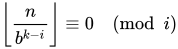
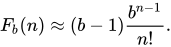
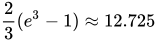
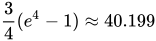
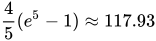
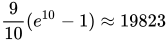
If is a polydivisible number in base with digits, then it can be extended to create a polydivisible number with digits if there is a number between and that is divisible by . If is less or equal to , then it is always possible to extend an digit polydivisible number to an -digit polydivisible number in this way, and indeed there may be more than one possible extension. If is greater than , it is not always possible to extend a polydivisible number in this way, and as becomes larger, the chances of being able to extend a given polydivisible number become smaller. On average, each polydivisible number with digits can be extended to a polydivisible number with digits in different ways. This leads to the following estimate for :
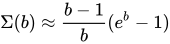
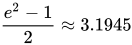
Summing over all values of n, this estimate suggests that the total number of polydivisible numbers will be approximately
Polydivisible numbers represent a generalization of the following well-known[2] problem in recreational mathematics:
Arrange the digits 1 to 9 in order so that the first two digits form a multiple of 2, the first three digits form a multiple of 3, the first four digits form a multiple of 4 etc. and finally the entire number is a multiple of 9.
The solution to the problem is a nine-digit polydivisible number with the additional condition that it contains the digits 1 to 9 exactly once each. There are 2,492 nine-digit polydivisible numbers, but the only one that satisfies the additional condition is
Other problems involving polydivisible numbers include:
Finding polydivisible numbers with additional restrictions on the digits - for example, the longest polydivisible number that only uses even digits is
48 000 688 208 466 084 040
Finding palindromic polydivisible numbers - for example, the longest palindromic polydivisible number is
30 000 600 003
A common, trivial extension of the aforementioned example is to arrange the digits 0 to 9 to make a 10 digit number in the same way, the result is 3816547290. This is a pandigital polydivisible number.