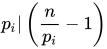
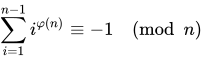
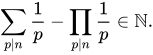
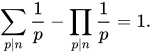
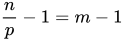
In number theory, a Giuga number is a composite number such that for each of its distinct prime factors we have , or equivalently such that for each of its distinct prime factorspi we have . For example, 30 = 2 × 3 × 5 is a Giuga number since we can verify that:
All known Giuga numbers n in fact satisfy the stronger condition
List of numbers
Thirteen Giuga numbers are known. The list is complete up to the 12th term and for numbers with 8 or fewer prime factors, but it is unknown if there is a Giuga number between the 12th and 13th terms.[1]
The prime factors of a Giuga number must be distinct. If divides , then it follows that , where is divisible by . Hence, would not be divisible by , and thus would not be a Giuga number.
Thus, only square-free integers can be Giuga numbers. For example, the factors of 60 are 2, 2, 3 and 5, and 60/2 - 1 = 29, which is not divisible by 2. Thus, 60 is not a Giuga number.
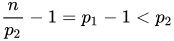
This rules out squares of primes, but semiprimes cannot be Giuga numbers either. For if , with primes, then
, so will not divide , and thus is not a Giuga number.
Unsolved problem in mathematics
Are there infinitely many Giuga numbers? Is there a composite Giuga number that is also a Carmichael number?
All known Giuga numbers are even. If an odd Giuga number exists, it must be the product of at least 14 primes. It is not known if there are infinitely many Giuga numbers.
It has been conjectured by Paolo P. Lava (2009) that Giuga numbers are the solutions of the differential equation n' = n+1, where n' is the arithmetic derivative of n. (For square-free numbers , , so n' = n+1 is just the last equation in the above section Definitions, multiplied by n.)
José Mª Grau and Antonio Oller-Marcén have shown that an integer n is a Giuga number if and only if it satisfies n' = a n + 1 for some integer a > 0, where n' is the arithmetic derivative of n. (Again, n' = a n + 1 is identical to the third equation in Definitions, multiplied by n.)