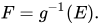
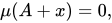
A null set is not to be confused with the empty set as defined in set theory. Although the empty set has Lebesgue measure zero, there are also non-empty sets which are null. For example, any non-empty countable set of real numbers has Lebesgue measure zero and therefore is null.
More generally, on a given measure space a null set is a set such that
The Cantor set is an example of an uncountable null set. It is uncountable because it contains all real numbers between 0 and 1 whose ternary expansion can be written using only 0s and 2s (see Cantor's diagonal argument), and it is null because it is constructed by beginning with the closed interval of real numbers from 0 to 1 and iteratively removing a third of the previous set, thereby multiplying the length by 2/3 with every step.
The set of Liouville numbers is another example of an uncountable null set.
This condition can be generalised to using -cubes instead of intervals. In fact, the idea can be made to make sense on any manifold, even if there is no Lebesgue measure there.
The standard construction of the Cantor set is an example of a null uncountable set in however other constructions are possible which assign the Cantor set any measure whatsoever.
All the subsets of whose dimension is smaller than have null Lebesgue measure in For instance straight lines or circles are null sets in
Sard's lemma: the set of critical values of a smooth function has measure zero.
If is Lebesgue measure for and π is Lebesgue measure for , then the product measure In terms of null sets, the following equivalence has been styled a Fubini's theorem:[2]
Any (measurable) subset of a null set is itself a null set (by monotonicity of ).
Together, these facts show that the null sets of form a 𝜎-ideal of the 𝜎-algebra. Accordingly, null sets may be interpreted as negligible sets, yielding a measure-theoretic notion of "almost everywhere".
Uses
Null sets play a key role in the definition of the Lebesgue integral: if functions and are equal except on a null set, then is integrable if and only if is, and their integrals are equal. This motivates the formal definition of spaces as sets of equivalence classes of functions which differ only on null sets.
A measure in which all subsets of null sets are measurable is complete. Any non-complete measure can be completed to form a complete measure by asserting that subsets of null sets have measure zero. Lebesgue measure is an example of a complete measure; in some constructions, it is defined as the completion of a non-complete Borel measure.
A subset of the Cantor set which is not Borel measurable
The Borel measure is not complete. One simple construction is to start with the standard Cantor set which is closed hence Borel measurable, and which has measure zero, and to find a subset of which is not Borel measurable. (Since the Lebesgue measure is complete, this is of course Lebesgue measurable.)
First, we have to know that every set of positive measure contains a nonmeasurable subset. Let be the Cantor function, a continuous function which is locally constant on and monotonically increasing on with and Obviously, is countable, since it contains one point per component of Hence has measure zero, so has measure one. We need a strictly monotonic function, so consider Since is strictly monotonic and continuous, it is a homeomorphism. Furthermore, has measure one. Let be non-measurable, and let Because is injective, we have that and so is a null set. However, if it were Borel measurable, then would also be Borel measurable (here we use the fact that the preimage of a Borel set by a continuous function is measurable; is the preimage of through the continuous function ). Therefore is a null, but non-Borel measurable set.









![{\displaystyle [0,1],}](https://wikimedia.org/api/rest_v1/media/math/render/svg/971caee396752d8bf56711f55d2c3b1207d4a236)