Definition
Let  be a measurable space and let
  be a measurable function from
  to itself. A measure
  on is said to be invariant under
  if, for every measurable set
  in
in 

In terms of the pushforward measure, this states that 
The collection of measures (usually probability measures) on that are invariant under is sometimes denoted  The collection of ergodic measures,
  is a subset of Moreover, any convex combination of two invariant measures is also invariant, so
  is a convex set;
  consists precisely of the extreme points of
In the case of a dynamical system  where is a measurable space as before,
  is a monoid and
  is the flow map, a measure on is said to be an invariant measure if it is an invariant measure for each map
 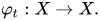 Explicitly, is invariant if and only if

Put another way, is an invariant measure for a sequence of random variables  (perhaps a Markov chain or the solution to a stochastic differential equation) if, whenever the initial condition
  is distributed according to
  so is
so is  for any later time
When the dynamical system can be described by a transfer operator, then the invariant measure is an eigenvector of the operator, corresponding to an eigenvalue of  this being the largest eigenvalue as given by the Frobenius–Perron theorem.









