| Episode 5: Asking Big Questions |
|---|
 |
Subject: Francis Crick |
Presenter: Richard Dawkins |
| A British molecular biologist, biophysicist, and neuroscientist, most noted for being a co-discoverer of the structure of the DNA molecule in 1953 with James Watson. Together with Watson and Maurice Wilkins, he was jointly awarded the 1962 Nobel Prize in Physiology or Medicine. |
 |
Subject: James D. Watson |
Presenter: Richard Dawkins |
| An American molecular biologist, geneticist and zoologist, best known as one of the co-discoverers of the structure of DNA in 1953 with Francis Crick and Rosalind Franklin. |
| – |
Subject: Rosalind Franklin |
Presenter: Olivia Judson |
| A British chemist and X-ray crystallographer who made contributions to the understanding of the molecular structures of DNA (deoxyribonucleic acid), RNA (ribonucleic acid), viruses, coal, and graphite. |
 |
Subject: Maurice Wilkins |
Presenter: Olivia Judson |
| A New Zealand-born British physicist and molecular biologist, who is best known for his work at King's College London on the structure of DNA, for which he shared the Nobel Prize in Physiology or Medicine with Crick and Watson. |
|
Subject: Fred Hoyle |
Presenter: Jim Al-Khalili |
| A British astronomer noted primarily for the theory of stellar nucleosynthesis, but also for his often controversial stances on other scientific matters—in particular his rejection of the "Big Bang" theory, a term coined by him on BBC radio, and his promotion of panspermia as the origin of life on Earth. |
 |
Subject: Stephen Hawking |
Presenter: Jim Al-Khalili |
| A British theoretical physicist and cosmologist whose scientific work includes the Penrose–Hawking singularity theorems, the prediction that black holes emit radiation, and a theory of cosmology unifying the general theory of relativity and quantum mechanics. |
| – |
Subject: Bill Hamilton |
Presenter: Richard Dawkins |
| A British evolutionary biologist, whose theoretical work expounding a rigorous genetic basis for the existence of altruism provided an insight that was a key part of the development of a gene-centric view of evolution. |
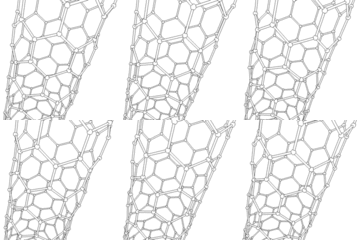 |
Subject: Carbon Nanotubes |
Presenter: James Dyson |
| Cylindrical carbon molecules, which are valuable for nanotechnology, electronics, optics and other fields of materials science, including being able to meet the specific strength requirements for a space elevator. |


