Compañía de Aviación Faucett, colloquially known simply as Faucett Perú or Faucett, was a Peruvian airline. Its headquarters were located on the premises of Jorge Chávez International Airport in Lima.[1]
History
Beginnings
Douglas DC-3 of Faucett at Lima Airport, Peru, in 1972A Faucett Lockheed L-1011-1 at Miami International Airport in 1996.
Having their initial investment increased to £200,000 by 1943, Elmer Faucett bought a large number of aircraft from the United States in 1945.[2]:471
By May1952(1952-05), the airline flew a route network that was 3,000 miles (4,800km) long.[7] Faucett carried 136,456 passengers in 1955, and at year end the company had 307 employees.[8]
Faucett Douglas DC-6B(F) in 1972 fitted with large rear cargo door for freight operations
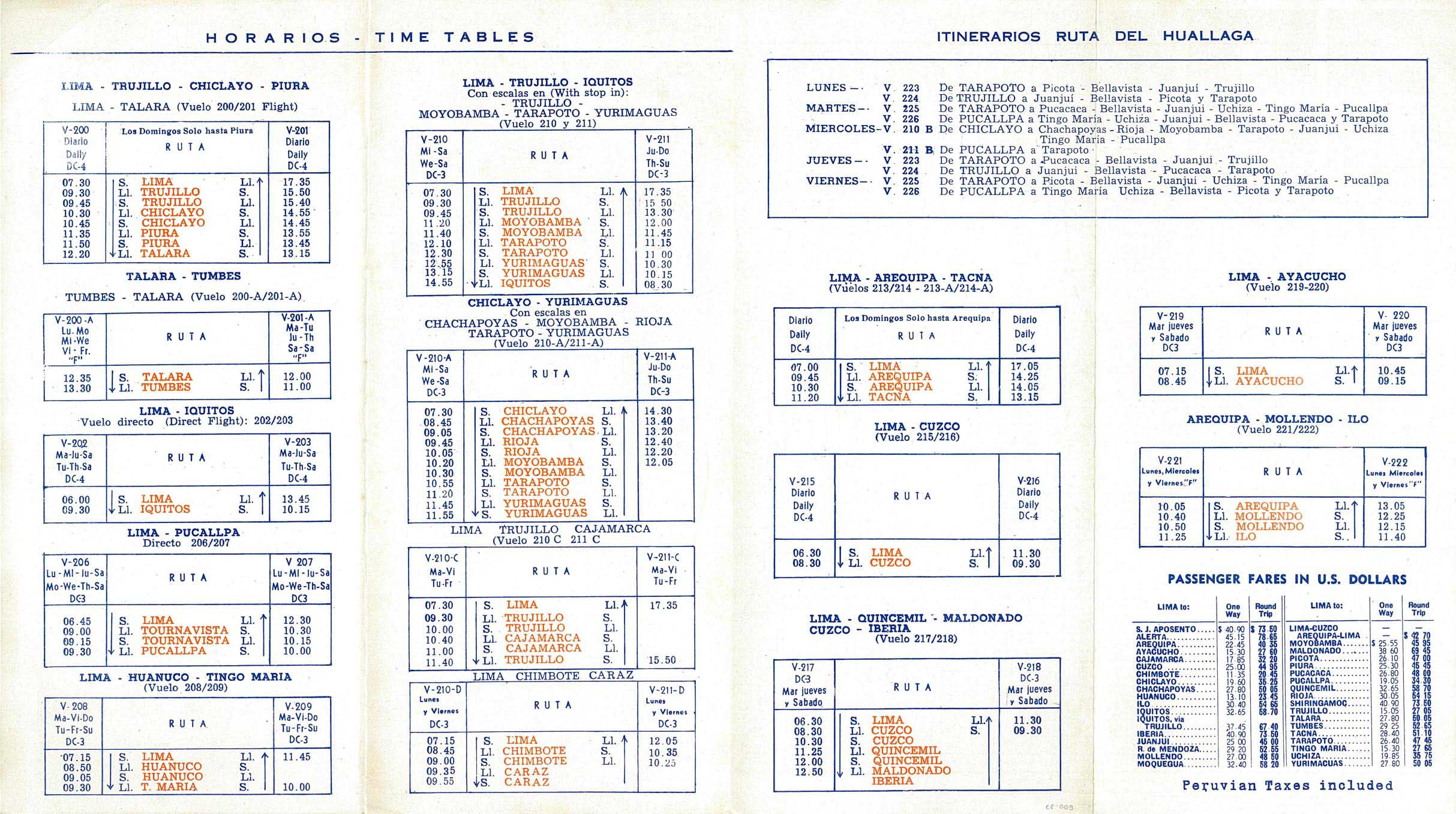
By March1960(1960-03), the airline had a fleet of eight DC-3s, four DC-4s and four Faucett Stinson F-19s to serve a route network that was 6,368 miles (10,248km) long.[9] A second-hand Douglas DC-6B acquired from Panagra was incorporated into the fleet in the early 1960s.[5][10] Another DC-6B was acquired in late 1964, and was converted to DC-6B(F) standard with a large rear freight door.[11] This was operated on cargo services to Miami, Florida.
1970s–1980s
In 1973, Faucett was owned by Peruvian interests (46%), the Fundación Faucett (35%) and Braniff International Airways (19%).[12] The cargo-only airline Aeronaves del Peru became Faucett's biggest shareholder in 1982.[13]
1990s: Decline and final years
The 1990s economic liberalization under Alberto Fujimori, after years of economic and political chaos (as well as a violent Maoist insurgency), brought a series of measures aimed at the privatization and deregulation of the airline market. A series of short-lived airlines sprung up during this decade (in the style of Russian Babyflots), state-owned Aeroperú was partly sold to Mexican investors and the rise of low-fare Aero Continente as the biggest domestic airline, contributed to the slow decline of Faucett. A series of high-profile accidents, especially Faucett Perú Flight 251 and Aeroperú Flight 603 (both in 1996) affected the safety reputation of the Peruvian airline industry, with the US Embassy in Lima banning their employees from flying on Aero Continente and, more broadly, advising caution to US citizens flying on Peru's airlines.[14]
In the end, problems with the economic-financial structure of the airline (with debts even with CORPAC for airport services), forced it to cease operations on 3 December 1997. Despite claiming that the 45-day closure would be temporary until government approval, all 1,250 employees were dismissed. Faucett incurred over US$1 million in debt.[15] By 1998, the former directors and employees were engaged in legal battles over labor and management issues, as well as accusations over bankrupting the company.[16] The airline was liquidated in 1999.[17][18]
Faucett-Stinson F.19 cargo aircraft built by Faucett, exhibited at their base at Lima in April 1972Douglas DC-4 of Faucett operating an internal Peruvian passenger service from Lima Airport in 1972
On 3 April 1989, Faucett 737-200, registered as OB-R-1314, veered off the runway while landing during a heavy tropical rainstorm at Iquitos Airport in Peru's Amazon region. There were no fatalities among the 130 passengers and crew, but 14 people were injured, and the aircraft was destroyed in the crash landing and its ensuing fire.[31][32][33][34]


![[21]](?wiki_title=Faucett_Perú#cite_note-cf60-3.jpg-21)