There are many types of conjugate variables, depending on the type of work a certain system is doing (or is being subjected to). Examples of canonically conjugate variables include the following:
Quantum theory
In quantum mechanics, conjugate variables are realized as pairs of observables whose operators do not commute. In conventional terminology, they are said to be incompatible observables. Consider, as an example, the measurable quantities given by position  and momentum
  . In the quantum-mechanical formalism, the two observables
  and
and  correspond to operators
  and
and  , which necessarily satisfy the canonical commutation relation:
![{\displaystyle [{\widehat {x}},{\widehat {p\,}}]={\widehat {x}}{\widehat {p\,}}-{\widehat {p\,}}{\widehat {x}}=i\hbar }](https://wikimedia.org/api/rest_v1/media/math/render/svg/6daec4f362b8f5be0bd62438003d9eb6c8803785)
For every non-zero commutator of two operators, there exists an "uncertainty principle", which in our present example may be expressed in the form:
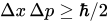
In this ill-defined notation,  and
and  denote "uncertainty" in the simultaneous specification of and . A more precise, and statistically complete, statement involving the standard deviation
  reads:

More generally, for any two observables  and
and  corresponding to operators
  and
and  , the generalized uncertainty principle is given by:
![{\displaystyle {\sigma _{A}}^{2}{\sigma _{B}}^{2}\geq \left({\frac {1}{2i}}\left\langle \left[{\widehat {A}},{\widehat {B}}\right]\right\rangle \right)^{2}}](https://wikimedia.org/api/rest_v1/media/math/render/svg/0ae563ff59236800a11ad9aeb157cf84adbd25a2)
Now suppose we were to explicitly define two particular operators, assigning each a specific mathematical form, such that the pair satisfies the aforementioned commutation relation. It's important to remember that our particular "choice" of operators would merely reflect one of many equivalent, or isomorphic, representations of the general algebraic structure that fundamentally characterizes quantum mechanics. The generalization is provided formally by the Heisenberg Lie algebra  , with a corresponding group called the Heisenberg group
  .
.

