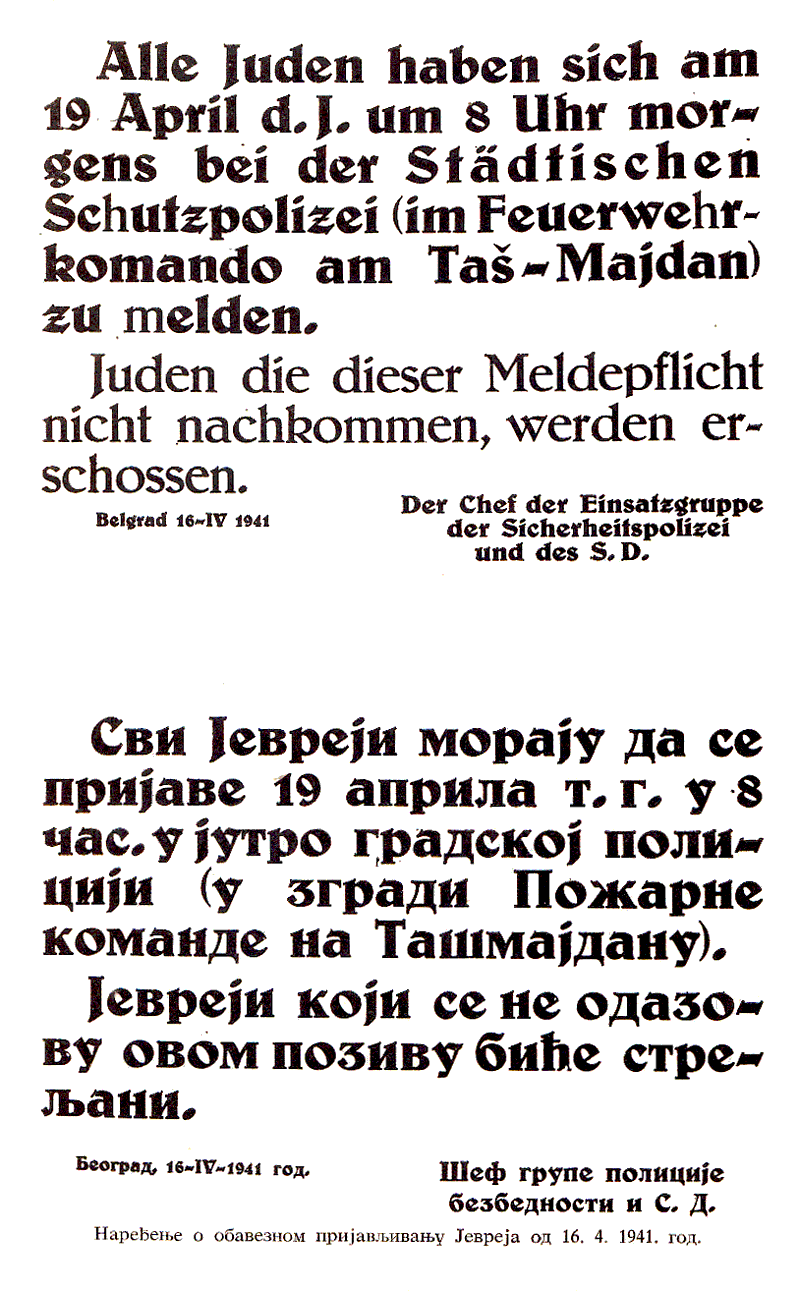
From 1940 onward, Fuchs was assigned as an SD officer to the Commander of the Security Police and SD (Befehlshaber der Sicherheitspolizei und des SD, BdS) in the General Government, Bruno Streckenbach.[5] Following the German attack on the Kingdom of Yugoslavia on 6 April 1941, Fuchs was named BdS for Serbia and was assigned the leadership of the Einsatzgruppe Serbia. One of his first acts was to order the registration of all Jews in Belgrade. His proclamation stated that anyone not registering would be shot.[6]Yugoslav partisans in July began a rebellion against the German occupiers by acts of sabotage, destroying railway lines, telephone lines and other infrastructure as well as ambushing German troops. During Fuchs tenure in Serbia, the Wehrmacht High Command issued the so-called "Keitel order" of 16 September 1941, which mandated executing 50 to 100 civilian hostages in reprisal for each German killed.[7] When discussing the implementation of the reprisal policy, Fuchs successfully advocated for including already incarcerated male Serbian Jews as victims.[8] By the end of the year, due to reprisals then more brutal than anywhere else in occupied Europe, the rebellion in Serbia largely had been quelled.[9] Fuchs was replaced as BdS in January 1942 by SS-StandartenführerEmanuel Schäfer.
Fuchs was promoted to SS-Oberführer in 1942.[10] Sent to Riga in the Reichskommissariat Ostland, he served as the acting SS and Police Leader in the Generalbezirk Lettland in June 1942, in place of SS-BrigadeführerWalther Schröder. Returning to his post in Braunschweig, he was appointed the acting Higher SS and Police Leader "Mitte" in place of SS-ObergruppenführerGünther Pancke from 8 July to 14 September 1943.[11] On 15 September 1943, Fuchs returned to the east as Führer of Einsatzkommando 3, which he commanded until 6 May 1944. He then advanced to the leadership of Einsatzgruppe A and BdS in Ostland until 17 October 1944. His next assignment was as the last commander of Einsatzgruppe E in Croatia between October and November 1944. In this role he was co-responsible for the murder of tens of thousands of people.[1] During the war, Fuchs was awarded the Clasp to the Iron Cross, 2nd class.[3]
Post-war prosecution and death
After the end of the war, Fuchs was arrested and extradited to Yugoslavia. He was tried along with seventeen others for the deaths of 150,000 men, women and children, including 35,000 Jews, and was sentenced to death by the Supreme Military Court in Belgrade on 22 December 1946.[12] Together with SS-GruppenführerAugust Meyszner, the former Higher SS and Police Leader in Serbia, Fuchs was executed by hanging on 24 January 1947.[13]
↑Carsten Schreiber: Elite im Verborgenen – Ideologie und regionale Herrschaftspraxis des Sicherheitsdienstes der SS und seines Netzwerks am Beispiel Sachsens, Munich 2008, p. 371.
↑Carsten Schreiber: Elite im Verborgenen – Ideologie und regionale Herrschaftspraxis des Sicherheitsdienstes der SS und seines Netzwerks am Beispiel Sachsens, Munich 2008, p. 58.
↑Alwin Ramme, Der Sicherheitsdienst der SS, Militärverlag, Berlin, 1970, p. 262.
Klee, Ernst (2007). Das Personenlexikon zum Dritten Reich. Wer war was vor und nach 1945. Frankfurt-am-Main: Fischer-Taschenbuch-Verlag. ISBN978-3-596-16048-8.
Mazower, Mark (2008). Hitler's Empire: How the Nazis Ruled Europe. New York: The Penguin Press. ISBN978-1-594-20188-2.
Ramme, Alwin: Der Sicherheitsdienst der SS, Militärverlag Berlin 1970, S. 262.
Schiffer Publishing Ltd., ed. (2000). SS Officers List: SS-Standartenführer to SS-Oberstgruppenführer (As of 30 January 1942). Schiffer Military History Publishing. ISBN0-7643-1061-5.