In mathematics, a unary operation is an operation with only one operand, i.e. a single input.[1] This is in contrast to binary operations, which use two operands.[2] An example is any function, where A is a set; the function is a unary operation on A.
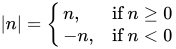
Obtaining the absolute value of a number is a unary operation. This function is defined as where is the absolute value of .
Negation
Negation is used to find the negative value of a single number. Here are some examples:
Factorial
For any positive integer n, the product of the integers less than or equal to n is a unary operation called factorial. In the context of complex numbers, the gamma function is a unary operation extension of factorial.
Trigonometry
In trigonometry, the trigonometric functions, such as , , and , can be seen as unary operations. This is because it is possible to provide only one term as input for these functions and retrieve a result. By contrast, binary operations, such as addition, require two different terms to compute a result.
Examples from programming languages
Below is a table summarizing common unary operators along with their symbols, description, and examples:[3]