In mathematics, the trigonometric moment problem is formulated as follows: given a sequence  , does there exist a distribution function
  on the interval
 ![{\displaystyle [0,2\pi ]}](https://wikimedia.org/api/rest_v1/media/math/render/svg/348d40bf3f8b7e1c00c4346440d7e2e4f0cc9b91) such that:
such that:
 with
with  for
for  . An affirmative answer to the problem means that are the Fourier-Stieltjes coefficients for some (consequently positive) unique Radon measure
  on as distribution function.
In case the sequence is finite, i.e.,  , it is referred to as the truncated trigonometric moment problem.
Characterization
The trigonometric moment problem is solvable, that is,  is a sequence of Fourier coefficients, if and only if the (n + 1) × (n + 1) Hermitian Toeplitz matrix
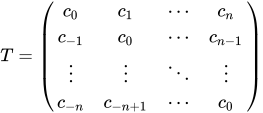 with
with  for ,
is positive semi-definite.
for ,
is positive semi-definite.
The "only if" part of the claims can be verified by a direct calculation. We sketch an argument for the converse. The positive semidefinite matrix  defines a sesquilinear product on
  , resulting in a Hilbert space
 of dimensional at most n + 1. The Toeplitz structure of means that a "truncated" shift is a partial isometry on
  . More specifically, let
  be the standard basis of . Let
  and
and  be subspaces generated by the equivalence classes
 ![{\displaystyle \{[e_{0}],\dotsc ,[e_{n-1}]\}}](https://wikimedia.org/api/rest_v1/media/math/render/svg/416f5f911ed5181411381de9f0a5f8c69c8c9ad2) respectively
respectively ![{\displaystyle \{[e_{1}],\dotsc ,[e_{n}]\}}](https://wikimedia.org/api/rest_v1/media/math/render/svg/bdfd9bea2e2a7b923b81592d19bc850adabb718a) . Define an operator
. Define an operator
 by
by
![{\displaystyle V[e_{k}]=[e_{k+1}]\quad {\mbox{for}}\quad k=0\ldots n-1.}](https://wikimedia.org/api/rest_v1/media/math/render/svg/456cf43acc90f6d02987661a47123ebb7160d31e) Since
Since
![{\displaystyle \langle V[e_{j}],V[e_{k}]\rangle =\langle [e_{j+1}],[e_{k+1}]\rangle =T_{j+1,k+1}=T_{j,k}=\langle [e_{j}],[e_{k}]\rangle ,}](https://wikimedia.org/api/rest_v1/media/math/render/svg/151268971dcfe8e370d45ac65cb88360fa2542a7)
 can be extended to a partial isometry acting on all of . Take a minimal unitary extension
  of , on a possibly larger space (this always exists). According to the spectral theorem, there exists a Borel measure
  on the unit circle
  such that for all integer k
![{\displaystyle \langle (U^{*})^{k}[e_{n+1}],[e_{n+1}]\rangle =\int _{\mathbb {T} }z^{k}dm.}](https://wikimedia.org/api/rest_v1/media/math/render/svg/22db45b313de7b5b6df498801546804ae40eccfe) For
For  , the left hand side is
![{\displaystyle \langle (U^{*})^{k}[e_{n+1}],[e_{n+1}]\rangle =\langle (V^{*})^{k}[e_{n+1}],[e_{n+1}]\rangle =\langle [e_{n+1-k}],[e_{n+1}]\rangle =T_{n+1,n+1-k}=c_{-k}={\overline {c_{k}}}.}](https://wikimedia.org/api/rest_v1/media/math/render/svg/c246ad47cfe023b126c005a61cfce0cdeda34861) As such, there is a
As such, there is a  -atomic measure on , with
  (i.e. the set is finite), such that
 which is equivalent to

for some suitable measure .
Parametrization of solutions
The above discussion shows that the truncated trigonometric moment problem has infinitely many solutions if the Toeplitz matrix is invertible.
In that case, the solutions to the problem are in bijective correspondence with minimal unitary extensions of the partial isometry .