Overview
As with any pseudocylindrical projection, in the projection’s normal aspect,[2] the parallels of latitude are parallel, straight lines. Their spacing is calculated to provide the equal-area property. The projection blends the cylindrical equal-area projection, which has straight, vertical meridians, with meridians that follow a particular kind of curve known as superellipses[3] or Lamé curves or sometimes as hyperellipses. A hyperellipse is described by 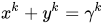 , where
  and
and  are free parameters. Tobler's hyperelliptical projection is given as:
![{\displaystyle {\begin{aligned}&x=\lambda [\alpha +(1-\alpha ){\frac {(\gamma ^{k}-y^{k})^{1/k}}{\gamma }}]\\\alpha &y=\sin \varphi +{\frac {\alpha -1}{\gamma }}\int _{0}^{y}(\gamma ^{k}-z^{k})^{1/k}dz\end{aligned}}}](https://wikimedia.org/api/rest_v1/media/math/render/svg/9941b7cbd504413e88bef988842478f223962aca)
where  is the longitude,
  is the latitude, and
  is the relative weight given to the cylindrical equal-area projection. For a purely cylindrical equal-area,
  ; for a projection with pure hyperellipses for meridians,
  ; and for weighted combinations,
  .
.
When and  the projection degenerates to the Collignon projection; when ,
  , and
, and  the projection becomes the Mollweide projection.[4] Tobler favored the parameterization shown with the top illustration; that is, ,
  , and
, and 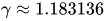 .
.

