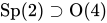
The name "symplectic" was introduced by Hermann Weyl as a replacement for older terminology such as line complex group. It was intended as a Greek-based analogue of the word "complex".
The notation Sp(2n, F) usually denotes the symplectic group of a 2n-dimensional symplectic vector space over a fieldF. A related but different family is the compact symplectic group, denoted Sp(n) or , which is the compact real form of the complex symplectic group.
Many authors use slightly different notations, often differing by factors of 2. In Cartan's classification, the Lie algebra of Sp(2n, C) has type Cn.
Sp(2n, F)
The symplectic group is a classical group defined as the set of linear transformations of a 2n-dimensional vector space over the field F which preserve a non-degenerateskew-symmetricbilinear form. Such a vector space is called a symplectic vector space, and the symplectic group of an abstract symplectic vector space V is denoted Sp(V). Upon fixing a basis for V, the symplectic form is represented by a nonsingular skew-symmetric matrix J, and Sp(V) is identified with the group of 2n × 2n matrices over F satisfying
This matrix group is denoted Sp(2n, F) or Sp(n, F), although the notation depends on the convention being used. Here MT denotes the transpose of M.
In an arbitrary basis, the matrix J need not have any particular form. However, one can choose a symplectic basis, in which the form is represented by the standard matrix
where In is the identity matrix. In such a basis,
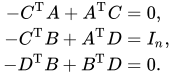
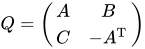
In this case, Sp(2n, F) can be expressed as those block matrices , where , satisfying the three equations:
Since all symplectic matrices have determinant1, the symplectic group is a subgroup of the special linear groupSL(2n, F). When n = 1, the symplectic condition on a matrix is satisfied if and only if the determinant is one, so that Sp(2, F) = SL(2, F). For n > 1, there are additional conditions, i.e. Sp(2n, F) is then a proper subgroup of SL(2n, F).
Typically, the field F is the field of real numbersR or complex numbersC. In these cases Sp(2n, F) is a real or complex Lie group of real or complex dimension n(2n + 1), respectively. These groups are connected but non-compact.
The center of Sp(2n, F) consists of the matrices I2n and −I2n as long as the characteristic of the field is not 2.[1] Since the center of Sp(2n, F) is discrete and its quotient modulo the center is a simple group, Sp(2n, F) is considered a simple Lie group.
The real rank of the corresponding Lie algebra, and hence of the Lie group Sp(2n, F), is n.
equipped with the commutator as its Lie bracket.[2] For the standard skew-symmetric bilinear form , this Lie algebra is the set of all block matrices subject to the conditions
Sp(2n, C)
The symplectic group over the field of complex numbers is a non-compact, simply connected, simple Lie group. The definition of this group includes no conjugates (contrary to what one might naively expect) but instead it is exactly the same as the definition bar the field change.[3]
Sp(2n, R)
Sp(2n, R) is a real, non-compact, connected simple Lie group of dimension .[4]
It has fundamental group isomorphic to the integers under addition.[5]
As the real form of a simple complex Lie algebra, its Lie algebra is the split real form of sp(2n, C).[4]
The exponential map from sp(2n, R) to Sp(2n, R) is not surjective.[6]
For every S in Sp(2n, R), one has a Cartan/polar decomposition[4][7]
with
and .
As a manifold, Sp(2n, R) is diffeomorphic to U(n) times a vector space of dimension n(n+1).[4]
Generators
Infinitesimal generators
The members of the symplectic Lie algebra sp(2n, F) are the Hamiltonian matrices.
The symplectic group is generated by its symplectic transvections. More precisely, if is a finite-dimensional symplectic vector space over F, then is generated by the transformations
where and . This is a general part of the structure theory of the classical groups, and appears in early form in work of Dieudonné; see also later treatments devoted specifically to symplectic transvections and the subgroups they generate.[8][9]
Generation by involutions
The symplectic group Sp(2n,F) can be generated by linear transformations of the symplectic vector space (V,J) such that and .[8][10]
Example of symplectic matrices
For Sp(2, R), the group of 2 × 2 matrices with determinant 1, the three symplectic (0, 1)-matrices are:[11]
Sp(2n, R)
It turns out that can have a fairly explicit description using generators. If we let denote the symmetric matrices, then is generated by where
A symplectic vector space is itself a symplectic manifold. A transformation under an action of the symplectic group is thus, in a sense, a linearised version of a symplectomorphism which is a more general structure preserving transformation on a symplectic manifold.
Sp(n)
The compact symplectic group[15]Sp(n) is the intersection of Sp(2n, C) with the unitary group:
It is sometimes written as USp(2n). Alternatively, Sp(n) can be described as the subgroup of GL(n, H) (invertible quaternionic matrices) that preserves the standard hermitian form on Hn:
That is, Sp(n) is just the quaternionic unitary group, U(n, H).[16] Indeed, it is sometimes called the hyperunitary group. Also Sp(1) is the group of quaternions of norm 1, equivalent to SU(2) and topologically a 3-sphereS3.
Note that Sp(n) is not a symplectic group in the sense of the previous section—it does not preserve a non-degenerate skew-symmetric H-bilinear form on Hn: there is no such form except the zero form. Rather, it is isomorphic to a subgroup of Sp(2n, C), and so does preserve a complex symplectic form in a vector space of twice the dimension. As explained below, the Lie algebra of Sp(n) is the compact real form of the complex symplectic Lie algebra sp(2n, C).
The unitary symplectic group can be represented in terms of a Clifford algebra defined as a tensor product of quaternion algebras called hyperquaternion numbers. One has, . Hence, entails the compact symplectic group .[18]
Sp(2n, Z)
The integral symplectic group Sp(2n, Z) is the subgroup of Sp(2n, R) consisting of matrices with integer entries. Equivalently, it is the group of 2n × 2n integer matrices preserving the standard symplectic form:
where
For n=1, this group coincides with the modular groupSL(2, Z).
The group Sp(2n, Z) acts on the Siegel upper half-space, the space of symmetric complex n × n matrices with positive-definite imaginary part, by fractional linear transformations
play a central role in the theory of Siegel modular forms. The quotient of Siegel upper half-space by Sp(2n, Z) is the moduli space of principally polarized abelian varieties of dimension n, and quotients by congruence subgroups correspond to adding level structure.
The Lie algebra of Sp(2n, C) is semisimple and is denoted sp(2n, C). Its split real form is sp(2n, R) and its compact real form is sp(n). These correspond to the Lie groups Sp(2n, R) and Sp(n) respectively.
The algebras, sp(p, n − p), which are the Lie algebras of Sp(p, n − p), are the indefinite signature equivalent to the compact form.
Sp(2,F) ≅ SL(2,F) (in characteristic different from two), and Sp(2,R) ≅ Spin0(1,2). This is because the special linear group automatically preserves any symplectic form in two dimensions.
Sp(1) ≅ SU(2) ≅ Spin(3)
Spin(4) ≅ Sp(1)×Sp(1)
Sp(2) ≅ Spin(5). This isomorphism is exhibited by identifying Sp(2) with the group of 2×2 quaternionic matrices such that where is the conjugate-transpose of . The reduced trace on is invariant under Sp(2)-conjugation, and the space of (reduced-)trace-free such that is a five-dimensional euclidean space, with quadratic form .
Sp(1,1) ≅ Spin0(1,4). This isomorphism is exhibited by identifying Sp(1,1) with the group of 2×2 quaternionic matrices such that where and is the conjugate-transpose of . The reduced trace is invariant under Sp(1,1)-conjugation, and the space of (reduced-)trace-free such that is a five-dimensional pseudo-euclidean space, with quadratic form , of signature .
Sp(4,R) ≅ Spin0(2,3). Identify Sp(4,R) as the subset of the ring of 4×4 real matrices such that where (with 2×2 blocks, and the 2×2 identity matrix). The subspace consisting of the trace-free matrices such that is five-dimensional, and the trace form defines a signature (2,3) pseudo-euclidean metric on it, which is preserved by the action of Sp(4,R).
its elements are precisely the linear changes of variables that preserve the standard symplectic form, or equivalently the Poisson bracket.
The Lie algebra sp(2n, R) is naturally identified with quadratic Hamiltonians on phase space: if
then the corresponding Hamiltonian flow is linear and defines a one-parameter subgroup of Sp(2n, R). In this sense, the symplectic group is generated by quadratic Hamiltonians.
The symplectic group acts by linear changes of coordinates in the phase space of classical mechanics. When one tries to make the same transformations act on the wavefunctions of quantum mechanics, there is a phase ambiguity, and it is necessary to pass to a double cover. The metaplectic group is a double cover of the symplectic group over R. (It has analogues over other local fields, finite fields, and adele rings.)
12Dieudonné, Jean (1955). "Sur les générateurs des groupes classiques". Summa Brasiliensis Mathematicae. 3: 149–179.
↑Brown, Ronald; Humphries, Stephen P. (1986). "Orbits under symplectic transvections. I". Proceedings of the London Mathematical Society. 3. 52 (3): 517–531. doi:10.1112/plms/s3-52.3.517.
↑Wonenburger, Anna (1966). "Transformations which are products of two involutions". Journal of Mathematics and Mechanics. 16 (4): 327–338.
Hall, Brian C. (2015), Lie groups, Lie algebras, and representations: An elementary introduction, Graduate Texts in Mathematics, vol.222 (2nded.), Springer, ISBN978-3319134666
Rossmann, Wulf (2002), Lie Groups – An Introduction Through Linear Groups, Oxford Graduate Texts in Mathematics, Oxford Science Publications, ISBN0-19-859683-9
Ferraro, Alessandro; Olivares, Stefano; Paris, Matteo G. A. (March 2005), "Gaussian states in continuous variable quantum information", arXiv:quant-ph/0503237.








![{\displaystyle {\begin{aligned}D(n)&=\left\{\left.{\begin{bmatrix}A&0\\0&(A^{T})^{-1}\end{bmatrix}}\,\right|\,A\in \operatorname {GL} (n,\mathbf {R} )\right\}\\[6pt]N(n)&=\left\{\left.{\begin{bmatrix}I_{n}&B\\0&I_{n}\end{bmatrix}}\,\right|\,B\in \operatorname {Sym} (n)\right\}\end{aligned}}}](https://wikimedia.org/api/rest_v1/media/math/render/svg/c1f58cbafa84f09e68c60189d79369de3b9eb2bb)