Quantitative description
Each photon that undergoes SRS is shifted in color from pump to Stokes color. Thus, the SRS signal is proportional to the decrease or increase in the pump, or Stokes beams intensities, respectively. The following rate equations describe these changes in the beams intensities
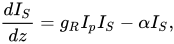
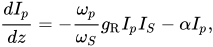
where,  and
and  are the pump and Stokes beams intensities, respectively,
  and
and  are the pump and Stokes angular frequencies, respectively,
  is the coordinate along which the beams propagate,
  is the Raman gain coefficient, and
  is the loss coefficient. The loss coefficient is an effective coefficient that might account for losses due to a variety of processes such as Rayleigh scattering, absorption, etc. The first-rate equation describes the change in Stokes beam intensity along the SRS interaction length. The first term on the right-hand side is equivalent to the amount of intensity gained by the Stokes beam due to SRS. As SRS involves both beams, this term is dependent both on and . The second term is equivalent to the amount of intensity lost and is thus dependent only on . The second rate equation describes the change in pump beam intensity; its form is similar to the former. The first term on the right-hand side of the second equation equals its counterpart from the first equation up to a multiplicative factor of
  . This factor reflects that each photon (as opposed to intensity units) lost from the pump beam due to SRS is gained by the Stokes beam.
In most cases, the experimental conditions support two simplifying assumptions: (1) photon loss along the Raman interaction length,  , is negligible. Mathematically, this corresponds to
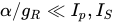
and (2) the change in beam intensity is linear; mathematically, this corresponds to
 .
.
Accordingly, the SRS signal, that is, the intensity changes in pump and Stokes beams, is approximated by

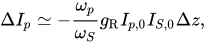
where  and
and  are the initial pump and Stokes beams intensities, respectively. As for the Raman interaction length, in many cases, this length can be evaluated similarly to the evaluation of the Rayleigh length as
 .
.
Here,  and
and  are the averaged refractive index and beam waist, respectively, and
  and
and  are the pump and Stokes wavelengths, respectively.
Every molecule has some characteristic Raman shifts associated with a specific vibrational (or rotational) transition. The relation between a Raman shift,  , and the pump and Stokes photon wavelengths is given by
![{\displaystyle \Delta \omega [\mathrm {cm} ^{-1}]=\left({\frac {1}{\lambda _{p}[\mathrm {nm} ]}}-{\frac {1}{\lambda _{S}[\mathrm {nm} ]}}\right)\times {\frac {[10^{7}\mathrm {nm} ]}{[\mathrm {cm} ]}}}](https://wikimedia.org/api/rest_v1/media/math/render/svg/0bb109a2386e2a6519cd5ad8084b30b16a5dd376)
When the difference in wavelengths between both lasers is close to some Raman transition, the Raman gain coefficient receives values on the order of ![{\displaystyle 10^{-30}[\mathrm {cm} ^{2}/\mathrm {molecule} \cdot \mathrm {sr} ]}](https://wikimedia.org/api/rest_v1/media/math/render/svg/0538e0dce3f76d829efc47357e20295fd662fb45) resulting with an efficient SRS. As this difference starts to differ from a specific Raman transition, the Raman gain coefficient's value drops, and the process becomes increasingly less efficient and less detectable.
resulting with an efficient SRS. As this difference starts to differ from a specific Raman transition, the Raman gain coefficient's value drops, and the process becomes increasingly less efficient and less detectable.
An SRS experimental setup includes two laser beams (usually co-linear) of the same polarization; one is employed as pump and the other as Stokes. Usually, at least one of the lasers is pulsed. This modulation in the laser intensity helps to detect the signal; furthermore, it helps increase the signal's amplitude, which also helps detection. When designing the experimental setup, one has great liberty when choosing the pump and Stokes lasers, as the Raman condition (shown in the equation above) applies only to the difference in wavelengths.


