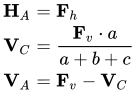
In the beam construction on the right, the four unknown reactions are VA, VB, VC, and HA. The equilibrium equations are:[2]
Since there are four unknown forces (or variables) (VA, VB, VC, and HA) but only three equilibrium equations, this system of simultaneous equations does not have a unique solution. The structure is therefore classified as statically indeterminate.
To solve statically indeterminate systems (determine the various moment and force reactions within it), one considers the material properties and compatibility in deformations.
Statically determinate
If the support at B is removed, the reaction VB cannot occur, and the system becomes statically determinate (or isostatic).[3] Note that the system is completely constrained here.
The system becomes an exact constraintkinematic coupling.
The solution to the problem is:[2]
If, in addition, the support at A is changed to a roller, the system can be moved horizontally, making it a mechanism rather than a structure, and reducing the number of reactions to three (without HA). As a result, the system becomes unstable or partly constrained, with the latter term preferable in distinguishing between this condition and when a system under equilibrium becomes unstable through a perturbation. In this case, the two unknowns VA and VC can be determined by resolving the vertical force equation and the moment equation simultaneously. The solution yields the same results as previously obtained. However, it is not possible to satisfy the horizontal force equation unless Fh = 0.[2]
Statical determinacy
Descriptively, a statically determinate structure can be defined as a structure where, if it is possible to find internal actions in equilibrium with external loads, those internal actions are unique. The structure has no possible states of self-stress, i.e. internal forces in equilibrium with zero external loads are not possible. Statical indeterminacy, however, is the existence of a non-trivial (non-zero) solution to the homogeneous system of equilibrium equations. It indicates the possibility of self-stress (stress in the absence of an external load) that may be induced by mechanical or thermal action.
Mathematically, this requires a stiffness matrix to have full rank.
A statically indeterminate structure can only be analyzed by including further information like material properties and deflections. Numerically, this can be achieved by using matrix structural analyses, finite element method (FEM) or the moment distribution method (Hardy Cross) .
Practically, a structure is called 'statically overdetermined' when it comprises more mechanical constraints– like walls, columns or bolts– than absolutely necessary for stability.
12345Megson, Thomas Henry Gordon (2014). "Analysis of statically indeterminate structures". Structural and stress analysis (Thirded.). Amsterdam: Elsevier. pp.489–570. ISBN9780080999364. OCLC873568410.