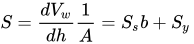
Unconfined
For an unconfined aquifer, storativity is approximately equal to the specific yield ( ) since the release from specific storage (
 ) is typically orders of magnitude less (
 ).
).

The specific storage is the amount of water that a portion of an aquifer releases from storage, per unit mass or volume of the aquifer, per unit change in hydraulic head, while remaining fully saturated.
Mass specific storage is the mass of water that an aquifer releases from storage, per mass of aquifer, per unit decline in hydraulic head:
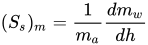
where
 is the mass specific storage ([L−1]);
 is the mass of that portion of the aquifer from which the water is released ([M]);
 is the mass of water released from storage ([M]); and
 is the decline in hydraulic head ([L]).
Volumetric specific storage (or volume-specific storage) is the volume of water that an aquifer releases from storage, per volume of the aquifer, per unit decline in hydraulic head (Freeze and Cherry, 1979):

where
- is the volumetric specific storage ([L−1]);
 is the bulk volume of that portion of the aquifer from which the water is released ([L3]);
 is the volume of water released from storage ([L3]);
 is the decline in pressure(N•m−2 or [ML−1T−2]) ;
- is the decline in hydraulic head ([L]) and
 is the specific weight of water (N•m−3 or [ML−2T−2]).
In hydrogeology, volumetric specific storage is much more commonly encountered than mass specific storage. Consequently, the term specific storage generally refers to volumetric specific storage.
In terms of measurable physical properties, specific storage can be expressed as

where
- is the specific weight of water (N•m−3 or [ML−2T−2])
 is the porosity of the material (dimensionless ratio between 0 and 1)
 is the compressibility of the bulk aquifer material (m2N−1 or [LM−1T2]), and
 is the compressibility of water (m2N−1 or [LM−1T2])
The compressibility terms relate a given change in stress to a change in volume (a strain). These two terms can be defined as:

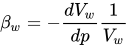
where
 is the effective stress (N/m2 or [MLT−2/L2])
These equations relate a change in total or water volume ( or
or  ) per change in applied stress (effective stress — or pore pressure —
  ) per unit volume. The compressibilities (and therefore also Ss) can be estimated from laboratory consolidation tests (in an apparatus called a consolidometer), using the consolidation theory of soil mechanics (developed by Karl Terzaghi).