ENSIKLOPEDIA
Sigmoid function


A sigmoid function is any mathematical function whose graph has a characteristic S-shaped or sigmoid curve.
A common example of a sigmoid function is the logistic function.
Other sigmoid functions are given in the Examples section. In some fields, most notably in the context of artificial neural networks, the term "sigmoid function" is used as a synonym for "logistic function".
Special cases of sigmoid functions include the Gompertz curve (used in modeling systems that saturate at large values of x) and the ogee curve (used in the spillway of some dams). Sigmoid functions have domain of all real numbers, with return (response) value commonly monotonically increasing but could be decreasing. Sigmoid functions most often show a return value (y axis) in the range 0 to 1. Another commonly used range is from −1 to 1.
There is also the Heaviside step function, which instantaneously transitions between 0 and 1.
A wide variety of sigmoid functions including the logistic and hyperbolic tangent functions have been used as the activation function of artificial neurons. Sigmoid curves are also common in statistics as cumulative distribution functions (which go from 0 to 1), such as the integrals of the logistic density, the normal density, and Student's t probability density functions. The logistic sigmoid function is invertible, and its inverse is the logit function.
Theory
In mathematics, a unitary sigmoid function is a bounded sigmoid-type function normalized to the unit range, typically with lower and upper asymptotes at 0 and 1. The theory proposed by Grebenc[1] distinguishes three kinds of unitary sigmoid functions according to their asymptotic behavior and the presence or absence of oscillation near the asymptotes.
A general form of a unitary sigmoid function is

where 


Classification
1st kind
A unitary sigmoid function of the first kind is a bounded increasing function that approaches its lower and upper asymptotes monotonically, without oscillation. This class includes many of the standard sigmoid functions used in statistics, biomathematics, and engineering, such as the logistic function and related generalizations.
2nd kind
A unitary sigmoid function of the second kind is a bounded increasing function that oscillates near the upper asymptote while preserving an overall sigmoid transition.
3rd kind
A unitary sigmoid function of the third kind is a bounded increasing function that oscillates near both the lower and upper asymptotes. These functions retain the global shape of a sigmoid curve but exhibit oscillatory behavior in the vicinity of both limiting states.

Taxonomy
The tables below show the taxonomy of unitary sigmoid functions of all three kinds.
Table 1. Taxonomy matrix with examples of sigmoid functions of the 1st kind
| No | Type of sigmoid function | Unbounded interval  | Semi-bounded interval  | Unitary interval  |
|---|---|---|---|---|
| 1 | rational |  (Elliot[2]) (Elliot[2]) |
 |
 |
| 2 | irrational |  (algebraic) (algebraic) ![{\displaystyle {\sqrt[{-b}]{1+e^{-b\,a\,x}}}}](https://wikimedia.org/api/rest_v1/media/math/render/svg/6a31e8c1ed86184e5fc8836c64316d5222befc46) (Richards[3]) (Richards[3]) |
 |
 |
| 3 | exponential |  (Logistic/Verhulst[4]) (Logistic/Verhulst[4])  (Laplace[5]) (Laplace[5]) |
 ; ;  (Rayleigh[6]) (Rayleigh[6]) |
 |
| 4 | logarithmic |  |
 |
 |
| 5 | trigonometric |  |
 |
 |
| 6 | inverse trigonometric |  (Lorenz[7]) (Lorenz[7]) |
 |
 |
| 7 | hyperbolic |  |
 (Log-logistic[8]) (Log-logistic[8]) |
 |
| 8 | inverse hyperbolic |  |
 |
 |
| 9 | special |  (Normal[9][10]) (Normal[9][10]) |
 (Log-normal[11]) (Log-normal[11]) |
 |
| 10 | stochastic | — |  |
— |
| 11 | chaotic |  (Grebenc[12]) (Grebenc[12]) |
— | — |
Table 2. Taxonomy matrix with examples of sigmoid functions of the 2nd kind on the unbounded interval
| No | Type of sigmoid function | Unbounded interval  | Explanation |
|---|---|---|---|
| 1 | All functions from Table 1 |  |
Adding  to the functions to the functions  of the 3rd column of the Table 1, where of the 3rd column of the Table 1, where  is the Airy Ai function is the Airy Ai function |
| 2 | special |  |
|
| 3 | special |  |
 , are Fresnel integrals , are Fresnel integrals |
| 4 | special |  |
|
| 5 | special |  |
 is a Bessel J function is a Bessel J function |
Table 3. Taxonomy matrix with examples of sigmoid functions of the 3rd kind
| No | Type | Unbounded interval  | Explanation |
|---|---|---|---|
| 1 | special |  |
Adding  to the functions to the functions  of the 3rd column of the Table 1, where of the 3rd column of the Table 1, where  is the sine integral function is the sine integral function |
| 2 | special |  |
Adding  to the functions of the 3rd column of Table 1, where to the functions of the 3rd column of Table 1, where  is the cosine integral function is the cosine integral function |
| 3 | special |  |
 is the Fresnel S integral is the Fresnel S integral |
| 4 | special |  |
 is the Fresnel C integral is the Fresnel C integral |
Construction methods
The same theory presents a list of 30 methods for constructing sigmoid functions.[1]. These include algebraic transformations, integration and convolution methods, constructions from bell-shaped functions, solutions of ordinary and partial differential equations, recursive schemes, stochastic differential equations, feedback systems, and chaotic systems.
- M0: Construction method for sigmoid functions not evident or intuitive
- M1: Inverse of singularity functions
- M2: Sigmoid functions of embedded positive functions
- M3: Rising a sigmoid function to the power
- M4: Exponentiating a sigmoid function
- M5: Symmetric sigmoid functions derived from asymmetric ones
- M6: Sigmoid functions of the reciprocal independent variable
- M7: Embedding a sigmoid function into other function
- M8: Sum of sigmoid functions
- M9: Multiplication of sigmoid functions
- M10: Integral of the product of an increasing and a decreasing function
- M11: Derivation from lambda (bell-shaped) functions
- M12: Integration of lambda (bell-shaped) function
- M13: Integration of the sum of lambda (bell-shaped) functions
- M14: Integration of the product of two lambda (bell-shaped) functions
- M15: Integration of the difference of two shifted sigmoid functions
- M16: Integration of the product of two shifted sigmoid functions
- M17: Convolution of sigmoid functions
- M18: Integration of the product of lambda and sigmoid function
- M19: Solutions of ordinary differential equations
- M20: Solutions of partial differential equation (PDE)
- M21: Solutions of functional differential equation (FDE)
- M22: Sum of a sigmoid function and some derivatives
- M23: Combination of sigmoid functions, its derivative and integral
- M24: Filtering sigmoid functions
- M25: Special cases of Gauss hypergeometric functions
- M26: Feedback closed-loop systems
- M27: Recursive functions
- M28: Recursive time-delayed feed-forward loops
- M29: Solutions of stochastic differential equation
- M30: Chaotic sigmoid functions
Consult reference[1] for more details.
Definition
A sigmoid function is a bounded, differentiable, real function that is defined for all real input values and has a positive derivative at each point.[13][14]
Properties
In general, a sigmoid function is monotonic, and has a first derivative which is bell shaped. Conversely, the integral of any continuous, non-negative, bell-shaped function (with one local maximum and no local minimum, unless degenerate) will be sigmoidal. Thus the cumulative distribution functions for many common probability distributions are sigmoidal. One such example is the error function, which is related to the cumulative distribution function of a normal distribution; another is the arctan function, which is related to the cumulative distribution function of a Cauchy distribution.
A sigmoid function is constrained by a pair of horizontal asymptotes as 
A sigmoid function is convex for values less than a particular point, and it is concave for values greater than that point: in many of the examples here, that point is 0.
Examples
.svg)
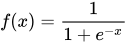
- Logistic function
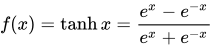
- Hyperbolic tangent (shifted and scaled version of the logistic function, above)
- Arctangent function
- Gudermannian function
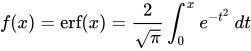
- Error function
- Generalised logistic function
- Smoothstep function
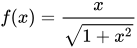
- Some algebraic functions, for example
- and in a more general form[15]
- Up to shifts and scaling, many sigmoids are special cases of
where
is the inverse of the negative Box–Cox transformation, and
and
are shape parameters.[16]
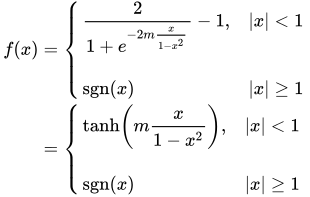
- Smooth transition function[17] normalized to (−1,1):







Applications

Many natural processes, such as those of complex systems learning curves, exhibit a progression from small beginnings that accelerates and approaches a climax over time.[18] When a specific mathematical model is lacking, a sigmoid function is often used.[19]
The van Genuchten–Gupta model is based on an inverted S-curve and applied to the response of crop yield to soil salinity.
Examples of the application of the logistic S-curve to the response of crop yield (wheat) to both the soil salinity and depth to water table in the soil are shown in modeling crop response in agriculture.
In artificial neural networks, non-smooth functions are sometimes used for efficiency; these are known as hard sigmoids.
In audio signal processing, sigmoid functions are used as waveshaper transfer functions to emulate the sound of analog circuitry clipping.[20]
In Digital signal processing in general, sigmoid functions, due to their higher order of continuity, have much faster asymptotic rolloff in the frequency domain than a Heavyside step function, and therefore are useful to smooth discontinuities before sampling to reduce aliasing. This is, for example, used to generate square waves in many kinds of Digital synthesizer.
In biochemistry and pharmacology, the Hill and Hill–Langmuir equations are sigmoid functions.
In computer graphics and real-time rendering, sigmoid functions are used to blend colors or geometry between two values, producing smooth transitions without visible seams or discontinuities.
Titration curves between strong acids and strong bases have a sigmoid shape due to the logarithmic nature of the pH scale.
The logistic function can be calculated efficiently by utilizing type III Unums.[21]
A hierarchy of sigmoid growth models with increasing complexity (number of parameters) was built[22] with the primary goal to re-analyze kinetic data, the so-called N-t curves, from heterogeneous nucleation experiments,[23] in electrochemistry. The hierarchy includes at present three models, with 1, 2, and 3 parameters, if not counting the maximal number of nuclei Nmax, respectively—a tanh2 based model called α21[24] originally devised to describe diffusion-limited crystal growth (not aggregation!) in 2D, the Johnson–Mehl–Avrami–Kolmogorov (JMAK) model,[25] and the Richards model.[26] It was shown that for the concrete purpose, even the simplest model works, and thus it was implied that the experiments revisited are an example of two-step nucleation with the first step being the growth of the metastable phase in which the nuclei of the stable phase form.[22]
See also

- Step function – Linear combination of indicator functions of real intervals
- Sign function – Function returning minus 1, zero or plus 1
- Heaviside step function – Indicator function of positive numbers
- Logistic regression – Statistical model for a binary dependent variable
- Logit – Function in statistics
- Softplus function – Smoothed ramp functionPages displaying short descriptions of redirect targets
- Soboleva modified hyperbolic tangent
- Softmax function – Smooth approximation of one-hot arg max
- Swish function – Mathematical activation function in data analysis
- Weibull distribution – Continuous probability distribution
- Fermi–Dirac statistics – Statistical description for the behavior of fermions
References
- 1 2 3 Grebenc, Andrej (August 2025). "Foundations for a General Theory of Sigmoid Functions: Modelling with 30 Methods". Intelligent Systems Conference. Cham: Springer Nature Switzerland. pp. 481–511. doi:10.1007/978-3-031-99958-1.
- ↑ Elliot, D. L. (1993). A better activation function for artificial neural networks (Technical report). College Park, MD: Institute for Systems Research, University of Maryland. TR 93–8.
- ↑ Richards, F. J. (1959). "A Flexible Growth Function for Empirical Use". Journal of Experimental Botany. 10 (2): 290–300. doi:10.1093/jxb/10.2.290.
- ↑ Verhulst, P.-F. (1838). "Notice sur la loi que la population suit dans son accroissement". Correspondance mathématique et physique. 10: 113–121.
- ↑ Laplace, P.-S. (1774). "Mémoire sur la probabilité des causes par les évènements". Mémoires de l'Académie Royale des Sciences Présentés par Divers Savans. 6: 621–656.
- ↑ Rayleigh, L. (1880). "On the resultant of a large number of vibrations of the same pitch and of arbitrary phase". Philosophical Magazine. 5th Series. 10: 73–78.
- ↑ Cauchy, A. L. (1853). "Memoire sur les resultats moyens d'un tres-grand nombre des observations". Comptes rendus hebdomadaires des séances de l'Académie des Sciences. 37: 381–385.
- ↑ Fisk, P. R. (1961). "The Graduation of Income Distributions". Econometrica. 29 (2): 171–185. doi:10.2307/1909287.
- ↑ Gauss, C. F. (1809). Theoria motvs corporvm coelestivm in sectionibvs conicis Solem ambientivm. Hamburg: Perthes et Besser.
- ↑ Glaisher, James Whitbread Lee (1871). "On a class of definite integrals". London, Edinburgh, and Dublin Philosophical Magazine and Journal of Science. 4th Series. 42 (277): 294–302. doi:10.1080/14786447108640568.
- ↑ Galton, F. (1874). "On men of science, their nature and their nurture". Proceedings of the Royal Institution of Great Britain. 7: 227–236.
- ↑ Grebenc, Andrej (2026). Chaotic sigmoid functions. to be published.
- ↑ Han, Jun; Morag, Claudio (1995). "The influence of the sigmoid function parameters on the speed of backpropagation learning". In Mira, José; Sandoval, Francisco (eds.). From Natural to Artificial Neural Computation. Lecture Notes in Computer Science. Vol. 930. pp. 195–201. doi:10.1007/3-540-59497-3_175. ISBN 978-3-540-59497-0.
- ↑ Ling, Yibei; He, Bin (December 1993). "Entropic analysis of biological growth models". IEEE Transactions on Biomedical Engineering. 40 (12): 1193–2000. doi:10.1109/10.250574. PMID 8125495.
- ↑ Dunning, Andrew J.; Kensler, Jennifer; Coudeville, Laurent; Bailleux, Fabrice (2015-12-28). "Some extensions in continuous methods for immunological correlates of protection". BMC Medical Research Methodology. 15 (107): 107. doi:10.1186/s12874-015-0096-9. PMC 4692073. PMID 26707389.
- ↑ "grex --- Growth-curve Explorer". GitHub. 2022-07-09. Archived from the original on 2022-08-25. Retrieved 2022-08-25.
- ↑ EpsilonDelta (2022-08-16). "Smooth Transition Function in One Dimension | Smooth Transition Function Series Part 1". 13:29/14:04 – via www.youtube.com.
- ↑ Laurens Speelman, Yuki Numata (2022). "Harnessing the Power of S-Curves". RMI. Rocky Mountain Institute.
- ↑ Gibbs, Mark N.; Mackay, D. (November 2000). "Variational Gaussian process classifiers". IEEE Transactions on Neural Networks. 11 (6): 1458–1464. doi:10.1109/72.883477. PMID 18249869. S2CID 14456885.
- ↑ Smith, Julius O. (2010). Physical Audio Signal Processing (2010 ed.). W3K Publishing. ISBN 978-0-9745607-2-4. Archived from the original on 2022-07-14. Retrieved 2020-03-28.
- ↑ Gustafson, John L.; Yonemoto, Isaac (2017-06-12). "Beating Floating Point at its Own Game: Posit Arithmetic" (PDF). Archived (PDF) from the original on 2022-07-14. Retrieved 2019-12-28.
- 1 2 Kleshtanova, Viktoria and Ivanov, Vassil V and Hodzhaoglu, Feyzim and Prieto, Jose Emilio and Tonchev, Vesselin (2023). "Heterogeneous Substrates Modify Non-Classical Nucleation Pathways: Reanalysis of Kinetic Data from the Electrodeposition of Mercury on Platinum Using a Hierarchy of Sigmoid Growth Models". Crystals. 13 (12). MDPI: 1690. doi:10.3390/cryst13121690. hdl:10261/341589.
{{cite journal}}: CS1 maint: multiple names: authors list (link) - ↑ Markov, I. and Stoycheva, E. (1976). "Saturation Nucleus Density in the Electrodeposition of Metals onto Inert Electrodes II. Experimental". Thin Solid Films. 35 (1). Elsevier: 21–35. doi:10.1016/0040-6090(76)90237-6.
{{cite journal}}: CS1 maint: multiple names: authors list (link) - ↑ Ivanov, V.V. and Tielemann, C. and Avramova, K. and Reinsch, S. and Tonchev, V. (2023). "Modeling Crystallization: When the Normal Growth Velocity Depends on the Supersaturation". Journal of Physics and Chemistry of Solids. 181 111542. Elsevier. doi:10.1016/j.jpcs.2023.111542.
{{cite journal}}: CS1 maint: multiple names: authors list (link) - ↑ Fanfoni, M. and Tomellini, M. (1998). "The Johnson-Mehl-Avrami-Kolmogorov Model: A Brief Review". Il Nuovo Cimento D. 20. Springer: 1171–1182. doi:10.1007/BF03185527.
{{cite journal}}: CS1 maint: multiple names: authors list (link) - ↑ Tjørve, E. and Tjørve, K.M.C. (2010). "A Unified Approach to the Richards-Model Family for Use in Growth Analyses: Why We Need Only Two Model Forms". Journal of Theoretical Biology. 267 (3). Elsevier: 417–425. doi:10.1016/j.jtbi.2010.09.008.
{{cite journal}}: CS1 maint: multiple names: authors list (link)
Further reading
- Mitchell, Tom M. (1997). Machine Learning. WCB McGraw–Hill. ISBN 978-0-07-042807-2.. (NB. In particular see "Chapter 4: Artificial Neural Networks" (in particular pp. 96–97) where Mitchell uses the word "logistic function" and the "sigmoid function" synonymously – this function he also calls the "squashing function" – and the sigmoid (aka logistic) function is used to compress the outputs of the "neurons" in multi-layer neural nets.)
- Humphrys, Mark. "Continuous output, the sigmoid function". Archived from the original on 2022-07-14. Retrieved 2022-07-14. (NB. Properties of the sigmoid, including how it can shift along axes and how its domain may be transformed.)
