When  varies according to a gamma distribution with shape parameter
  and scale parameter
  (mean =
  ), the distribution of
  is Gamma/Shifted Gompertz (G/SG). When is equal to one, the G/SG reduces to the Bass model (Bemmaor 1994). The three-parameter G/SG has been applied by Dover, Goldenberg and Shapira (2009)[6] and Van den Bulte and Stremersch (2004)[7] among others in the context of the diffusion of innovations. The model is discussed in Chandrasekaran and Tellis (2007).[8] Similar to the shifted Gompertz distribution, the G/SG can either be represented according to the propensity-to-adopt paradigm or according to the innovation-imitation paradigm. In the latter case, it includes three parameters:
  and with
  and
and  . The parameter modifies the curvature of the hazard rate as expressed as a function of
  : when is less than 0.5, it decreases to a minimum prior to increasing at an increasing rate as
  increases, it is convex when is less than one and larger or equal to 0.5, linear when is equal to one, and concave when is larger than one. Here are some special cases of the G/SG distribution in the case of homogeneity (across the population) with respect to the likelihood to adopt at a given time:
 = Exponential
 = Left-skewed two-parameter distribution
 = Bass model
 = Shifted Gompertz
with:

One can compare the parameters  and
and  across the values of as they capture the same notions. In all the cases, the hazard rate is either constant or a monotonically increasing function of (positive word of mouth). As the diffusion curve is all the more skewed as becomes large, we expect to decrease as the level of right-skew increases.


![{\displaystyle be^{-bx}e^{-\eta e^{-bx}}\left[1+\eta \left(1-e^{-bx}\right)\right]}](https://wikimedia.org/api/rest_v1/media/math/render/svg/fbadea38d6b94a55d5f17ae57cfd323d3087c50d)
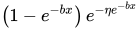
![{\displaystyle (-1/b)\{\mathrm {E} [\ln(X)]-\ln(\eta )\}\,}](https://wikimedia.org/api/rest_v1/media/math/render/svg/17f3d6c07b28031be6be13130c6d9ea2456f740b)

![{\displaystyle {\begin{aligned}\mathrm {E} [\ln(X)]=&[1{+}1/\eta ]\!\!\int _{0}^{\eta }\!\!\!\!e^{-X}[\ln(X)]dX\\&-1/\eta \!\!\int _{0}^{\eta }\!\!\!\!Xe^{-X}[\ln(X)]dX\end{aligned}}}](https://wikimedia.org/api/rest_v1/media/math/render/svg/2e9b1348bed769f35ea2362aa83fc20e11d76102)


![{\displaystyle {\text{ where }}z^{\star }=[3+\eta -(\eta ^{2}+2\eta +5)^{1/2}]/(2\eta )}](https://wikimedia.org/api/rest_v1/media/math/render/svg/ad229a0429bfc3af98e17a7d39427867a15a50c1)
![{\displaystyle (1/b^{2})(\mathrm {E} \{[\ln(X)]^{2}\}-(\mathrm {E} [\ln(X)])^{2})\,}](https://wikimedia.org/api/rest_v1/media/math/render/svg/380373a5d08e1eb23d31e2a4b04e7b6e0eac8a7e)
![{\displaystyle {\begin{aligned}\mathrm {E} \{[\ln(X)]^{2}\}=&[1{+}1/\eta ]\!\!\int _{0}^{\eta }\!\!\!\!e^{-X}[\ln(X)]^{2}dX\\&-1/\eta \!\!\int _{0}^{\eta }\!\!\!\!Xe^{-X}[\ln(X)]^{2}dX\end{aligned}}}](https://wikimedia.org/api/rest_v1/media/math/render/svg/14d229cb87ed0c947aa1970467341ba6f3807166)

![{\displaystyle f(x;b,\eta )=be^{-bx}e^{-\eta e^{-bx}}\left[1+\eta \left(1-e^{-bx}\right)\right]{\text{ for }}x\geq 0.\,}](https://wikimedia.org/api/rest_v1/media/math/render/svg/fba4681d3f19801762dd7815710735c434b565b3)

![{\displaystyle f(x;p,q)=(p+q)e^{-(p+q)x}e^{-\ln(1+q/p)e^{-(p+q)x}}\left[1+\ln(1+q/p)\left(1-e^{-(p+q)x}\right)\right]{\text{ for }}x\geq 0,p,q\geq 0.\,}](https://wikimedia.org/api/rest_v1/media/math/render/svg/060e06354216ff9946c30e74922c498e5ed67751)
![{\displaystyle =(p+q)e^{-(p+q)x}{(1+q/p)^{-e^{-(p+q)x}}}\left[1+\ln(1+q/p)\left(1-e^{-(p+q)x}\right)\right]{\text{ for }}x\geq 0,p,q\geq 0.\,}](https://wikimedia.org/api/rest_v1/media/math/render/svg/eefbb7d079b72aba361acc24845f894420871b9e)







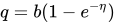





![{\displaystyle z^{\star }=[3+\eta -(\eta ^{2}+2\eta +5)^{1/2}]/(2\eta ).}](https://wikimedia.org/api/rest_v1/media/math/render/svg/e3e0f64c863bd96f25d4c0c3cb3ab81ee245671a)


