Pure states
Let 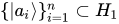 and
and  be orthonormal bases for
  and
and  , respectively. A basis for
  is then
  , or in more compact notation
  . From the very definition of the tensor product, any vector of norm 1, i.e. a pure state of the composite system, can be written as

where  is a constant.
If
is a constant.
If  can be written as a simple tensor, that is, in the form
  with
with  a pure state in the i-th space, it is said to be a product state, and, in particular, separable. Otherwise it is called entangled. Note that, even though the notions of product and separable states coincide for pure states, they do not in the more general case of mixed states.
Pure states are entangled if and only if their partial states are not pure. To see this, write the Schmidt decomposition of as
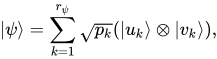
where  are positive real numbers,
  is the Schmidt rank of , and
 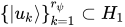 and
and 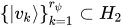 are sets of orthonormal states in and , respectively.
The state is entangled if and only if
are sets of orthonormal states in and , respectively.
The state is entangled if and only if  . At the same time, the partial state has the form
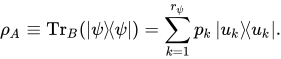
It follows that  is pure --- that is, is projection with unit-rank --- if and only if
  , which is equivalent to being separable.
Physically, this means that it is not possible to assign a definite (pure) state to the subsystems, which instead ought to be described as statistical ensembles of pure states, that is, as density matrices. A pure state  is thus entangled if and only if the von Neumann entropy of the partial state
 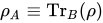 is nonzero.
Formally, the embedding of a product of states into the product space is given by the Segre embedding.[1] That is, a quantum-mechanical pure state is separable if and only if it is in the image of the Segre embedding.
For example, in a two-qubit space, where 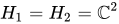 , the states
  ,
,  ,
,  , are all product (and thus separable) pure states, as is
  with
with  . On the other hand, states like
 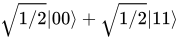 or
or 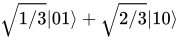 are not separable.
Mixed states
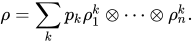
Consider the mixed state case. A mixed state of the composite system is described by a density matrix  acting on . Such a state is separable if there exist
  ,
,  and
and  which are mixed states of the respective subsystems such that
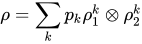
where

Otherwise is called an entangled state. We can assume without loss of generality in the above expression that and are all rank-1 projections, that is, they represent pure ensembles of the appropriate subsystems. It is clear from the definition that the family of separable states is a convex set.
Notice that, again from the definition of the tensor product, any density matrix, indeed any matrix acting on the composite state space, can be trivially written in the desired form, if we drop the requirement that and are themselves states and If these requirements are satisfied, then we can interpret the total state as a probability distribution over uncorrelated product states.
In terms of quantum channels, a separable state can be created from any other state using local actions and classical communication while an entangled state cannot.
When the state spaces are infinite-dimensional, density matrices are replaced by positive trace class operators with trace 1, and a state is separable if it can be approximated, in trace norm, by states of the above form.
If there is only a single non-zero  , then the state can be expressed just as
  and is called simply separable or product state. One property of the product state is that in terms of entropy,