Brief definition
Suppose that X is a topological vector space (TVS) over the field  (which is either the real or complex numbers) whose continuous dual space,
  , separates points on X (i.e. for any
  there exists some
  such that
  ).
Let
).
Let  and
and  both denote the strong dual of X, which is the vector space of continuous linear functionals on X endowed with the topology of uniform convergence on bounded subsets of X;
this topology is also called the strong dual topology and it is the "default" topology placed on a continuous dual space (unless another topology is specified).
If X is a normed space, then the strong dual of X is the continuous dual space with its usual norm topology.
The bidual of X, denoted by
both denote the strong dual of X, which is the vector space of continuous linear functionals on X endowed with the topology of uniform convergence on bounded subsets of X;
this topology is also called the strong dual topology and it is the "default" topology placed on a continuous dual space (unless another topology is specified).
If X is a normed space, then the strong dual of X is the continuous dual space with its usual norm topology.
The bidual of X, denoted by  , is the strong dual of ; that is, it is the space
  .
.
For any  let
let  be defined by
 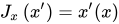 , where
  is called the evaluation map at x;
since
is called the evaluation map at x;
since  is necessarily continuous, it follows that
  .
Since separates points on X, the map
.
Since separates points on X, the map 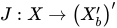 defined by
  is injective where this map is called the evaluation map or the canonical map.
This map was introduced by Hans Hahn in 1927.
is injective where this map is called the evaluation map or the canonical map.
This map was introduced by Hans Hahn in 1927.
We call X semireflexive if is bijective (or equivalently, surjective) and we call X reflexive if in addition  is an isomorphism of TVSs.
If X is a normed space then J is a TVS-embedding as well as an isometry onto its range;
furthermore, by Goldstine's theorem (proved in 1938), the range of J is a dense subset of the bidual
is an isomorphism of TVSs.
If X is a normed space then J is a TVS-embedding as well as an isometry onto its range;
furthermore, by Goldstine's theorem (proved in 1938), the range of J is a dense subset of the bidual  .
A normable space is reflexive if and only if it is semi-reflexive.
A Banach space is reflexive if and only if its closed unit ball is
.
A normable space is reflexive if and only if it is semi-reflexive.
A Banach space is reflexive if and only if its closed unit ball is  -compact.
Detailed definition
Let X be a topological vector space over a number field (of real numbers  or complex numbers
  ).
Consider its strong dual space , which consists of all continuous linear functionals
).
Consider its strong dual space , which consists of all continuous linear functionals  and is equipped with the strong topology
  , that is, the topology of uniform convergence on bounded subsets in X.
The space is a topological vector space (to be more precise, a locally convex space), so one can consider its strong dual space , which is called the strong bidual space for X.
It consists of all
continuous linear functionals
, that is, the topology of uniform convergence on bounded subsets in X.
The space is a topological vector space (to be more precise, a locally convex space), so one can consider its strong dual space , which is called the strong bidual space for X.
It consists of all
continuous linear functionals  and is equipped with the strong topology
 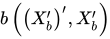 .
Each vector generates a map
.
Each vector generates a map 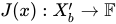 by the following formula:

This is a continuous linear functional on , that is, 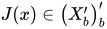 .
One obtains a map called the evaluation map or the canonical injection:
.
One obtains a map called the evaluation map or the canonical injection:
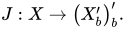
which is a linear map.
If X is locally convex, from the Hahn–Banach theorem it follows that J is injective and open (that is, for each neighbourhood of zero  in X there is a neighbourhood of zero V in such that
  ).
But it can be non-surjective and/or discontinuous.
).
But it can be non-surjective and/or discontinuous.
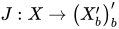
A locally convex space  is called semi-reflexive if the evaluation map
  is surjective (hence bijective); it is called reflexive if the evaluation map is surjective and continuous, in which case J will be an isomorphism of TVSs).


