The ring of integers is the simplest possible ring of integers.[a] Namely, where is the field of rational numbers.[4] And indeed, in algebraic number theory the elements of are often called the "rational integers" because of this.
The ring of integers of an algebraic number field is the unique maximal order in the field. It is always a Dedekind domain.[5]
Properties
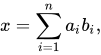
The ring of integers OK is a finitely-generated-module. Indeed, it is a free-module, and thus has an integral basis, that is a basisb1, ..., bn ∈ OK of the -vector spaceK such that each elementx in OK can be uniquely represented as
with .[6] The rankn of OK as a free -module is equal to the degree ofK over .
Examples
Computational tool
A useful tool for computing the integral closure of the ring of integers in an algebraic field is the discriminant. If K is of degree n over , and form a basis of over , set . Then, is a submodule of the -module spanned by .[7]pg. 33 In fact, if d is square-free, then forms an integral basis for .[7]pg. 35
In a ring of integers, every element has a factorization into irreducible elements, but the ring need not have the property of unique factorization: for example, in the ring of integers , the element 6 has two essentially different factorizations into irreducibles:[5][10]
One defines the ring of integers of a non-archimedean local fieldF as the set of all elements of F with absolute value ≤1; this is a ring because of the strong triangle inequality.[13] If F is the completion of an algebraic number field, its ring of integers is the completion of the latter's ring of integers. The ring of integers of an algebraic number field may be characterised as the elements which are integers in every non-archimedean completion.[4]
Integral closure – gives a technique for computing integral closures
Notes
↑The ring of integers, without specifying the field, refers to the ring of "ordinary" integers, the prototypical object for all those rings. It is a consequence of the ambiguity of the word "integer" in abstract algebra.
Citations
↑Marcus, Daniel A. (2018). Number fields. Universitext. Emanuele Sacco (2nded.). Cham: Springer. ISBN978-3-319-90232-6.





![{\displaystyle \mathbb {Z} [i]}](https://wikimedia.org/api/rest_v1/media/math/render/svg/9ffa94e9e2e6d9e5e5373d5fafb954b902743fde)








![{\displaystyle {\mathcal {O}}_{K}=\mathbb {Z} [\zeta ]}](https://wikimedia.org/api/rest_v1/media/math/render/svg/dd0b8759ac5da256f6a1af091437bffac42c2b7d)




![{\displaystyle \mathbb {Z} [{\sqrt {-5}}]}](https://wikimedia.org/api/rest_v1/media/math/render/svg/a37499ef27234d8a67a65932184280bb17301312)
