Single homogeneous resource, general utilities
Suppose society has  units of some homogeneous divisible resource, such as water or flour. The resource should be divided among
  agents with different utilities. The utility of agent
  is represented by a function
  ; when agent receives
  units of resource, he derives from it a utility of
  . Society has to decide how to divide the resource among the agents, i.e, to find a vector
  such that:
  .
.
Two classic allocation rules are the egalitarian rule - aiming to equalize the utilities of all agents (equivalently: maximize the minimum utility), and the utilitarian rule - aiming to maximize the sum of utilities.
The egalitarian rule is always RM:[1]: 47 when there is more resource to share, the minimum utility that can be guaranteed to all agents increases, and all agents equally share the increase. In contrast, the utilitarian rule might be not RM.
For example, suppose there are two agents, Alice and Bob, with the following utilities:
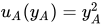
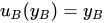
The egalitarian allocation is found by solving the equation: 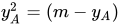 , which is equivalent to
 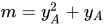 , so
, so  is monotonically increasing with . An equivalent equation is:
  , which is equivalent to
  , so
, so  too is monotonically increasing with . So in this example (as always) the egalitarian rule is RM.
In contrast, the utilitarian rule is not RM. This is because Alice has increasing returns: her marginal utility is small when she has few resources, but it increases fast when she has many resources. Hence, when the total amount of resource is small (specifically,  ), the utilitarian sum is maximized when all resources are given to Bob; but when there are many resources (
 ), the maximum is attained when all resources are given to Alice. Mathematically, if
  is the amount given to Alice, then the utilitarian sum is
 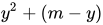 . This function has only an internal minimum point but not an internal maximum point; its maximum point in the range
 ![{\displaystyle [0,m]}](https://wikimedia.org/api/rest_v1/media/math/render/svg/1be36490b34e5d66e9566fa907c0e78fb3cd4540) is attained in one of the endpoints. It is the left endpoint when and the right endpoint when . In general, the utilitarian allocation rule is RM when all agents have diminishing returns, but it may be not RM when some agents have increasing returns (as in the example).[1]: 46–47
is attained in one of the endpoints. It is the left endpoint when and the right endpoint when . In general, the utilitarian allocation rule is RM when all agents have diminishing returns, but it may be not RM when some agents have increasing returns (as in the example).[1]: 46–47
Thus, if society uses the utilitarian rule to allocate resources, then Bob loses value when the amount of resources increases. This is bad because it gives Bob an incentive against economic growth: Bob will try to keep the total amount small in order to keep his own share large.
Two complementary resources, Leontief utilities
Consider a cloud server with some units of RAM and CPU. There are two users with different types of tasks:
- The tasks of Alice need 1 unit of RAM and 2 units of CPU;
- The tasks of Bob need 2 units of RAM and 1 unit of CPU.
Thus, the utility functions (=number of tasks), denoting RAM by r and CPU by c, are Leontief utilities:


If the server has 12 RAM and 12 CPU, then both the utilitarian and the egalitarian allocations (and also the Nash-optimal, max-product allocation) are:


Now, suppose 12 more units of CPU become available. The egalitarian allocation does not change, but the utilitarian allocation now gives all resources to Alice:


so Bob loses value from the increase in resources.
The Nash-optimal (max-product) allocation becomes:


so Bob loses value here too, but the loss is less severe.[1]: 83–84