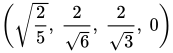
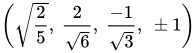
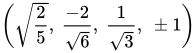
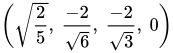
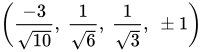
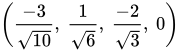
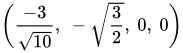
ENSIKLOPEDIA Cari Tekan Enter untuk memulai pencarian cepat. Kembali ke Ensiklopedia Arsip Wikipedia Indonesia Rectified 5-cell Rectified 5-cellUniform polychoron Rectified 5-cell Schlegel diagram with the 5 tetrahedral cells shown. Type Uniform 4-polytope Schläfli symbol t1{3,3,3} or r{3,3,3}{32,1} = { 3 3 , 3 } {\displaystyle \left\{{\begin{array}{l}3\\3,3\end{array}}\right\}} Coxeter-Dynkin diagram Cells 10 5 {3,3} 5 3.3.3.3 Faces 30 {3} Edges 30 Vertices 10 Vertex figure Triangular prism Symmetry group A4, [3,3,3], order 120 Petrie polygon Pentagon Properties convex, isogonal, isotoxal Uniform index 1 2 3 The 10 vertices, and 10 of the triangle faces represent a self dual symmetric Desargues configuration, (103), seen here perspective projected into 3-dimensions, with 2 colors of vertices and triangles within the projected tetrahedral symmetry. It has the full 120 automorphisms of the rectified 5-cell. In four-dimensional geometry, the rectified 5-cell is a uniform 4-polytope composed of 5 regular tetrahedral and 5 regular octahedral cells. Each edge has one tetrahedron and two octahedra. Each vertex has two tetrahedra and three octahedra. In total it has 30 triangle faces, 30 edges, and 10 vertices. Each vertex is surrounded by 3 octahedra and 2 tetrahedra; the vertex figure is a triangular prism. Topologically, under its highest symmetry, [3,3,3], there is only one geometrical form, containing 5 regular tetrahedra and 5 rectified tetrahedra (which is geometrically the same as a regular octahedron). It is also topologically identical to a tetrahedron-octahedron segmentochoron.[clarification needed] The vertex figure of the rectified 5-cell is a uniform triangular prism, formed by three octahedra around the sides, and two tetrahedra on the opposite ends.[1] Despite having the same number of vertices as cells (10) and the same number of edges as faces (30), the rectified 5-cell is not self-dual because the vertex figure (a uniform triangular prism) is not a dual of the polychoron's cells. Wythoff construction Seen in a configuration matrix, all incidence counts between elements are shown. The diagonal f-vector numbers are derived through the Wythoff construction, dividing the full group order of a subgroup order by removing one mirror at a time.[2] A4 k-facefkf0f1f2f3k-figure Notes A1A2( ) f0 1063632{3}x{ }A4/A1A2 = 5!/3!/2 = 10 A1A1{ } f1 2301221{ }v( )A4/A1A1 = 5!/2/2 = 30 A2A1{3} f2 3310*20{ }A4/A2A1 = 5!/3!/2 = 10 A2 33*2011A4/A2 = 5!/3! = 20 A3r{3,3} f3 612445*( )A4/A3 = 5!/4! = 5 A3{3,3} 4604*5 Structure Together with the simplex and 24-cell, this shape and its dual (a polytope with ten vertices and ten triangular bipyramid facets) was one of the first 2-simple 2-simplicial 4-polytopes known. This means that all of its two-dimensional faces, and all of the two-dimensional faces of its dual, are triangles. In 1997, Tom Braden found another dual pair of examples, by gluing two rectified 5-cells together; since then, infinitely many 2-simple 2-simplicial polytopes have been constructed.[3][4] Semiregular polytope It is one of three semiregular 4-polytopes made of two or more cells which are Platonic solids, discovered by Thorold Gosset in his 1900 paper. He called it a tetroctahedric for being made of tetrahedron and octahedron cells.[5] E. L. Elte identified it in 1912 as a semiregular polytope, labeling it as tC5. Alternate names Tetroctahedric (Thorold Gosset) Dispentachoron Rectified 5-cell (Norman W. Johnson) Rectified 4-simplex Fully truncated 4-simplex Rectified pentachoron (Acronym: rap) (Jonathan Bowers)[2] Ambopentachoron (Neil Sloane & John Horton Conway) (5,2)-hypersimplex (the convex hull of five-dimensional (0,1)-vectors with exactly two ones) Images Orthographic projections AkCoxeter plane A4 A3 A2 Graph Dihedral symmetry [5] [4] [3] stereographic projection(centered on octahedron) Net (polytope) Tetrahedron-centered perspective projection into 3D space, with nearest tetrahedron to the 4D viewpoint rendered in red, and the 4 surrounding octahedra in green. Cells lying on the far side of the polytope have been culled for clarity (although they can be discerned from the edge outlines). The rotation is only of the 3D projection image, in order to show its structure, not a rotation in 4D space. Coordinates The Cartesian coordinates of the vertices of an origin-centered rectified 5-cell having edge length 2 are: Coordinates ( 2 5 , 2 6 , 2 3 , 0 ) {\displaystyle \left({\sqrt {\frac {2}{5}}},\ {\frac {2}{\sqrt {6}}},\ {\frac {2}{\sqrt {3}}},\ 0\right)} ( 2 5 , 2 6 , − 1 3 , ± 1 ) {\displaystyle \left({\sqrt {\frac {2}{5}}},\ {\frac {2}{\sqrt {6}}},\ {\frac {-1}{\sqrt {3}}},\ \pm 1\right)} ( 2 5 , − 2 6 , 1 3 , ± 1 ) {\displaystyle \left({\sqrt {\frac {2}{5}}},\ {\frac {-2}{\sqrt {6}}},\ {\frac {1}{\sqrt {3}}},\ \pm 1\right)} ( 2 5 , − 2 6 , − 2 3 , 0 ) {\displaystyle \left({\sqrt {\frac {2}{5}}},\ {\frac {-2}{\sqrt {6}}},\ {\frac {-2}{\sqrt {3}}},\ 0\right)} ( − 3 10 , 1 6 , 1 3 , ± 1 ) {\displaystyle \left({\frac {-3}{\sqrt {10}}},\ {\frac {1}{\sqrt {6}}},\ {\frac {1}{\sqrt {3}}},\ \pm 1\right)} ( − 3 10 , 1 6 , − 2 3 , 0 ) {\displaystyle \left({\frac {-3}{\sqrt {10}}},\ {\frac {1}{\sqrt {6}}},\ {\frac {-2}{\sqrt {3}}},\ 0\right)} ( − 3 10 , − 3 2 , 0 , 0 ) {\displaystyle \left({\frac {-3}{\sqrt {10}}},\ -{\sqrt {\frac {3}{2}}},\ 0,\ 0\right)} More simply, the vertices of the rectified 5-cell can be positioned on a hyperplane in 5-space as permutations of (0,0,0,1,1) or (0,0,1,1,1). These construction can be seen as positive orthant facets of the rectified pentacross or birectified penteract respectively. Related 4-polytopes The rectified 5-cell is the vertex figure of the 5-demicube, and the edge figure of the uniform 221 polytope. Compound of the rectified 5-cell and its dual The convex hull the rectified 5-cell and its dual (of the same long radius) is a nonuniform polychoron composed of 30 cells: 10 tetrahedra, 20 octahedra (as triangular antiprisms), and 20 vertices. Its vertex figure is a triangular bifrustum. Pentachoron polytopes The rectified 5-cell is one of 9 Uniform 4-polytopes constructed from the [3,3,3] Coxeter group. Name 5-cell truncated 5-cell rectified 5-cell cantellated 5-cell bitruncated 5-cell cantitruncated 5-cell runcinated 5-cell runcitruncated 5-cell omnitruncated 5-cell Schläflisymbol {3,3,3}3r{3,3,3} t{3,3,3}3t{3,3,3} r{3,3,3}2r{3,3,3} rr{3,3,3}r2r{3,3,3} 2t{3,3,3} tr{3,3,3}t2r{3,3,3} t0,3{3,3,3} t0,1,3{3,3,3}t0,2,3{3,3,3} t0,1,2,3{3,3,3} Coxeterdiagram Schlegeldiagram A4Coxeter planeGraph A3 Coxeter planeGraph A2 Coxeter planeGraph Semiregular polytopes The rectified 5-cell is second in a dimensional series of semiregular polytopes. Each progressive uniform polytope is constructed as the vertex figure of the previous polytope. Thorold Gosset identified this series in 1900 as containing all regular polytope facets, containing all simplexes and orthoplexes (tetrahedrons and octahedrons in the case of the rectified 5-cell). The Coxeter symbol for the rectified 5-cell is 021. k21 figures in n dimensions Space Finite Euclidean Hyperbolic En 3 4 5 6 7 8 9 10 Coxetergroup E3=A2A1 E4=A4 E5=D5 E6 E7 E8 E9 = E ~ 8 {\displaystyle {\tilde {E}}_{8}} = E8+ E10 = T ¯ 8 {\displaystyle {\bar {T}}_{8}} = E8++ Coxeterdiagram Symmetry [3−1,2,1] [30,2,1] [31,2,1] [32,2,1] [33,2,1] [34,2,1] [35,2,1] [36,2,1] Order 12 120 1,920 51,840 2,903,040 696,729,600 ∞ Graph - - Name −121 021 121 221 321 421 521 621 Isotopic polytopes Isotopic uniform truncated simplices Dim. 2 3 4 5 6 7 8 NameCoxeter Hexagon = t{3} = {6} Octahedron = r{3,3} = {31,1} = {3,4} { 3 3 } {\displaystyle \left\{{\begin{array}{l}3\\3\end{array}}\right\}} Decachoron2t{33} Dodecateron2r{34} = {32,2} { 3 , 3 3 , 3 } {\displaystyle \left\{{\begin{array}{l}3,3\\3,3\end{array}}\right\}} Tetradecapeton3t{35} Hexadecaexon3r{36} = {33,3} { 3 , 3 , 3 3 , 3 , 3 } {\displaystyle \left\{{\begin{array}{l}3,3,3\\3,3,3\end{array}}\right\}} Octadecazetton4t{37} Images Vertex figure ( )∨( ) { }×{ } { }∨{ } {3}×{3} {3}∨{3} {3,3}×{3,3} {3,3}∨{3,3} Facets {3} t{3,3} r{3,3,3} 2t{3,3,3,3} 2r{3,3,3,3,3} 3t{3,3,3,3,3,3} Asintersectingdualsimplexes ∩ ∩ ∩ ∩ ∩ ∩ ∩ Notes ↑ Conway, 2008 1 2 Klitzing, Richard. "o3x4o3o - rap". ↑ Eppstein, David; Kuperberg, Greg; Ziegler, Günter M. (2003), "Fat 4-polytopes and fatter 3-spheres", in Bezdek, Andras (ed.), Discrete Geometry: In honor of W. Kuperberg's 60th birthday, Pure and Applied Mathematics, vol. 253, pp. 239–265, arXiv:math.CO/0204007. ↑ Paffenholz, Andreas; Ziegler, Günter M. (2004), "The Et-construction for lattices, spheres and polytopes", Discrete & Computational Geometry, 32 (4): 601–621, arXiv:math.MG/0304492, doi:10.1007/s00454-004-1140-4, MR 2096750, S2CID 7603863. ↑ Gosset, 1900 References T. Gosset: On the Regular and Semi-Regular Figures in Space of n Dimensions, Messenger of Mathematics, Macmillan, 1900 J.H. Conway and M.J.T. Guy: Four-Dimensional Archimedean Polytopes, Proceedings of the Colloquium on Convexity at Copenhagen, page 38 and 39, 1965 H.S.M. Coxeter: H.S.M. Coxeter, Regular Polytopes, 3rd Edition, Dover New York, 1973 Kaleidoscopes: Selected Writings of H.S.M. Coxeter, edited by F. Arthur Sherk, Peter McMullen, Anthony C. Thompson, Asia Ivic Weiss, Wiley-Interscience Publication, 1995, wiley.com, ISBN 978-0-471-01003-6 (Paper 22) H.S.M. Coxeter, Regular and Semi-Regular Polytopes I, [Math. Zeit. 46 (1940) 380–407, MR 2,10] (Paper 23) H.S.M. Coxeter, Regular and Semi-Regular Polytopes II, [Math. Zeit. 188 (1985) 559–591] (Paper 24) H.S.M. Coxeter, Regular and Semi-Regular Polytopes III, [Math. Zeit. 200 (1988) 3–45] Norman Johnson Uniform Polytopes, Manuscript (1991) N.W. Johnson: The Theory of Uniform Polytopes and Honeycombs, Ph.D. (1966) John H. Conway, Heidi Burgiel, Chaim Goodman-Strauss, The Symmetries of Things 2008, ISBN 978-1-56881-220-5 (Chapter 26) External links Rectified 5-cell - data and images 1. Convex uniform polychora based on the pentachoron - Model 2, George Olshevsky. Klitzing, Richard. "4D uniform polytopes (polychora) x3o3o3o - rap". vteFundamental convex regular and uniform polytopes in dimensions 2–10 Family An Bn I2(p) / Dn E6 / E7 / E8 / F4 / G2 Hn Regular polygon Triangle Square p-gon Hexagon Pentagon Uniform polyhedron Tetrahedron Octahedron • Cube Demicube Dodecahedron • Icosahedron Uniform polychoron Pentachoron 16-cell • Tesseract Demitesseract 24-cell 120-cell • 600-cell Uniform 5-polytope 5-simplex 5-orthoplex • 5-cube 5-demicube Uniform 6-polytope 6-simplex 6-orthoplex • 6-cube 6-demicube 122 • 221 Uniform 7-polytope 7-simplex 7-orthoplex • 7-cube 7-demicube 132 • 231 • 321 Uniform 8-polytope 8-simplex 8-orthoplex • 8-cube 8-demicube 142 • 241 • 421 Uniform 9-polytope 9-simplex 9-orthoplex • 9-cube 9-demicube Uniform 10-polytope 10-simplex 10-orthoplex • 10-cube 10-demicube Uniform n-polytope n-simplex n-orthoplex • n-cube n-demicube 1k2 • 2k1 • k21 n-pentagonal polytope Topics: Polytope families • Regular polytope • List of regular polytopes and compounds • Polytope operations