Usage
As the term "range" can have different meanings, it is considered a good practice to define it the first time it is used in a textbook or article. Older books, when they use the word "range", tend to use it to mean what is now called the codomain. More modern books, if they use the word "range" at all, generally use it to mean what is now called the image. To avoid any confusion, a number of modern books don't use the word "range" at all.
Elaboration and example
Given a function

with domain  , the range of
  , sometimes denoted
  or
or  ,[4] may refer to the codomain or target set
  (i.e., the set into which all of the output of is constrained to fall), or to
  , the image of the domain of under (i.e., the subset of consisting of all actual outputs of ). The image of a function is always a subset of the codomain of the function.[5]
As an example of the two different usages, consider the function  as it is used in real analysis (that is, as a function that inputs a real number and outputs its square). In this case, its codomain is the set of real numbers
  , but its image is the set of non-negative real numbers
  , since
  is never negative if
  is real. For this function, if we use "range" to mean codomain, it refers to
  ; if we use "range" to mean image, it refers to .
For some functions, the image and the codomain coincide; these functions are called surjective or onto. For example, consider the function  which inputs a real number and outputs its double. For this function, both the codomain and the image are the set of all real numbers, so the word range is unambiguous.
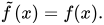
Even in cases where the image and codomain of a function are different, a new function can be uniquely defined with its codomain as the image of the original function. For example, as a function from the integers to the integers, the doubling function  is not surjective because only the even integers are part of the image. However, a new function
  whose domain is the integers and whose codomain is the even integers is surjective. For
  the word range is unambiguous.