In 1834, Théophile-Jules Pelouze distilled tartaric acid and isolated glutaric acid and another unknown organic acid. Jöns Jacob Berzelius characterized this other acid the following year and named pyruvic acid because it was distilled using heat.[5][6] The correct molecular structure was deduced by the 1870s.[7]
Pyruvic acid crystallizes as the keto acid, not the enol. The six non-hydrogen atoms are nearly coplanar. More relevant to biochemistry is the structure of the pyruvate anion. Several salts of pyruvate have been examined by X-ray crystallography. These tests confirm that pyruvate anion also exists in the keto form.[9][10]
Reactivity
As a simple, abundant and bifunctional compound, pyruvic acid has been shown to participate in many reactions.
Pyruvate reacts with amino acids to give alanine by the process called transamination:
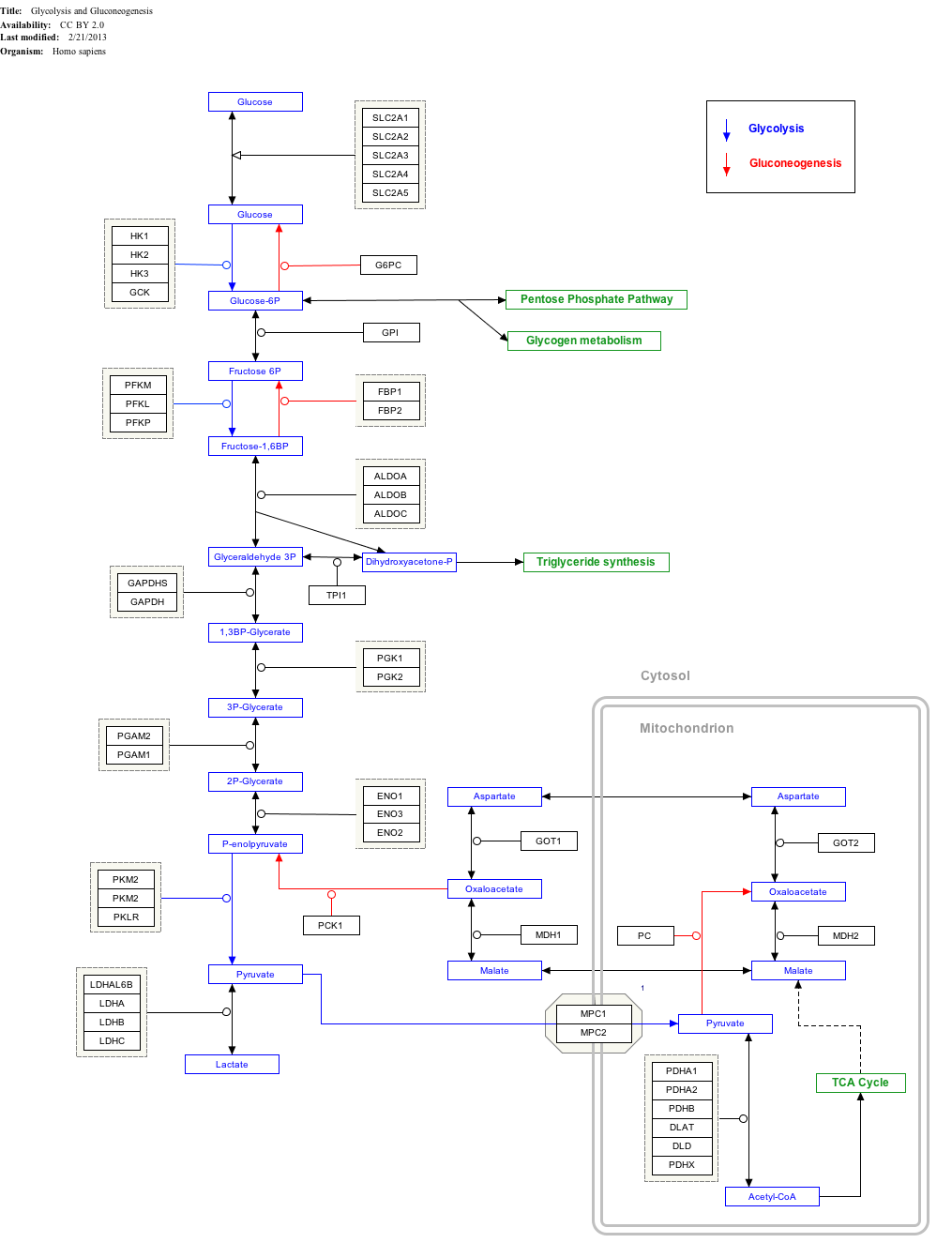
Pyruvate is important in biochemistry. It is the output of the metabolism of glucose known as glycolysis.[14] One molecule of glucose breaks down into two molecules of pyruvate,[14] which are then used to provide further energy, in one of two ways. Pyruvate is converted into acetyl-coenzyme A, which is the main input for a series of reactions known as the Krebs cycle (also known as the citric acid cycle or tricarboxylic acid cycle). Pyruvate is also converted to oxaloacetate by an anaplerotic reaction, which replenishes Krebs cycle intermediates; also, the oxaloacetate is used for gluconeogenesis.[15]
These reactions are named after Hans Adolf Krebs, the biochemist awarded the 1953 Nobel Prize for physiology, jointly with Fritz Lipmann, for research into metabolic processes. The cycle is also known as the citric acid cycle or tricarboxylic acid cycle, because citric acid is one of the intermediate compounds formed during the reactions.[citation needed]
Aside from its major role in the functioning of living organisms, pyruvic acid is of interest as a reagent in the synthesis of specialized organic compounds as discussed above in the reactivity section.[13]
↑"Pyruvic acid". Journal of the Chemical Society, Abstracts. 34: 31. 1878. doi:10.1039/CA8783400019.Berzelius, J. J. (1835). "Ueber die Destillationsproducte der Traubensäure" [About the Distillation of Grape Acid (Tartaric Acid)]. Annalen der Physik. 112 (9): 1–29. doi:10.1002/andp.18351120902.
↑Rach, W.; Kiel, G.; Gattow, G. (1988). "Über Chalkogenolate. 187. Untersuchungen über Salze der Pyruvinsäure 2. Kristallstruktur von Kaliumpyruvat, Neubestimmung der Struktur von Natriumpyruvat". Zeitschrift für Anorganische und Allgemeine Chemie. 563: 87–95. doi:10.1002/zaac.19885630113.
↑Perkins, Russell J.; Shoemaker, Richard K.; Carpenter, Barry K.; Vaida, Veronica (2016). "Chemical Equilibria and Kinetics in Aqueous Solutions of Zymonic Acid". The Journal of Physical Chemistry A. 120 (51): 10096–10107. doi:10.1021/acs.jpca.6b10526. PMID27991786.