An integer function is Presburger-definable if and only if it is piecewise linear on a semilinear partition of its domain, with each linear piece having a periodic component.
Muchnik's characterization
Presburger-definable relations admit another characterization: by Muchnik's theorem. It is more complicated to state, but led to the proof of the two former characterizations. Before Muchnik's theorem can be stated, some additional definitions must be introduced.
Let  be a set, the section
  of
of  , for
, for  and
and  is defined as

Given two sets  and a
and a  -tuple of integers
  , the set is called
 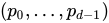 -periodic in
  if, for all
  such that
  then
then  if and only if
  . For
. For  , the set is said to be
  -periodic in if it is
 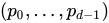 -periodic for some
  such that

Finally, for  let
let

denote the cube of size  whose lesser corner is
 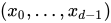 .
.
Muchnik's Theorem— is Presburger-definable if and only if:
- if
 then all sections of are Presburger-definable and
- there exists such that, for every
 , there exists
  such that for all
  with
with  is -periodic in
  .
.
Intuitively, the integer represents the length of a shift, the integer is the size of the cubes and  is the threshold before the periodicity. This result remains true when the condition

is replaced either by  or by
or by  .
.
This characterization led to the so-called "definable criterion for definability in Presburger arithmetic", that is: there exists a first-order formula with addition and a -ary predicate that holds if and only if is interpreted by a Presburger-definable relation. Muchnik's theorem also allows one to prove that it is decidable whether an automatic sequence accepts a Presburger-definable set.





