Under controlled conditions (typically in a laboratory) a laminar flame may be formed in one of several possible flame configurations. The inner structure of a laminar premixed flame is composed of layers over which the decomposition, reaction and complete oxidation of fuel occurs. These chemical processes are much faster than the physical processes such as vortex motion in the flow and, hence, the inner structure of a laminar flame remains intact in most circumstances. The constitutive layers of the inner structure correspond to specified intervals over which the temperature increases from the specified unburned mixture up to as high as the adiabatic flame temperature (AFT). In the presence of volumetric heat transfer and/or aerodynamic stretch, or under the development intrinsic flame instabilities, the extent of reaction and, hence, the temperature attained across the flame may be different from the AFT.
Laminar burning velocity
For a one-step irreversible chemistry, i.e.,  , the planar, adiabatic flame has explicit expression for the burning velocity derived from activation energy asymptotics when the Zel'dovich number
  The reaction rate
  (number of moles of fuel consumed per unit volume per unit time) is taken to be Arrhenius form,

where  is the pre-exponential factor,
  is the density,
  is the fuel mass fraction,
  is the oxidizer mass fraction,
  is the activation energy,
  is the universal gas constant,
  is the temperature,
  are the molecular weights of fuel and oxidizer, respectively and
  are the reaction orders. Let the unburnt conditions far ahead of the flame be denoted with subscript
  and similarly, the burnt gas conditions by
  , then we can define an equivalence ratio
  for the unburnt mixture as
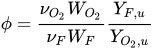 .
.
Then the planar laminar burning velocity for fuel-rich mixture ( ) is given by[2][3]

where

and  . Here
  is the thermal conductivity,
  is the specific heat at constant pressure and
  is the Lewis number. Similarly one can write the formula for lean
  mixtures. This result is first obtained by T. Mitani in 1980.[4] Second order correction to this formula with more complicated transport properties were derived by Forman A. Williams and co-workers in the 80s.[5][6][7]
Variations in local propagation speed of a laminar flame arise due to what is called flame stretch. Flame stretch can happen due to the straining by outer flow velocity field or the curvature of flame; the difference in the propagation speed from the corresponding laminar speed is a function of these effects and may be written as:
[8][9]

where  is the unit normal to the flame surface (pointing towards the burnt gas side),
  is the flow velocity field evaluated at the flame surface and
  is the surface divergence of the tangential velocity
  ; with flow being incompressible outside the flame,
  . Moreover,
  and
and  are the two Markstein numbers, associated with the curvature and tangential straining.[10]


