Besides spaces, a variety of function spaces arising naturally in analysis are Orlicz spaces. One such space is , which arises in the study of Hardy–Littlewood maximal functions, consisting of measurable functions such that
Here is the positive part of the logarithm. Also included in the class of Orlicz spaces are many of the most important Sobolev spaces. In addition, the Orlicz sequence spaces are examples of Orlicz spaces.
Terminology
These spaces are called Orlicz spaces because Władysław Orlicz was the first who introduced them, in 1932.[1] Some mathematicians, including Wojbor Woyczyński, Edwin Hewitt and Vladimir Mazya, include the name of Zygmunt Birnbaum as well, referring to his earlier joint work with Władysław Orlicz. However in the Birnbaum–Orlicz paper the Orlicz space is not introduced, neither explicitly nor implicitly, hence the name Orlicz space is preferred. By the same reasons this convention has been also openly criticized by another mathematician (and an expert in the history of Orlicz spaces), Lech Maligranda.[2] Orlicz was confirmed as the person who introduced Orlicz spaces already by Stefan Banach in his 1932 monograph.[3]
Definition
Let be a σ-finite measure on a set , and a Young function; i.e., a convex, lower semicontinuous, and non-trivial function. Non-trivial in the sense that it is neither the zero function nor the convex dual of the zero function
Now let be the set of measurable functions such that the integral
is finite, where, as usual, functions that agree almost everywhere are identified.
This is not necessarily a vector space (for example, it might fail to be closed under scalar multiplication). The Orlicz space, denoted , is the vector space of functions spanned by ; that is, the smallest linear space containing . Formally,
There is another Orlicz space, the small Orlicz space, defined by
In other words, it is the largest linear space contained in .
Norm
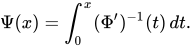
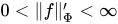
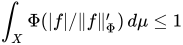
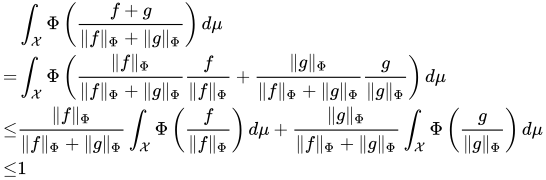
To define a norm on , let be the complementary Young function to ; i.e.,
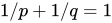
For any , space is an Orlicz space with Orlicz function . Here
When , the small and the large Orlicz spaces for are equal: .
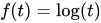
For an example where is not a vector space, and is strictly smaller than , let be the open unit interval , , and . Then is in the space for all but is only in if .
This is the analytical content of the Trudinger inequality: For open and bounded with Lipschitz boundary , consider the space with and . Then there exist constants such that
Orlicz norm of a random variable
Similarly, the Orlicz norm of a random variable characterizes it as follows:
This norm is homogeneous and is defined only when this set is non-empty.
When , this coincides with the p-th moment of the random variable. Other special cases in the exponential family are taken with respect to the functions (for ). A random variable with finite norm is said to be "sub-Gaussian" and a random variable with finite norm is said to be "sub-exponential". Indeed, the boundedness of the norm characterizes the limiting behavior of the probability distribution function:
so that the tail of the probability distribution function is bounded above by .
The norm may be easily computed from a strictly monotonic moment-generating function. For example, the moment-generating function of a chi-squared random variable X with K degrees of freedom is , so that the reciprocal of the norm is related to the functional inverse of the moment-generating function:
↑Lech Maligranda, Osiągnięcia polskich matematyków w teorii interpolacji operatorów: 1910–1960, 2015, „Wiadomości matematyczne”, 51, 239-281 (in Polish).
↑Stefan Banach, 1932, Théorie des opérations linéaires, Warszawa (p.202)
↑Rao, M.M.; Ren, Z.D. (1991). Theory of Orlicz Spaces. Pure and Applied Mathematics. Marcel Dekker. ISBN0-8247-8478-2.
Rao, M.M.; Ren, Z.D. (1991). Theory of Orlicz Spaces. Pure and Applied Mathematics. Marcel Dekker. ISBN0-8247-8478-2. Contains properties of Orlicz spaces over general spaces with general measures, including many pathological examples.
Rubshtein, Ben-Zion A.; Grabarnik, Genady Ya; Muratov, Mustafa A.; Pashkova, Yulia S. (2016-12-20). Foundations of Symmetric Spaces of Measurable Functions: Lorentz, Marcinkiewicz and Orlicz Spaces (1sted.). New York, NY: Springer. ISBN978-3-319-42756-0.





![{\displaystyle \Phi :[0,\infty )\to [0,\infty ]}](https://wikimedia.org/api/rest_v1/media/math/render/svg/86046f660d6226f9ed7090ae74cd07e190ed097e)






![{\displaystyle p\in [1,\infty ]}](https://wikimedia.org/api/rest_v1/media/math/render/svg/97b602ff0617b1b60e63d22200cad684dc5b26a0)

![{\displaystyle t^{\infty }={\begin{cases}0&{\text{ if }}t\in [0,1],\\+\infty &{\text{ else.}}\end{cases}}}](https://wikimedia.org/api/rest_v1/media/math/render/svg/279d556e51c69b1b1ef5abbedb12b15374ade07b)















![{\displaystyle \|X\|_{\Psi }\triangleq \inf \left\{k\in (0,\infty )\mid \operatorname {E} [\Psi (|X|/k)]\leq 1\right\}.}](https://wikimedia.org/api/rest_v1/media/math/render/svg/a4fe8ac4f94daa05e2b485e12a4f670bcfe911e6)









