Israel
The 1979 Camp David Accords, which established peace between Egypt and Israel, mandates that the Sinai must remain demilitarized.
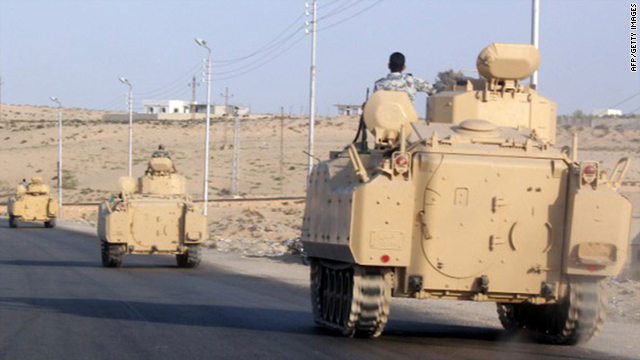
During the beginning of the operation in 2011, Israel allowed the deployment of thousands of troops in the Sinai, with helicopters and armored vehicles, but not tanks.[34]
During the beginning of August 2012, when Operation Eagle intensified, Israel approved a request from Barak to allow Egypt to deploy attack helicopters in the Sinai.[38]
However, concern began to be raised as Egypt began deploying more force and tanks without coordination from Israel. On 21 August, Israeli foreign minister Avigdor Lieberman said that it is important for Israel to make sure that the Egyptian-Israeli peace treaty is upheld, and not to remain silent as Egyptian military forces enter the Sinai. Concern was raised by Israeli officials over Egyptian failure to notify Israel about the deployment of tanks in the Sinai, which violates the peace treaty. Lieberman said, "We must make sure that every detail is upheld, otherwise we'll find ourselves in a slippery slope as far as the peace treaty is concerned."[39]
On the same day, Israeli daily Maariv reported that Israel sent a message to Egypt via the White House, protesting Egypt's ongoing increase in military presence in the Sinai without coordination from Israel, and telling Egypt that it must remove tanks from the Sinai because their presence violates the Egyptian-Israeli peace treaty of 1979, which states that Sinai Peninsula is to remain demilitarized. The Israeli daily Maariv reported was reinforced by an article in The New York Times, which stated that Israel was "troubled" by the entry of Egyptian tanks into the northern Sinai Peninsula without coordination with Israel and had asked Egypt to withdraw them.[40] Partly due to Egypt's military deploying tanks in the Sinai Peninsula, Israel is increasingly worried about what has long been their most critical regional relationship.[41] The lack of coordination around their deployment is seen as potentially undermining a peace treaty that has been a cornerstone of Israel's security for decades according to the New York Times.[41] Israel is also concerned that Egypt may use Operation Eagle to build up its military presence in the Sinai, and leave the tanks and armored carriers in the Sinai while not doing much more than symbolic action to eliminate the terrorist threat.[42]
Israel has not issued a formal complaint, and instead prefers to resolve the issue through quiet contacts, as well as mediation from the U.S., to avoid straining its relationship with Egypt.[43]
On 24 August 2012, a senior Egyptian military source said that Egyptian Defense Minister Abdel Fattah el-Sissi and Israeli Defense Minister Ehud Barak have reached an agreement on the issue of the militarization of the Sinai. Al Hayat reported that Sissi phoned Barak and said that Egypt was committed to maintaining the peace treaty with Israel.[44] Sissi also said that the militarization was temporary, and is needed for security and to fight terrorism. However, an Israeli defense official denied that such a conversation took place.[45]
In late August 2012, then Egyptian president Mohamed Morsi said that the security operations do not threaten anyone, and "there should not be any kind of international or regional concerns at all from the presence of Egyptian security forces". Morsi added that the campaign was in "full respect to international treaties". The Egyptian-Israeli peace deal places limits on Egyptian military deployment in the Sinai. Officials in Israel were concerned about Egypt building up heavy armour in Sinai.[46]
On 8 September, an Israeli official confirmed that coordination exists between Israel and Egypt regarding Operation Eagle. Egyptian Military spokesman Ahmed Mohammed Ali had earlier announced that Egypt has been consulting with Israel regarding its security measures in the Sinai.[47]
United States
According to CNN, in a move to increase security in the Sinai, help Morsi, and reassure Israel, U.S. Defense Secretary Leon Panetta offered Egypt classified intelligence-sharing capabilities to help Egypt identify military threats in the area, which he discussed during his recent trips to Egypt and Israel. The technology has been widely used in Iraq and Afghanistan to identify vehicles at great distances. The technology may also be used by the Multinational Force and Observers in Sinai. The United States is also offering increased intelligence sharing, including satellite imagery and drone flights, as well as cellphone intercepts and other communications among militants suspected of plotting attacks.[48]
On 22 August, the State Department urged Egypt to be transparent over Operation Eagle and any security operations in the Sinai. The State Department said that the United States supports Operation Eagle against terrorism, but stressed that Egypt must continue coordination with Israel regarding these operations and military increases in the Sinai, according to the 1979 Camp David Accords.[49] The State Department also called on Egypt to fulfill its obligations under the 1979 Egyptian-Israeli peace treaty and deal strongly with security threats in the Sinai, while ensuring that "lines of communication stay open."[50]
On 23 August, then Secretary of State Hillary Clinton, speaking with Egyptian foreign minister Mohamed Kamel Amr, urged Amr to maintain lines of communication with Israel, and emphasized the importance of being transparent over the militarization of the Sinai.[43]