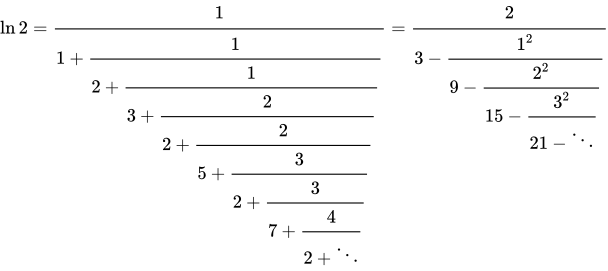
The following continued fraction representation (J.L.Lagrange) gives (asymptotically) 1.53 new correct decimal places per cycle:
[2][3]
or
Bootstrapping other logarithms
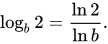
Given a value of ln 2, a scheme of computing the logarithms of other integers is to tabulate the logarithms of the prime numbers and in the next layer the logarithms of the composite numbers c based on their factorizations
In a third layer, the logarithms of rational numbers r = a/b are computed with ln(r) = ln(a) − ln(b), and logarithms of roots via ln n√c = 1/n ln(c).
The logarithm of 2 is useful in the sense that the powers of 2 are rather densely distributed; finding powers 2i close to powers bj of other numbers b is comparatively easy, and series representations of ln(b) are found by coupling 2 to b with logarithmic conversions.
Example
If ps = qt + d with some small d, then ps/qt = 1 + d/qt and therefore
Selecting q = 2 represents ln p by ln 2 and a series of a parameter d/qt that one wishes to keep small for quick convergence. Taking 32 = 23 + 1, for example, generates
This is actually the third line in the following table of expansions of this type:
s
p
t
q
d/qt
1
3
1
2
1/2 = −0.50000000…
1
3
2
2
−1/4 = −0.25000000…
2
3
3
2
1/8 = −0.12500000…
5
3
8
2
−13/256 = −0.05078125…
12
3
19
2
7153/524288 = −0.01364326…
1
5
2
2
1/4 = −0.25000000…
3
5
7
2
−3/128 = −0.02343750…
1
7
2
2
3/4 = −0.75000000…
1
7
3
2
−1/8 = −0.12500000…
5
7
14
2
423/16384 = −0.02581787…
1
11
3
2
3/8 = −0.37500000…
2
11
7
2
−7/128 = −0.05468750…
11
11
38
2
10433763667/274877906944 = −0.03795781…
1
13
3
2
5/8 = −0.62500000…
1
13
4
2
−3/16 = −0.18750000…
3
13
11
2
149/2048 = −0.07275391…
7
13
26
2
−4360347/67108864 = −0.06497423…
10
13
37
2
419538377/137438953472 = −0.00305254…
1
17
4
2
1/16 = −0.06250000…
1
19
4
2
3/16 = −0.18750000…
4
19
17
2
−751/131072 = −0.00572968…
1
23
4
2
7/16 = −0.43750000…
1
23
5
2
−9/32 = −0.28125000…
2
23
9
2
17/512 = −0.03320312…
1
29
4
2
13/16 = −0.81250000…
1
29
5
2
−3/32 = −0.09375000…
7
29
34
2
70007125/17179869184 = −0.00407495…
1
31
5
2
−1/32 = −0.03125000…
1
37
5
2
5/32 = −0.15625000…
4
37
21
2
−222991/2097152 = −0.10633039…
5
37
26
2
2235093/67108864 = −0.03330548…
1
41
5
2
9/32 = −0.28125000…
2
41
11
2
−367/2048 = −0.17919922…
3
41
16
2
3385/65536 = −0.05165100…
1
43
5
2
11/32 = −0.34375000…
2
43
11
2
−199/2048 = −0.09716797…
5
43
27
2
12790715/134217728 = −0.09529825…
7
43
38
2
−3059295837/274877906944 = −0.01112965…
Starting from the natural logarithm of q = 10 one might use these parameters:
s
p
t
q
d/qt
10
2
3
10
3/125 = −0.02400000…
21
3
10
10
460353203/10000000000 = −0.04603532…
3
5
2
10
1/4 = −0.25000000…
10
5
7
10
−3/128 = −0.02343750…
6
7
5
10
17649/100000 = −0.17649000…
13
7
11
10
−3110989593/100000000000 = −0.03110990…
1
11
1
10
1/10 = −0.10000000…
1
13
1
10
3/10 = −0.30000000…
8
13
9
10
−184269279/1000000000 = −0.18426928…
9
13
10
10
604499373/10000000000 = −0.06044994…
1
17
1
10
7/10 = −0.70000000…
4
17
5
10
−16479/100000 = −0.16479000…
9
17
11
10
18587876497/100000000000 = −0.18587876…
3
19
4
10
−3141/10000 = −0.31410000…
4
19
5
10
30321/100000 = −0.30321000…
7
19
9
10
−106128261/1000000000 = −0.10612826…
2
23
3
10
−471/1000 = −0.47100000…
3
23
4
10
2167/10000 = −0.21670000…
2
29
3
10
−159/1000 = −0.15900000…
2
31
3
10
−39/1000 = −0.03900000…
Known digits
This is a table of recent records in calculating digits of ln 2. As of December 2018, it has been calculated to more digits than any other natural logarithm[4][5] of a natural number, except that of 1.
↑A. N. Khovanski, The applications of continued fractions and their Generalisation to problemes in approximation theory,1963, Noordhoff, Groningen, The Netherlands
↑Mathematical Analysis Functions, Limits, Series, Continued Fractions. Edited by L.A. Lyusternik and A. R. Yanpol’Skii
Translated by D. E. Brown, Translation edited by E. Spence, 1965, p.273. Pergamon Press, Oxford, London, Edinburgh, New York
↑"y-cruncher". numberworld.org. Retrieved 10 December 2018.









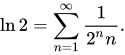
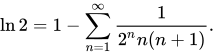




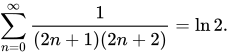
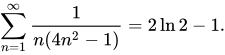
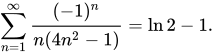
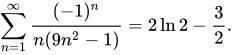
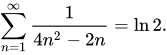
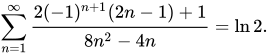

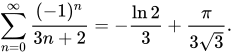
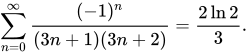
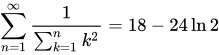
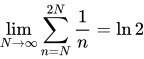
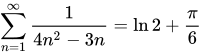
![{\displaystyle \sum _{n=1}^{\infty }{\frac {1}{n}}[\zeta (2n)-1]=\ln 2.}](https://wikimedia.org/api/rest_v1/media/math/render/svg/9ef59c49175d34e1aee22a9a50f45fabf050db5f)
![{\displaystyle \sum _{n=2}^{\infty }{\frac {1}{2^{n}}}[\zeta (n)-1]=\ln 2-{\frac {1}{2}}.}](https://wikimedia.org/api/rest_v1/media/math/render/svg/b61c76e20b8727253043baa534c03f6a85808e72)
![{\displaystyle \sum _{n=1}^{\infty }{\frac {1}{2n+1}}[\zeta (2n+1)-1]=1-\gamma -{\frac {\ln 2}{2}}.}](https://wikimedia.org/api/rest_v1/media/math/render/svg/69aa41d922c642991e8a73fb2c8567ec80d89632)


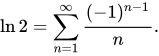
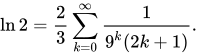


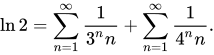


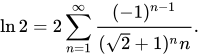
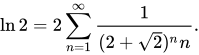





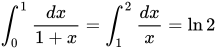

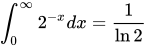

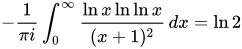



![{\displaystyle \ln 2=\left[0;1,2,3,1,6,3,1,1,2,1,1,1,1,3,10,1,1,1,2,1,1,1,1,3,2,3,1,...\right]}](https://wikimedia.org/api/rest_v1/media/math/render/svg/5f8173c7c5f057cbbf1d0292b9cf10e9eee6e208)
![{\displaystyle \ln 2=\left[0;1,2,3,1,5,{\tfrac {2}{3}},7,{\tfrac {1}{2}},9,{\tfrac {2}{5}},...,2k-1,{\frac {2}{k}},...\right]}](https://wikimedia.org/api/rest_v1/media/math/render/svg/81cd30af8050ce0bde521ec3ff78833704ba286a)