ENSIKLOPEDIA
Moray eels
| Moray eel | |
|---|---|
 | |
| Whitemouth Moray eel in the Maldives | |
Scientific classification  | |
| Kingdom: | Animalia |
| Phylum: | Chordata |
| Class: | Actinopterygii |
| Order: | Anguilliformes |
| Suborder: | Muraenoidei |
| Family: | Muraenidae Rafinesque, 1810 |
| Subfamiles | |
| |
Moray eels, or Muraenidae (/ˈmɒreɪ, məˈreɪ/), are a family of eels whose members are found worldwide. There are approximately 200 species in 16 genera which are almost exclusively marine, but several species are regularly seen in brackish water, and a few are found in fresh water.[2]
The English name, moray, dates back to the early 17th century, and is believed to be a derivative from Portuguese moreia, which itself derives from Latin mūrēna, in turn from Greek μύραινα, muraina; these are the Latin and Greek names of the Mediterranean moray.[3]
Anatomy
The dorsal fin extends from just behind the head along the back and joins seamlessly with the caudal and anal fins, with the exception of members of the subfamily Uropterygiinae, which have fins restricted to the tip of the tail. Most species lack pectoral and pelvic fins, contributing to their elongated appearance. Their eyes are relatively small; morays rely mostly on their highly developed sense of smell, while remaining concealed to ambush prey.[4]
The body is generally patterned. In some species, the interior of the mouth is patterned as well. Their jaws are wide, framing a protruding snout. Most possess large teeth suited for tearing flesh or grasping slippery prey. A smaller number of species, for example the snowflake moray (Echidna nebulosa) and zebra moray (Gymnomuraena zebra), primarily feed on crustaceans and other hard-shelled animals, and they have blunt, molar-like teeth suitable for crushing.[5]
Morays secrete a protective mucus over their smooth, scaleless skin, which in some species contains a toxin. They have much thicker skin and high densities of goblet cells in the epidermis that allows mucus to be produced at a higher rate than in other eel species. This allows sand granules to adhere to the sides of their burrows in sand-dwelling morays,[6] thus making the walls of the burrow more permanent due to the glycosylation of mucins in mucus. Placement of their small, circular gills on their flanks, far behind the mouth, requires the moray to maintain a gape / gulping motion to facilitate respiration.[clarification needed]
Jaw

The pharyngeal jaws of morays are located farther back in the head and closely resemble the oral jaws (complete with tiny "teeth"). When feeding, morays launch these jaws into the mouth cavity, where they grasp prey and transport it into the throat. Moray eels are the only known animals that use pharyngeal jaws to actively capture and restrain prey in this way.[7][8][9]

In addition to the presence of pharyngeal jaws, morays' mouth openings extend far back into the head, compared to fish which feed using suction. In the action of lunging at prey and biting down, water flows out the posterior side of the mouth opening, reducing waves in front of the eel which would otherwise displace prey. Thus, aggressive predation is still possible even with reduced bite times.[10] In at least one species, the California moray (Gymnothorax mordax), teeth in the roof of the mouth are able to fold down as prey slides backwards, thus preventing the teeth from breaking and maintaining a hold on prey as it is transported to the throat.
Differing shapes of the jaw and teeth reflect the respective diets of different species of moray eel. Evolving separately multiple times within the Muraenidae family, short, rounded jaws and molar-like teeth allow durophagous eels (e.g. zebra moray and genus Echidna) to consume crustaceans, while other piscivorous genera of Muraenidae have pointed jaws and longer teeth.[11][12][13] These morphological patterns carry over to teeth positioned on the pharyngeal jaw.[14][15]
Feeding behavior
Morays are opportunistic, carnivorous predators,[16] and feed primarily on smaller fish, crabs and octopuses.[17] A spotted moray eel has been observed eating a red lionfish without harm.[18][19] Groupers, barracudas and sea snakes are among their few known predators, making many morays (especially the larger species) apex predators in their ecosystems.[20]
Cooperative hunting
Reef-associated roving coral groupers (Plectropomus pessuliferus) have been observed recruiting giant morays to help them hunt. The invitation to hunt is initiated by head-shaking. This style of hunting may allow morays to flush prey from niches not accessible to groupers.[21][22][23]
Habitat

The moray eel can be found in both fresh and saltwater habitats. The vast majority of species are strictly marine, never entering freshwater. Of the few species known to live in freshwater, the most well-known is Gymnothorax polyuranodon.[24][25]

Within the marine realm, morays are found in shallow water nearshore areas, continental slopes, continental shelves, deep benthic habitats, and mesopelagic zones of the ocean, and in both tropical and temperate environments.[25] Most species are found in tropical or subtropical environments, with only a few species (yellow moray) found in temperate ocean environments.
Although the moray eel can occupy both tropical oceans and temperate oceans, as well as both freshwater and saltwater, the majority of moray eels occupy warm saltwater environments, which contain reefs.[26] Within the tropical oceans and temperate oceans, the moray eel occupies shelters, such as dead patch reefs and coral rubble rocks, and less frequently occupies live coral reefs.[26]
Reproduction and lifecycle
The reproductive biology of moray eels remains incompletely understood. Most species are oviparous, with external fertilization occurring in the water column. During spawning, both males and females release gametes simultaneously, and the fertilized eggs are subsequently dispersed by ocean currents.
Following fertilization, the eggs develop into leptocephalus larvae, which are transparent and ribbon-like in appearance. These larvae remain in the pelagic zone for extended periods—often up to a year—feeding on microscopic plankton. This prolonged larval phase facilitates wide geographic dispersal prior to settlement in benthic habitats such as coral reefs or rocky substrates, where metamorphosis into juvenile eels occurs.[27][better source needed]
The transition from larva to juvenile involves significant morphological and behavioral changes, including the development of adult pigmentation, body form, and ecological habits. Juvenile moray eels typically adopt the solitary and territorial behavior characteristic of adults.
Due to their nocturnal activity and the often inaccessible environments in which reproduction occurs, direct observations of moray eel courtship and spawning behavior are rare. Consequently, their reproductive mechanisms remain one of the least documented aspects of their biology.
Environmental factors such as water temperature, photoperiod, and food availability are believed to influence spawning events. Breeding in captivity is infrequent, which further limits opportunities for scientific study of their reproductive cycle.[28][user-generated source]
Taxonomy

Genera

There are over 200 known species of moray eels, in 16 genera. These genera are in two sub-families, Muraeninae and Uropterygiinae, which are distinguished by the location of their fins.[29] In Muraeninae the dorsal fin is near the gill slits and runs down the back of the eel, and the anal fin is behind the anus.[29] In Uropterygiinae, both the dorsal and the anal fin are at the end of the tail.[29] Though this distinction can be seen between the two sub-families, there are still many varieties of genera within Muraeninae and Uropterygiinae. Of these, the genus Gymnothorax is by far the broadest, including more than half of the total number of species.
The family Muraenidae comprises the following subfamiles and genera:[30]
- †Eomuraena Casier, 1967 (fossil; Early Eocene of Germany)[31]
- Subfamily Muraeninae Rafinesque, 1815
- Diaphenchelys McCosker & Randall, 2007
- Echidna Forster, 1788
- Enchelycore Kaup, 1856
- Enchelynassa Kaup, 1855
- Gymnomuraena Lacepède, 1803
- Gymnothorax Bloch, 1795
- Monopenchelys Böhlke & McCosker, 1982
- Muraena Linnaeus, 1758
- Pseudechidna Bleeker, 1863
- Rhinomuraena Garman, 1888
- Strophidon McClelland, 1844
- Subfamily Uropterygiinae Fowler 1925
- Anarchias D. S. Jordan & Starks, 1906
- Channomuraena Richardson, 1848
- Cirrimaxilla H.-M. Chen & K.-T .Shao, 1995
- Scuticaria D. S. Jordan & Snyder, 1901
- Uropterygius Rüppell, 1838


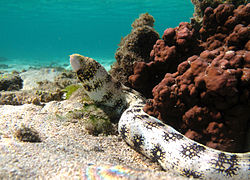 Snowflake moray (Echidna nebulosa)
 Barred moray (Echidna polyzona)
 Viper moray (Enchelynassa canina)
 Zebra moray (Gymnomuraena zebra)
 Laced moray (Gymnothorax favagineus)

 Mediterranean moray (Muraena helena)
 White ribbon eel (Pseudechidna brummeri)
 Ribbon eel (Rhinomuraena quaesita)
 Slender giant moray (Strophidon sathete)
 Kidako moray (Gymnothorax kidako)


.jpeg)


_(6052858389).jpg)


Evolution
The moray eel's elongation is due to an increase in the number of vertebrae, rather than a lengthening of each individual vertebra or a substantial decrease in body depth.[32] Vertebrae have been added asynchronously between the pre-tail ("precaudal") and tail ("caudal") regions, unlike other groups of eels such as Ophicthids and Congrids.[33]
Relationship with humans
Aquarium trade
Several moray species are popular among aquarium hobbyists for their hardiness, flexible diets, and disease resistance. The most commonly traded species are the snowflake, zebra and goldentail moray (Gymnothorax miliaris). Several other species are occasionally seen, but are more difficult to obtain and can command a steep price on the market.[34]
Food poisoning
Moray eels, particularly the giant moray (Gymnothorax javanicus) and yellow-edged moray (G. flavimarginatus), are known to accumulate high levels of ciguatoxins, unlike other reef fish;[35][36] if consumed by humans, ciguatera fish poisoning may result. Ciguatera is characterised by neurological, gastrointestinal, and cardiovascular problems that may persist for days after eating tainted fish. In morays, the toxins are most concentrated in the liver.[36] In an especially remarkable instance, 57 people in the Northern Mariana Islands were poisoned after eating just the head and half of a cooked yellow-edged moray.[37] Thus, morays are not recommended for human consumption.
References
- ↑ Froese, Rainer; Pauly, Daniel (eds.). "Family Muraenidae". FishBase. January 2009 version.
- ↑ Froese, Rainer; Pauly, Daniel (eds.). "Gymnothorax polyuranodon". FishBase. January 2010 version.
- ↑ "Moray - definition of moray in English". Oxford Dictionaries. Archived from the original on 26 September 2016. Retrieved 11 December 2016 – via oxforddictionaries.com.
- ↑ "Crazy facts about the moray eel". Moray eels. Khao Lak Explorer (khaolakexplorer.com). Marine Life Guide. 16 August 2019. Retrieved 17 June 2021.
Liveaboard to Similan Islands
- ↑ Randall, J.E. (2005). Reef and Shore Fishes of the South Pacific. University of Hawai'i Press. ISBN 0-8248-2698-1.
- ↑ Fishelson, L. (September 1996). "Skin morphology and cytology in marine eels adapted to different lifestyles". The Anatomical Record. 246 (1): 15–29. doi:10.1002/(SICI)1097-0185(199609)246:1<15::AID-AR3>3.0.CO;2-E. PMID 8876820.
- ↑ Mehta RS, Wainwright PC (September 2007). "Raptorial jaws in the throat help moray eels swallow large prey". Nature. 449 (7158): 79–82. Bibcode:2007Natur.449...79M. doi:10.1038/nature06062. PMID 17805293. S2CID 4384411.
- ↑ Hopkin, Michael (5 September 2007). "Eels imitate Alien: Fearsome fish have protruding jaws in their throats to grab prey". Nature News. doi:10.1038/news070903-11. S2CID 85118599. Retrieved 6 September 2007.
- ↑ "Moray eels are uniquely equipped to pack big prey into their narrow bodies". nsf.gov/news (Press release). U.S. National Science Foundation (NSF). Retrieved 11 December 2016.
- ↑ Mehta RS, Wainwright PC (February 2007). "Biting releases constraints on moray eel feeding kinematics". The Journal of Experimental Biology. 210 (Part 3): 495–504. Bibcode:2007JExpB.210..495M. doi:10.1242/jeb.02663. PMID 17234619.
- ↑ Reece JS, Bowen BW, Smith DG, Larson A (November 2010). "Molecular phylogenetics of moray eels (Muraenidae) demonstrates multiple origins of a shell-crushing jaw (Gymnomuraena, Echidna) and multiple colonizations of the Atlantic Ocean". Molecular Phylogenetics and Evolution. 57 (2): 829–35. Bibcode:2010MolPE..57..829R. doi:10.1016/j.ympev.2010.07.013. PMID 20674752.
- ↑ Mehta RS (January 2009). "Ecomorphology of the moray bite: relationship between dietary extremes and morphological diversity". Physiological and Biochemical Zoology. 82 (1): 90–103. doi:10.1086/594381. PMID 19053846. S2CID 19640346.
- ↑ Collar DC, Reece JS, Alfaro ME, Wainwright PC, Mehta RS (June 2014). "Imperfect morphological convergence: variable changes in cranial structures underlie transitions to durophagy in moray eels". The American Naturalist. 183 (6): E168–184. Bibcode:2014ANat..183E.168C. doi:10.1086/675810. PMID 24823828. S2CID 17433961.
- ↑ Böhlke, Eugenia B., ed. (1989). "Part 9: Orders Anguilliformes and Saccopharyngiformes". Fishes of the Western North Atlantic. Sears Foundation for marine research. New Haven, CT: Yale University. ISBN 978-0935868456. OCLC 30092375.
- ↑ Gregory, William K. (2002). Fish Skulls: A study of the evolution of natural mechanisms. Malabar, FL: Krieger Pub. ISBN 978-1575242149. OCLC 48892721.
- ↑ Kooser, Amanda. "See a snowflake moray eel swallow a sushi snack in an extraordinary way". CNET. Retrieved 17 June 2021.
- ↑ Young, Robert F.; Winn, Howard E. (February 2003). "Activity Patterns, Diet, and Shelter Site Use for Two Species of Moray Eels, Gymnothorax moringa and Gymnothorax vicinus, in Belize". Copeia. 2003 (1): 44–55. doi:10.1643/0045-8511(2003)003[0044:APDASS]2.0.CO;2. ISSN 0045-8511. S2CID 85897128.
- ↑ Pimiento, Catalina; Monaco, Eric; Barbour, Andrew B.; Silliman, Brian R. (2013). "Predation on Speared Red Lionfish, Pterois Volitans, by Spotted Moray, Gymnothorax Moringa". Florida Scientist. 76 (3/4): 391–394. ISSN 0098-4590. JSTOR 24321994.
- ↑ Weisberger, Mindy (10 June 2021). "These eels can swallow prey on land, thanks to extendable jaws in their throats". livescience.com. Retrieved 17 June 2021.
- ↑ "Moray Eel - Facts and Beyond". Biology Dictionary. 10 July 2020. Retrieved 17 June 2021.
- ↑ In the December 2006 issue of the journal Public Library of Science Biology, a team of biologists announced the discovery of interspecies cooperative hunting involving morays. The biologists, who were engaged in a study of Red Sea cleaner fish (fish that enter the mouths of other fish to rid them of parasites), made the discovery.An Amazing First: Two Species Cooperate to Hunt | LiveScience
- ↑ Bshary R, Hohner A, Ait-el-Djoudi K, Fricke H (December 2006). "Interspecific communicative and coordinated hunting between groupers and giant moray eels in the Red Sea". PLOS Biology. 4 (12): e431. doi:10.1371/journal.pbio.0040431. PMC 1750927. PMID 17147471.
- ↑ Vail A.L., Manica A., Bshary R., Referential gestures in fish collaborative hunting, in Nature Communications, vol. 4, 2013.
- ↑ Ebner, Brendan C.; Fulton, Christopher J.; Donaldson, James A.; Schaffer, Jason (2015). "Distinct habitat selection by freshwater morays in tropical rainforest streams". Ecology of Freshwater Fish. 25 (2): 329–335. doi:10.1111/eff.12213. ISSN 0906-6691.
- 1 2 Tsukamoto, Katsumi; Watanabe, Shun; Kuroki, Mari; Aoyama, Jun; Miller, Michael J. (2014). "Freshwater habitat use by a moray eel species, Gymnothorax polyuranodon, in Fiji shown by otolith microchemistry". Environmental Biology of Fishes. 97 (12): 1377–1385. Bibcode:2014EnvBF..97.1377T. doi:10.1007/s10641-014-0228-9. ISSN 0378-1909. S2CID 7596020.
- 1 2 Young, Robert F.; Winn, Howard E.; Montgomery, W. L. (2003). "Activity Patterns, Diet, and Shelter Site Use for Two Species of Moray Eels, Gymnothorax moringa and Gymnothorax vicinus, in Belize". Copeia. 2003 (1): 44–55. doi:10.1643/0045-8511(2003)003[0044:APDASS]2.0.CO;2. ISSN 0045-8511. S2CID 85897128.
- ↑ "Moray Eel - Anatomy, Feeding, Behaviour, Reproduction and Types".
- ↑ "Moray Eel Facts and Habitat | All About Morena Fish Species".
- 1 2 3 Reece, Joshua (January 2010). "Phylogenetics and phylogeography of moray eels (Muraenidae)". Washington University Open Scholarship – via openscholarship.wustl.edu.
- ↑ Fricke, Ron; Eschmeyer, William N. & van der Laan, Richard (eds.). "Genera in the family Muraenidae". Catalog of Fishes. California Academy of Sciences. Retrieved 10 November 2024.
- ↑ Young, Sally V. T.; Williams, R. J. (2008). "New information on the cranial anatomy of the eel genus Echelus Rafinesque, 1810 (Ophichthidae: Anguilliformes) from the Early Eocene". Geological Society, London, Special Publications. 295 (1): 311–336. doi:10.1144/SP295.15. ISSN 0305-8719.
- ↑ Mehta, Rita S.; Reece, Joshua S. (July 2013). "Evolutionary history of elongation and maximum body length in moray eels (Anguilliformes: Muraenidae)". Biological Journal of the Linnean Society. 109 (4): 861–875. doi:10.1111/bij.12098.
- ↑ Mehta RS, Ward AB, Alfaro ME, Wainwright PC (December 2010). "Elongation of the body in eels". Integrative and Comparative Biology. 50 (6): 1091–105. doi:10.1093/icb/icq075. PMID 21558261.
- ↑ Maddox, Mike. "Morays!". TFH Magazine. Retrieved 29 August 2018.
- ↑ Chan TY (April 2016). "Characteristic Features and Contributory Factors in Fatal Ciguatera Fish Poisoning--Implications for Prevention and Public Education". The American Journal of Tropical Medicine and Hygiene. 94 (4): 704–9. doi:10.4269/ajtmh.15-0686. PMC 4824207. PMID 26787145.
- 1 2 Chan TY (June 2017). "Regional Variations in the Risk and Severity of Ciguatera Caused by Eating Moray Eels". Toxins. 9 (7): 201. doi:10.3390/toxins9070201. PMC 5535148. PMID 28672845.
- ↑ Khlentzos, Constantine T. (1 September 1950). "Seventeen Cases of Poisoning Due to Ingestion of an Eel, Gymnothorax Flavimarginatus 1". The American Journal of Tropical Medicine and Hygiene. s1-30 (5): 785–793. doi:10.4269/ajtmh.1950.s1-30.785. ISSN 0002-9637. PMID 14771403.
Further reading
- Gross, Miriam J. The Moray Eel. United States: Rosen Publishing Group's PowerKids Press, 2005.
- Purser, Phillip. Keeping Moray Eels in Aquariums. United States: T.F.H., 2005.
- Didier, Dominique A. Moray Eel. United States: Cherry Lake Publishing, 2014.
- Goldish, Meish. Moray Eel: Dangerous Teeth. United Kingdom: Bearport Publishing, 2009.
External links


- Moray Eels Grab Prey With Alien Jaws
- Smith, J.L.B. 1962. The moray eels of the Western Indian Ocean and the Red Sea. Ichthyological Bulletin; No. 23. Department of Ichthyology, Rhodes University, Grahamstown, South Africa.
True eels (Anguilliformes) | ||||||||||||||||||||
|---|---|---|---|---|---|---|---|---|---|---|---|---|---|---|---|---|---|---|---|---|
| ||||||||||||||||||||
|  | |||||||||||||||||||

