In particle physics, wave mechanics, and optics, momentum transfer is the amount of momentum that one particle gives to another particle. It is also called the scattering vector as it describes the transfer of wavevector in wave mechanics. In the simplest example of scattering of two colliding particles with initial momenta , resulting in final momenta , the momentum transfer is given by
where the last identity expresses momentum conservation. Momentum transfer is an important quantity because is a better measure for the typical distance resolution of the reaction than the momenta themselves.
Wave mechanics and optics
A wave has a momentum and is a vectorial quantity. The difference of the momentum of the scattered wave to the incident wave is called momentum transfer. The wave number k is the absolute of the wave vector and is related to the wavelength. Momentum transfer is given in wavenumber units in reciprocal space
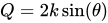
The presentation in reciprocal space is generic and does not depend on the type of radiation and wavelength used but only on the sample system, which allows to compare results obtained from many different methods. Some established communities such as powder diffraction employ the diffraction angle as the independent variable, which worked fine in the early years when only a few characteristic wavelengths such as Cu-K were available. The relationship to -space is
with and basically states that larger corresponds to larger .
See also
Atomic form factor– Measure of the scattering amplitude of a wave by an isolated atom