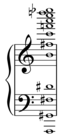
The minor chord timbre is sometimes described as darker than its major counterpart.[3] The primary intervals in a minor chord are the minor third above the root, and the perfect fifth above the root. There is a major third between the third and fifth.[4] It is a tertian chord because it is built in thirds.[5]:458
A justly tuned perfect fifth is 702 cents, compared to 700 in equal temperament. The just minor third is 316 cents, where the equal interval is 300.[5]:455
Georg Andreas Sorge derived the minor chord from the confluence of two major triads such as F-A-C and C-E-G. An A minor triad arises from the connection.[12] He pointed out that overtones 10, 12, 15, and 18 of the harmonic series form a minor seventh chord.[13]
↑White, Paul James. "Is Perfect Intonation Practicable? II", Music: a Monthly Magazine Devoted to the Art, Science, Technic And Literature of Music, Volume VII. November 1894–April 1895. Chicago: The Music Magazine Publishing Company, 1895. 608.
↑Lester, Joel (1994). Compositional Theory in the Eighteenth Century. p.194. ISBN978-0-674-15523-7.