ENSIKLOPEDIA
MAX light rail


The Metropolitan Area Express (MAX) is a light rail system serving the Portland metropolitan area in the U.S. state of Oregon. Owned and operated by TriMet, it comprises five lines connecting the six sections of Portland; the communities of Beaverton, Clackamas, Gresham, Hillsboro, Milwaukie, and Oak Grove; and Portland International Airport with Portland City Center. Trains operate daily with headways ranging from 30 minutes off-peak to three minutes during rush hours. In 2025, MAX recorded an annual ridership of 22,061,900.
MAX was among the first second-generation light rail systems built in the United States, emerging from freeway revolts in the 1970s. Planning for its inaugural eastside segment, then known as the Banfield Light Rail Project, began in 1973 following the cancellation of the Mount Hood Freeway. Construction started in 1982, and service between downtown Portland and Gresham commenced on September 5, 1986. The original 27-station, 15.1-mile (24 km) line has since expanded to 93 stations and 59.7 miles (96.1 km) of track. The most recent extension, between Portland and Milwaukie, opened in 2015.
MAX is one of three urban rail systems in the Portland metropolitan area, alongside the Portland Streetcar and WES Commuter Rail. MAX connects directly with these systems and with other services, including Amtrak, Frequent Express, and local and intercity buses. Trains operate in consists of up to two cars due to Portland's short downtown blocks. All vehicles and platforms are accessible, and fares are collected using the Hop Fastpass payment system.
History
Predecessors
In the early 20th century, privately funded interurbans and streetcars gave Portland one of the largest urban rail systems in the American West, with lines that once extended as far north as Vancouver, Washington, south as Eugene, east as Troutdale, and west as Forest Grove.[5]: 7–8 [6]: 7–8 Ben Holladay brought Portland's first trolleys from San Francisco in 1872; drawn by horses and mules, they were operated by the Portland Street Railway Company. In 1890, the first electric streetcar opened in Albina while the first cable car began serving 5th Avenue; these marked the start of an era of major rail expansion.[7] In 1892, the East Side Railway Company opened the first long-distance interurban line—a 16-mile (25.7 km) route from Portland to Oregon City.[8] The Portland Railway, Light and Power Company had taken over all local streetcars by 1906,[9] and interurbans by 1908.[10]: 93 In 1912, as Portland's population exceeded 250,000, transit ridership stood at 70 million passengers annually.[5]: 8 Passenger rail services had started to decline by the 1920s with the rise of the automobile and suburban and freeway development.[5]: 9 [11] Portland's original streetcar lines had ceased operating by 1950,[6]: 33 replaced by buses until 2001,[12] when the modern Portland Streetcar opened in downtown Portland.[13][14] The region's last two interurban lines, which traveled to Oregon City and Bellrose (Southeast 136th Avenue), permanently closed in 1958.[10]: 61, 93 [15]
Early beginnings
.jpg)
At the height of local freeway revolts in the 1970s, studies for public transit began using funds made available by the Federal-Aid Highway Act of 1973.[5]: 20 These funds had been intended for the Mount Hood Freeway and Interstate 505 (I-505) projects,[5]: 30 which were abandoned amid strong opposition from the Portland city government and neighborhood associations.[16][17] In 1973, Governor Tom McCall assembled a task force that helped determine several alternative options, including a busway and light rail.[18][19] Local jurisdictions originally favored the busway alternative, but support for light rail prevailed following the mode's inclusion in a 1977 environmental impact statement.[20][21] The proposal became known as the Banfield light rail project, named for the Banfield Freeway, a segment of I-84 that part of the alignment followed. TriMet approved the project in September 1978.[22] Construction of the 15.3-mile (24.6 km), 27-station line between 11th Avenue in downtown Portland and Cleveland Avenue in Gresham began in March 1982.[23] Inaugural service commenced on September 5, 1986.[24] Less than two months before opening, TriMet adopted the name "Metropolitan Area Express", or "MAX", following an employee contest.[25][26]
As the planning of a light rail line to the west side gained momentum in the mid-1980s, the original MAX line came to be referred to as the Eastside MAX to distinguish it from what would become the Westside MAX extension.[27] Early proposals called for the extension to terminate just west of the Beaverton–Hillsboro boundary on 185th Avenue in Washington County.[28] A dispute between TriMet and the Urban Mass Transportation Administration over a financing plan suspended the project for several years but planning resumed in 1988 and studies were completed in 1991.[28][29] Staunch lobbying by local and state officials led by Hillsboro Mayor Shirley Huffman forced an extension of the line further west to downtown Hillsboro in 1993.[30] Construction of the 20-station, 18-mile (29 km) line began that August with the excavation of the Robertson Tunnel.[31] The Westside MAX opened in two stages following delays in tunneling: the section from 11th Avenue to Kings Hill/Southwest Salmon Street was opened in 1997 and the section to Hatfield Government Center—the segment's current western terminus—was opened in 1998.[32] The resulting 33-mile (53 km) MAX line began operating as a single, through service on September 12, 1998.[33]
South/North plan
.jpg)
At the same time TriMet was planning the Westside MAX in the mid-1980s, Metro regional government announced new light rail proposals for Clackamas County. Its planning committee—the Joint Policy Advisory Committee on Transportation (JPACT)—proposed two separate routes that would have run between downtown Portland and Oregon City via Milwaukie and between Portland International Airport and Clackamas Town Center via I-205.[34] Further planning led JPACT to favor the I-205 corridor due to an existing right-of-way along the I-205 Transitway, an unfinished mass transit component of the freeway that had been built to accommodate a busway.[35][36] TriMet, however, prioritized the Westside MAX during its bid for federal matching funds and the I-205 plans were put on hold.[37] In 1989, studies for both I-205 and Milwaukie proposals received funding from the U.S. Senate Committee on Appropriations under the condition that they included potential route extensions to Clark County, Washington.[38][39] Metro completed the studies in 1993, ultimately abandoning I-205 in favor of a route along the I-5 and Willamette River corridors.[40][41] It finalized a single 25-mile (40 km) line from Hazel Dell, Washington south to Clackamas Town Center via Milwaukie,[42][43] which Metro and TriMet formally named the South–North Line.[5]: 80 Metro said it adopted the name "South/North" instead of the more conventional "North/South" word order, at the request of representatives in the southern part of the corridor after the southern leg, which had long been planned to be the next-priority MAX corridor after the Westside line, was merged with the northern leg as a single proposed project.[44]
In November 1994, 63% of Portland area voters passed a $475 million ballot measure to fund Oregon's portion of the project.[5]: 80 The following February, however, Clark County residents defeated a tax measure that would have funded Washington's share.[45] To move the project forward, TriMet downsized the plan and abandoned the line's Clark County and North Portland segments up to the Rose Quarter.[46] That July, the Oregon House of Representatives approved a $750 million transportation package, which included $375 million for the scaled-back line.[47] The funding was annulled by the Oregon Supreme Court due to the inclusion of unrelated measures that violated the state's constitution.[48][49] The legislature met again in February 1996 and passed a revised $375 million package,[48] but light rail opponents forced a statewide vote and defeated it the following November.[50] A third proposal between Lombard Street in North Portland and Clackamas Town Center followed.[51] This time, Metro and TriMet pursued the project without seeking contributions from either Clark County or the state, instead sourcing funds from Clackamas County and Portland. In 1998, TriMet placed a new ballot measure to reaffirm voter support for the $475 million originally approved in 1994.[5]: 80 The measure failed by 52% in November of that year, effectively canceling the proposed line.[52]
Airport and Interstate lines

Driven by the rapid expansion of Portland International Airport in the 1990s, the Port of Portland explored ways to ease growing traffic congestion, including introducing MAX service decades earlier than regional planners had anticipated.[53] In 1997, engineering firm Bechtel accelerated the effort with an unsolicited proposal to design and build the airport rail link in exchange for 120 acres (49 ha) of Port property.[54][55] A public–private partnership was formed, and construction of the Airport MAX began in June 1999.[56] With right-of-way already secured and no federal funding requested,[57] the project was completed in under two years.[58] The four-station, 5.5-mile (8.9 km) branch line between Gateway Transit Center and the airport opened on September 10, 2001.[59][60] Celebrations planned for that weekend were cancelled in the aftermath of the September 11 attacks.[61] To service the new route, TriMet enacted a color-coded route naming scheme: the Blue Line ran between Hillsboro and Gresham, while the Red Line ran between the airport and downtown Portland, using the loop tracks on 11th Avenue to reverse direction.[62][63] On September 1, 2003, the Red Line was extended west to Beaverton Transit Center to relieve Blue Line overcrowding and provide a one-seat airport connection for the west side.[64]
In 1999, Portland business leaders and residents opposed to the cancellation of the South/North Line urged TriMet to revive the project.[65][66] TriMet responded with a scaled-back proposal extending MAX only to North Portland via North Interstate Avenue.[67] Construction on the Interstate MAX began in February 2001.[68] To reduce taxpayer costs, the city created an urban renewal district, while federal matching funds from the locally funded Airport MAX and Central City Streetcar projects were redirected to the line.[69][70] The 10-station, 5.8-mile (9.3 km) extension from Rose Quarter Transit Center to the Portland Expo Center opened on May 1, 2004, as part of the Yellow Line.[71] From 2004 to 2009, the Yellow Line ran from Expo Center station to 11th Avenue in downtown Portland, sharing tracks with the Blue and Red lines across the Steel Bridge. On August 30, 2009, it was rerouted to the PSU Urban Center stations following the addition of light rail to the Portland Transit Mall.[72] In September 2012, service was extended farther south to the PSU South stations, which had been delayed by nearby transit-oriented development.[73][74] Since 2015, the Yellow Line has interlined with the Orange Line and now operates only the northbound segment of the transit mall.[75]
South Corridor extensions
.jpg)
In 2001, Metro revisited its former light rail plans for Clackamas County and reconsidered proposals similar to those of the canceled south–north project, with two routes extending to Clackamas and Milwaukie.[76] This resulted in a new study, which Metro referred to as the South Corridor transportation project,[77] that evaluated light rail among other alternatives.[78] The study's task force recommend both light rail options in 2003 and suggested splitting the project into two phases.[79][80] The first phase planned for the addition of light rail to I-205, between Gateway Transit Center and Clackamas Town Center. In October of that year, the first phase plans were amended to include adding light rail to the Portland Transit Mall following a petition from Portland business leaders.[81] The combined project was approved for federal funding in 2006 and work began in January 2007.[82][83] Light rail commenced service along the 14-station, 1.8-mile (2.9 km) Portland Transit Mall on August 30, 2009, first served by the Yellow Line.[72] The opening of the eight-station, 6.5-mile (10.5 km) I-205 MAX and Green Line service followed on September 12.[84]
The South Corridor project's second phase initially proposed the extension of MAX between downtown Portland and Milwaukie via the Hawthorne Bridge.[85] Studies showed that this alignment would cause severe traffic bottlenecks in downtown.[81] As a result, Portland businesses pushed for the construction of a new bridge further upstream that led to the southern end of the Portland Transit Mall.[78] The locally preferred alignment was finalized in mid-2008; a new bridge would carry light rail across the Willamette River from the South Waterfront to just south of the Oregon Museum of Science and Industry (OMSI).[86] TriMet designed this bridge, which was eventually inaugurated as Tilikum Crossing, to be "car-free" and to accommodate only transit vehicles, bicycles, and pedestrians.[87] Construction of the line began in June 2011.[88] In September 2012, opponents passed a ballot initiative—with 60% of the vote—requiring all Clackamas County spending on light rail to be approved by voters.[89][90] Following the county's attempt to end its involvement and a suit filed by TriMet, a circuit court upheld the project's continuation.[91] The 17-station, 7.3-mile (11.7 km) Portland–Milwaukie segment and Orange Line service opened on September 12, 2015.[92] The Orange Line, operating along the Portland Transit Mall's southbound segment, became the third service to serve this corridor.[75]
Red Line track improvements and extension to Hillsboro

In October 2017,[93] TriMet, citing system-wide delays caused by two single-track segments along the Airport MAX, announced the MAX Red Line Improvements Project,[94] later renamed "A Better Red".[95] A Better Red sought double-tracking a 2,800-foot-long (850 m) section of track north of Gateway Transit Center and another 3,800-foot-long (1,200 m) section alongside Northeast Airport Way just before the airport terminal.[96] To qualify the project for federal funding, TriMet included extending Red Line service farther west to Fair Complex/Hillsboro Airport station in Hillsboro;[93] this extension would use existing Westside MAX tracks and create a one-seat option from 10 additional stations to Portland International Airport. Additionally, TriMet had announced it would procure up to eight new light rail vehicles to accommodate the improvements,[94] but later purchased 30 new trains overall; four were part of A Better Red, while the remaining 26 were replacements for the original MAX fleet, which are gradually being retired.[97]
Preliminary design work began in February 2018.[98] TriMet adopted a locally preferred alternative in April 2019,[99] and the FTA announced $99.99 million for the project through the Capital Investment Grants program in May 2020.[100][101] Final design was completed by engineering firm Parametrix in early 2021.[102][103] The design includes two new bridges north of Gateway Transit Center to accommodate the second track and a new MAX platform called "Gateway North".[95] TriMet broke ground on September 28, 2021.[104]
From April 2–9, 2022,[105][106] Red Line service was suspended to make way for construction, and shuttle buses operated between Gateway Transit Center and Portland International Airport.[107][108] The project was completed in March 2024.[109][110]
From June 18 to October 21, 2023, TriMet suspended MAX service between Gateway Transit Center and the airport to allow for construction of the second track between the airport and Mount Hood Avenue.[111][112]
From January 14 to March 3, 2024, TriMet suspended MAX Red, Blue and Green Line service between NE 7th and Gateway Transit Center.[113] Inbound Red Line trains from PDX began serving Gateway North on March 4, 2024.[114] These projects eliminated the last bidirectional single-track sections on the MAX system.[115]
The Red Line extension to Hillsboro began service on August 25, 2024, with a soft launch, with the full launch beginning on August 28. Fair Complex/Hillsboro Airport station was also renamed to Hillsboro Airport/Fairgrounds station.[116][117]
Future expansion and improvements
MAX expansion projects are generally advised by the federally mandated regional transportation plan (RTP). The RTP evaluates the region's most urgent transportation needs and guides investment strategy over the next two decades. Every five years, the RTP is updated,[118] during which TriMet collaborates with local, regional, state, and federal governments and agencies, community organizations, business groups, and members of the public to identify and recommend projects.[119] Metro is the metropolitan planning organization for the Oregon side of the Portland metropolitan area tasked with publishing the RTP, and the 2023 RTP is its latest iteration.[118]
The 2023 RTP update included an update to Metro's high-capacity transit (HCT) strategy,[120] which further identified regional corridors to prioritize for transit upgrades and transit modes to invest in.[121] The 2023 HCT strategy lists 29 regional priority investment corridors, ranked into four tiers based on a readiness criteria. Tier 1 near-term corridors are defined as "corridors most viable to advance into implementation in the next four years" and include those with adopted locally preferred alternatives. Tier 2 next-phase corridors are corridors that may be pursued "if recommended land use planning and policy actions are implemented" and are candidates for HCT implementation within the next five years. Tier 3 and 4 corridors are corridors that ranked low on the readiness criteria and have a longer-term path towards implementation.[122]
| Project | Status | Termini | Length | New stations | Expected opening | |
|---|---|---|---|---|---|---|
| Yellow Line extension to Vancouver (Interstate Bridge Replacement) | Design | Expo Center | Evergreen Boulevard | 1.9 miles (3.1 km) | 3 | To be determined |
| Southwest Corridor[123] | Suspended[124] | PSU South | Bridgeport Village | 11 miles (18 km) | 13 | To be determined |
Yellow Line extension to Vancouver
The Interstate Bridge Replacement (IBR) Program includes a northward extension of the Yellow Line to serve Vancouver, Washington. The project would add 1.9 miles (3.1 km) of track and three new stations at Hayden Island, the Vancouver Waterfront, and Evergreen Boulevard.[125] An earlier proposal for the extension was a part of the Columbia River Crossing project in the early 2010s. That project would have extended light rail 2.9 miles (4.7 km) to Clark College and added seven stations.[126][127] The CRC project was cancelled in July 2013 after the Washington State Senate failed to approve $450 million in funding,[128] with the inclusion of light rail cited as a common objection from opponents.[129]
Southwest Corridor
The Southwest Corridor Light Rail Project is a planned extension of MAX from PSU in downtown Portland to Bridgeport Village in Tualatin via Southwest Portland and Tigard.[130] It would add 11 miles (18 km) of track and 13 new stations.[131][132]: 191 Initially scheduled to open in 2027, the project was indefinitely suspended on November 3, 2020, after voters rejected a tax ballot measure that would have funded the local-area share.[133][134][135]
Central City Tunnel
Constructs a tunnel beneath downtown Portland from Goose Hollow to the Lloyd Center.[136]: 7 [137][138] In 2025, Metro completed a Regional Rail Futures Study where it concluded that the proposed tunnel or a replacement of the Steel Bridge should be the highest priority for cross-regional transit mobility.[139]
Other proposals
Metro's Regional Rail Futures Study identifies two additional corridors presenting "immediate" opportunities for light rail.[139]
- Forest Grove–Hillsboro
- Milwaukie–Oregon City (McLoughlin Boulevard)
- Supplemental "Teal Line" service from the Airport to Clackamas, avoiding the congested Banfield Line.[140]
Lines
For MAX, a "line" refers to the physical railroad tracks and stations a train serves within its designated termini—in other words, a train route or service. TriMet operates five MAX lines, each identified by a color.[141] It adopted color designations for separately operated routes in 2000 and implemented them on September 10, 2001, with the opening of the Airport MAX extension. On that date, service between Hillsboro and Gresham was designated the Blue Line, while service between downtown Portland and Portland International Airport became the Red Line.[62][142][143]
Every MAX line interlines with at least one other service, particularly near the system's central area.[141] The Steel Bridge carries the greatest number of interlining routes, with four lines—Blue, Green, Red, and Yellow—sharing the same tracks.[144] TriMet has modified routes over time, often in conjunction with system expansions. For example, the Yellow Line, which began service in 2004, originally followed the same downtown Portland alignment as the Blue and Red lines. In 2009, it was realigned to the Portland Transit Mall when light rail service was introduced to that corridor.[145][72]
| Service | Stations | Termini | |
|---|---|---|---|
 Blue Line[146] Blue Line[146] |
47 | Hatfield Government Center (Hillsboro) | Cleveland Ave (Gresham) |
 Red Line[147] Red Line[147] |
36 | Hillsboro Airport/Fairgrounds | Portland International Airport |
 Green Line[148] Green Line[148] |
30 | PSU South | Clackamas Town Center Transit Center |
 Yellow Line[149] Yellow Line[149] |
17 | Expo Center | PSU South |
 Orange Line[150] Orange Line[150] |
17 | Union Station | SE Park Ave (Milwaukie) |
Infrastructure
Segments
The MAX rail network is 59.7 miles (96.1 km) long. It was built in a series of six projects starting with the 15.1-mile (24.3 km) Banfield—now called Eastside—segment between downtown Portland and Gresham. Each successive project has either been an extension or a branch of an existing segment. TriMet has typically paired each project with the opening of a new line, often making the line and segment synonymous (e.g. "Airport MAX Red Line").[151][152]

| Project name | Opened | Endpoints | Length (new) |
|---|---|---|---|
| Banfield (Eastside)[27] | September 5, 1986 | 11th Ave loop–Cleveland Ave[153] | 15.1 miles (24.3 km)[154][155][156] |
| Westside[157] | September 12, 1998 | Hatfield Government Center–11th Ave loop | 17.7 miles (28.5 km)[158] |
| Airport[53] | September 10, 2001 | Portland Airport–Gateway | 5.5 miles (8.9 km) |
| Interstate[159] | May 1, 2004 | Expo Center–Rose Quarter | 5.8 miles (9.3 km)[159] |
| Portland Mall[160] | August 30, 2009 | Steel Bridge–PSU South | 1.8 miles (2.9 km)[161][145] |
| I-205[160] | September 12, 2009 | Gateway–Clackamas Town Center | 6.5 miles (10.5 km)[162][161] |
| Portland–Milwaukie[163] | September 12, 2015 | PSU South–SE Park Ave | 7.3 miles (11.7 km)[163] |
| Total | 59.7 miles (96.1 km) | ||
Right-of-way

MAX operates on a mixture of shared and exclusive transit rights-of-way.[164] Within downtown Portland, trains run on surface streets in dedicated lanes restricted to private vehicles, and operators follow the city's traffic control system.[165][166] On the Morrison–Yamhill couplet, MAX travels in the left lanes.[167] On the Portland Transit Mall (the 5th and 6th avenue couplet), MAX shares dedicated lanes with buses, and both travel in the center or right lanes and stop at their respective curbside platforms on the right.[4] Lanes may be separated by turtleback delineators or double solid white lines and are marked with white diamonds or white “T” symbols.[164][166]
Outside downtown Portland, MAX runs along street medians and viaducts, alongside freeways and freight rail lines, and underground. Where tracks run within a street median, intersections are controlled by traffic signals that grant trains preemption. Where tracks occupy a separate right-of-way, trains are protected by automated grade crossing gates at level crossings.[4] Some segments are elevated to carry trains over busy thoroughfares and difficult terrain.[168][169] A three-mile (4.8 km) section runs beneath Washington Park in Portland's West Hills through the Robertson Tunnel, the system's longest underground segment.[170]
MAX crosses the Willamette River via the Steel Bridge and Tilikum Crossing. In studies for the Banfield Light Rail Project, planners recommended using the Steel Bridge because of its earlier role as a river crossing for the city's historic streetcars. When MAX entered service in 1986, trains shared the bridge's center lanes with vehicular traffic.[167] In 2008, the bridge's upper deck was closed to construct a junction between the Eastside MAX tracks and the newer Portland Transit Mall tracks. After reopening, the two inner lanes were reserved exclusively for MAX trains, while cars, buses, and other motorized traffic were restricted to the outer lanes.[171] The newer Tilikum Crossing prohibits private vehicles and allows transit vehicles (MAX, streetcar, and buses), cyclists, pedestrians, and emergency responders only.[172] As a result, Tilikum Crossing is widely recognized as the first major “car-free” bridge in the United States.[87]
Power and signaling
MAX is powered by a conventional 750-volt direct current (DC) overhead wire system. Most of the network uses a dual-wire catenary, in which a contact wire is supported by a messenger wire. In urban areas such as downtown Portland, however, a single contact wire is used to reduce the amount of overhead wiring. To further minimize visual impact, ornamental streetlight poles, buildings, and bridge structures support the wiring. Substations, spaced about one mile (1.6 km) apart, convert the high-voltage public supply to the voltage used by trains. The power system is designed to bridge any single substation, allowing trains to continue operating if a substation or its supply fails.[4]
Approximately 70 percent of the MAX system uses automatic block signaling (ABS),[4] which supports relatively high operating speeds—up to 55 miles per hour (89 km/h)—and short headways.[157][173][174] For example, along the Banfield Freeway between Lloyd Center/NE 11th Ave station and Gateway Transit Center, ABS can accommodate operating headways as short as two minutes. In these sections, automatic train stops (ATS) enforce speed limits and apply the brakes if an operator fails to do so. The remaining 30 percent of the system relies on traffic signals and line-of-sight operation, where speeds are limited to 35 mph (56 km/h).[4]
Operations and maintenance facilities
.jpg)
TriMet's vehicle-maintenance complexes for the MAX system are the Ruby Junction facility in Gresham and the smaller Elmonica facility in Beaverton.[175][176] The Ruby Junction facility is located near Ruby Junction/E 197th Ave station while the Elmonica facility is adjacent to Elmonica/SW 170th Ave station; both are on the Blue Line.[177]
Ruby Junction began with one building that TriMet built as part of the Banfield Light Rail Project in 1982. It had expanded to three multi-story buildings totaling 143,000 square feet (13,300 m2) occupying 17 acres (6.9 ha) by 2010,[175] and to four buildings totalling 149,000 square feet (13,800 m2) occupying 23 acres (9.3 ha) by 2016. It contains 13 maintenance bays and its yard tracks have the capacity to store 87 light rail cars. In 2016, around 200 employees worked at Ruby Junction and almost 200 MAX operators operated trains that were based there. In addition to vehicle maintenance, crews who maintain the MAX system's tracks and signals are also based at Ruby Junction.[176] In 2015, some maintenance-of-way personnel moved into the Portland Vintage Trolley carbarn next to Rose Quarter Transit Center after Vintage Trolley service was discontinued.[178] Ruby Junction originally housed light-rail operations, communications, and administrative workers.[179]
The Elmonica facility was built as part of the Westside MAX extension in the mid-1990s and was completed in 1996. It was built as a satellite facility to reduce dead mileage and improve system reliability in the event of a service disruption on the Eastside MAX. Its building has 78,000 square feet (7,200 m2) of space.[180]
Stations
.jpg)
The MAX system comprises 93 stations. Of these, 47 are served by the Blue Line, 30 by the Green Line, 36 by the Red Line, 17 by the Orange Line, and 17 by the Yellow Line. Many stations are served by multiple lines: 23, between Hillsboro Airport/Fairgrounds and Old Town/Chinatown, are shared by the Blue and Red lines; 14, between Union Station and PSU South, are shared by the Green, Orange, and Yellow lines; and eight, between Rose Quarter Transit Center and Gateway Transit Center, are shared by the Blue, Green, and Red lines.[181] The system's central stations, where riders can board any MAX service, are located at the Pioneer Courthouse and Pioneer Courthouse Square in downtown Portland. These are the Pioneer Courthouse/SW 6th and Pioneer Place/SW 5th stations, served by the Green, Orange, and Yellow lines, and the Pioneer Square stations, served by the Blue and Red lines.[141]
MAX stations vary in size but are generally simple and austere. Platforms are about 200 feet (61 m) long, a result of Portland's short downtown city blocks,[181] which restrict trains to two-car consists.[182][183] Like other North American light rail systems,[184] MAX stations do not have faregates; paid fare zones are delineated but remain accessible to anyone. In 2015, TriMet proposed installing turnstiles at stations along the Portland–Milwaukie segment but has not yet done so.[185] Stations are typically equipped with trash cans, shelters, and ticket vending machines.[181][186] Most stations have arrival information displays that show when trains will arrive and provide other service information,[187][188] and concession stands operate at some locations.[189][190]
A majority of MAX stations are at street level, correlating to the system's predominant alignment.[191] Sunset Transit Center, Southeast Bybee Boulevard, and stations along the Banfield Freeway are below street level.[181][192] One station, Lents Town Center/Southeast Foster Road, is elevated.[193] Washington Park is the system's only underground station and holds the distinction as North America's deepest transit station at 260 feet (79 m) below ground.[194][195]
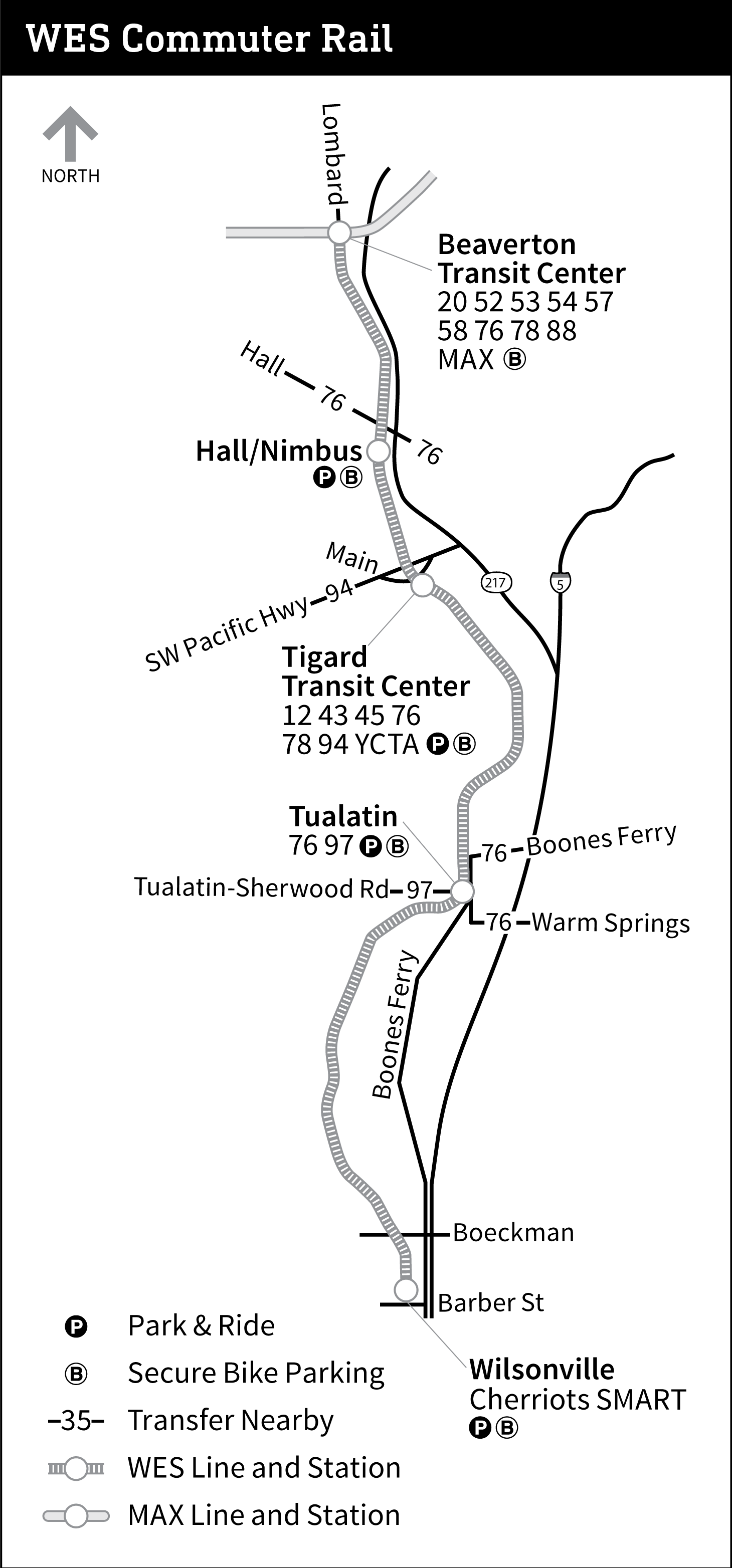
MAX stations are often served by or connected with other modes of public transit. Eleven stations are designated as transit centers with connections to multiple local and intercity bus routes.[196] Beaverton Transit Center is the only MAX-served transit center with a transfer to the region's commuter rail line, WES Commuter Rail, which operates between Beaverton and Wilsonville in Washington County.[197] Within the Portland Transit Mall, trains connect with buses serving downtown Portland; bus stops take up transit mall blocks unoccupied by light rail platforms.[198] MAX riders can transfer to the Portland Streetcar at points where MAX and streetcar lines intersect and to Amtrak via two stations near Portland Union Station.[199][198] The Red Line operates as an airport rail link with a stop at a MAX station attached to the main passenger terminal of Portland International Airport.[200]
TriMet has built a total of six infill stations. Four were built on the original Eastside MAX alignment—Mall/Southwest 4th Avenue (1990), Mall/Southwest 5th Avenue (1990),[201] Convention Center (1990),[202] and Civic Drive (2010)[203]—while two were built on the Portland Transit Mall—PSU South/Southwest 6th and College (2012) and PSU South/Southwest 5th and Jackson (2012).[73] On March 1, 2020, TriMet permanently closed the Mall infill stations in an effort to speed up travel times in downtown Portland. The agency also closed Kings Hill/Southwest Salmon Street station (originally for a trial period, but is now permanent).[204][205]
 Morrison/SW 3rd Ave, a surface station in downtown Portland
 Clackamas Town Center Transit Center, a station alongside Interstate 205
 Washington Park, the only underground MAX station
 Albina/Mississippi, a surface station along the median of Interstate Avenue


Accessibility


Stations built as part of the Banfield Light Rail Project were originally equipped with electric wheelchair lifts to allow riders using mobility devices to board the system’s high-floor, first-generation vehicles. Due to mechanical and operational issues, only a dozen of the planned 54 lifts serving all 25 stations had been installed by the time the line opened; the final one was installed in May 1987.[206][207] Each station had two lifts, one for each direction of travel.[208] They were installed on platforms rather than on trains to prevent malfunctions from delaying service,[27] but as ridership increased, the lifts themselves became a source of delays. Many users also felt stigmatized by their "boxy" design and time-consuming operation.[209][210]
After the Americans with Disabilities Act (ADA) was signed into law, TriMet developed a paratransit plan in January 1992.[211] Shortly before the start of the Westside MAX project, MAX became the first light rail system in North America to procure low-floor vehicles, following a TriMet study of European systems.[209] The low-floor cars, jointly developed by TriMet and Siemens,[212] entered service in August 1997.[210]
MAX achieved full accessibility in April 1999.[5]: 53 Ticket vending machines provide information and instructions in audio, braille, and raised lettering. Station platforms also have signs with braille and raised lettering to indicate which lines provide service and where they go. The edge of platforms have tactile paving to warn riders from standing too close to the edge.[213] Non-street-level platforms may be accessed with elevators.[192] Most light rail cars, with the exception of Type 1, are low-floor and have ramps that extend onto platforms to allow mobility devices to board.[213] High-floor Type 1 cars are paired with low-floor Type 2 or 3 cars to maintain accessibility.[214] In each train, an audio system and LED signs announce the name of each upcoming station. All trains have spaces and priority seating areas reserved for seniors and people with disabilities, and service animals are permitted on board.[213]
In 2011, TriMet began upgrading the oldest sections of MAX to improve pedestrian safety and compliance with updated ADA standards.[215] TriMet installed pipe barriers at Gateway Transit Center platform crossings to force pedestrians to slow down and face oncoming trains before crossing the tracks and realigned sidewalks and crosswalks at four at-grade crossings in Gresham. Other improvements made throughout the line include the installation of pedestrian warning signals and tactile paving upgrades.[216]
Parking
_-_2.jpg)
Based on a report published in 2019, TriMet provides a total of 12,614 park-and-ride spaces, of which 10,219 directly serve 25 MAX stations. The agency's parking facilities are either surface lots or multi-level garages,[217]: 2–3 and they are free to use. TriMet allows vehicles to park at most stalls overnight as long as they do not exceed 24 hours.[218] At some locations, TriMet negotiates with nearby establishments for additional parking spaces.[219] Westside MAX stations contain 3,643 parking spaces, the most number of spaces in a corridor.[217]: 3 Clackamas Town Center Transit Center on the I-205 MAX segment includes a 750-space parking garage, the largest capacity of any single MAX station. Southeast Holgate Boulevard station, also on the I-205 MAX, provides the fewest parking spaces with 125 stalls.[218]
In the 2019 report, passengers originating from TriMet park and rides accounted for five percent of TriMet's total weekday ridership. In 2017, the Portland–Milwaukie segment had a 100-percent usage rate of its available spaces while the Westside MAX segment had 85 percent. The corridor with the lowest use of available parking spaces was the I-205 MAX at 30 percent; TriMet attributes this to factors such as inconvenient lot access and the Green Line's indirect route to downtown Portland compared with the availability of more direct bus routes. The cost-per-space for building park and rides is estimated at $18,000 per surface-lot space and $52,000 per structured space.[217]: 3–5
TriMet additionally offers four different bicycle parking options at its MAX stations, although not all options are available at every station.[220] Bike and rides are secure, enclosed spaces that are accessible by keycard and are monitored 24 hours per day by security cameras; as of 2020[update] they are available at eight stations.[221] Electronic bicycle lockers, or eLockers, are secure lockers that may also be accessed by keycard and are made available on a first-come, first-served basis. TriMet contracts some keycard access to BikeLink and uses its Hop Fastpass on others.[221][222] Other lockers may be rented by users.[223] Bicycle racks are the most common form of bicycle parking.[224]
Rolling stock
.jpg)

As of January 2025[update], TriMet operates six models of light rail cars, designated as "Type 1" through "Type 6",[225] two of which are successive upgrades of the same base model. The MAX system’s 145 cars range in length from 88 feet (26.8 m) to 95 feet (29.0 m) and are used interchangeably across all lines.[226][227][214] Downtown Portland's 200-foot (61 m) blocks permit the operation of only one- or two-car consists.[228][229] Type 2 and Type 3 low-floor cars may operate either individually or coupled with Type 1, Type 2, or Type 3 cars. Type 1 high-floor cars are also capable of running individually, but TriMet does not do this due to a lack of wheelchair access. Instead, high-floor cars are coupled with low-floor cars. Type 4 and 5 cars can only be coupled to one another,[214] and Type 6 cars can run as single cars or coupled with other Type 6 cars.
Twenty-six Type 1 high-floor vehicles were produced for the Banfield light rail project by a joint venture between Bombardier and La Brugeoise et Nivelles beginning in 1983.[227] TriMet announced it would purchase seven additional vehicles that August,[230] but a budget shortfall forced the agency to withdraw this proposal the following November.[231] The cars are similar in design to Bombardier vehicles that had been used in Rio de Janeiro.[227] Bombardier built the frames in Quebec but its factory in Barre, Vermont, manufactured the majority of each car,[232] the first of which arrived in Portland in 1984.[233] Each 45-short-ton (41 t) car is single-articulated and contains six axles.[214][234] The high floors connect with the low platforms through interior steps, which necessitated platform wheelchair lifts until the arrival of low-floor cars.[214] A car sits 76 people and has an overall capacity of 166.[227][235] The Type 1 was officially retired in April 2026, with a special farewell event taking place on April 18.[236]
In 1992, TriMet officials conducted an accessibility study and determined that low-floor cars were the most cost-effective alternative to providing universal access.[214] The following year, TriMet procured 39 Siemens SD660, and MAX became the first light rail system in North America to acquire low-floor train sets.[237][238][239] These Type 2 cars were equipped with doorway wheelchair ramps.[240] They entered service during the partial opening of the Westside MAX in 1997.[241] By 2000, TriMet had ordered 17 more Type 2 cars including six for the Airport MAX project.[56][214] The system's 27 Type 3 vehicles, which the agency purchased as part of the Interstate MAX project and first brought into use in 2003, are the same model as the Type 2 vehicles but with technical upgrades and a new livery.[214][242]
Twenty-two Siemens S70 low-floor cars, which were designated Type 4, were purchased in conjunction with the I-205 MAX and Portland Transit Mall projects, and were first used in 2009. Type 4 cars have a more streamlined design and more seating, and are lighter and more energy-efficient than the previous models. The Type 4 cars were the first in the MAX network to use LED-type destination signs.[243] The second series of S70 cars, TriMet's Type 5 vehicles, were procured for the Portland–Milwaukie light rail project. TriMet placed an order for the Type 5 cars with Siemens in 2012 and delivery commenced in 2014.[244] These vehicles include some improvements over the Type 4 cars, including less-cramped interior seating, and improvements to the air-conditioning system and wheelchair ramps.[245][246] These introduced a new seating layout in the center section, among other changes, and Siemens later retroactively redesignated TriMet's Type 5 cars as model S700.[247]
In July 2019, TriMet placed an order for 26 Siemens S700 light rail vehicles to replace the system's 26 Type 1 vehicles.[212] The order was expanded to 30 cars in June 2021.[248] The first car was delivered in December 2022, and the type is designated Type 6.[249][250] In January 2025, Type 6 vehicles began entering service, with vehicles 603 and 605 being the first two cars to enter revenue service.[225]
Services
From Monday to Thursday, MAX trains run for 221⁄2 hours per day. Additional late-night trips are provided on Fridays, and except for additional late-night trips on Saturdays, weekend service runs on a slightly reduced schedule.[251] TriMet designates all MAX lines as "Frequent Service" routes, which ensures service runs on a 15-minute headway for most of each day.[252] During the early morning and late evening hours, trains operate with headways of up to 30 minutes. During rush hours, headways can be as short as three minutes, particularly in the central section of the system where lines overlap.[4] At many stations, a live display shows the destination and time-to-arrival of the next several trains using data gathered by a vehicle tracking system installed on the light rail tracks.[253]
Ridership
| Fiscal year | Ridership | %± |
|---|---|---|
| 1987[254] | 7,200,000 | — |
| 2000 | 21,165,600 | +194.0% |
| 2005 | 31,920,000 | +50.8% |
| 2010 | 38,390,400 | +20.3% |
| 2015 | 37,746,000 | −1.7% |
| 2016 | 40,019,560 | +6.0% |
| 2017 | 39,699,760 | −0.8% |
| 2018 | 38,906,694 | −2.0% |
| 2019 | 38,817,600 | −0.2% |
| 2020 | 30,780,230 | −20.9% |
| 2021 | 14,798,155 | −51.9% |
| 2022 | 18,647,585 | +26.0% |
| 2023 | 21,899,720 | +17.4% |
| 2024 | 24,069,880 | +9.9% |
| Source: TriMet[255] | ||
MAX carried over 38.8 million total passengers in 2019, an average of 120,900 riders per day on weekdays. This is slightly lower than the number of riders recorded in 2018 and represents the system's third consecutive year of fallen ridership. MAX ridership peaked in 2012, when the system recorded around 42.2 million annual passengers. 2016 marks the last year ridership increased; this was due to the opening of the Orange Line.[255] TriMet attributes falling ridership to perceived crime within trains and stations and lower-income riders being forced out of the inner city by rising housing prices.[256][257] In 2019 (prior to the COVID-19 pandemic), MAX was the fourth-busiest light rail system in the United States after the light rail services of Metro Rail in Los Angeles, the MBTA in Boston, and Muni Metro in San Francisco.[258]
Fares

.jpg)
As is standard practice on North American light rail systems,[259] MAX uses proof-of-payment for fare collection, and stations do not have ticket barriers.[185] Since 2017, TriMet has employed an automated fare collection system through a stored-value, contactless smart card called Hop Fastpass,[260] which can be purchased from the TriMet ticket office or participating retail outlets.[261][262] Smartphone users may download a virtual version of Hop Fastpass,[263][264] while single-use Hop Fastpass tickets are dispensed by ticket vending machines at every MAX station.[265][266] Smartphones with a debit or credit card loaded into Google Pay, Samsung Pay, or Apple Pay, and Portland Streetcar 21⁄2-hour tickets and one-day passes can also be used to board MAX.[267][268] Riders must tap their fare medium onto a card reader with each boarding.[269] Fares are flat rate and are capped according to use.[270] Using Hop Fastpass, riders may transfer to the Portland Streetcar and other TriMet and C-Tran services.[271]
In 2025, TriMet replaced all of its ticket vending machines with new machines that dispense only Hop cards at all of its stations, in a project that began in December 2024.[272]
Late-night bus service
On August 25, 2024, TriMet introduced four new bus routes to replace late-night MAX services, to expand the length of time available each night for routine overnight maintenance. The new routes replace the last one or two MAX trips of the night on the Blue (two bus routes), Red, and Yellow Lines, but not the Green Line.[273][274][275] This practice had already been in effect on the Orange Line since its opening in 2015.[276][277]
Discontinued services
From the MAX system's opening until 2012, riding trains within Fareless Square, which was known as the Free Rail Zone from 2010 to 2012, was free of charge. Fareless Square included all of downtown and, starting in 2001, part of the Lloyd District. The 37-year-old fare-free zone was discontinued on September 1, 2012, as part of system-wide cost-cutting measures. As part of the same budget cuts, TriMet discontinued its zonal fares and moved to a flat-fare system. Zones had been in place since 1986; higher fares were charged for longer journeys across four paid zones.[74][173]
The MAX Mall Shuttle operated on weekday afternoons from when it was introduced on September 14, 2009, until 2011.[278] It acted as a supplement to the light rail service provided on the Portland Transit Mall by the Green and Yellow lines.[279] The Mall Shuttle operated between Union Station and Portland State University every 30 minutes from noon until 5:30 p.m.[279] TriMet discontinued this supplementary shuttle service on June 5, 2011.[280][281] Along with bus services, the mall continues to be served by two MAX lines in each direction—Green and Yellow lines northbound and Green and Orange lines southbound—which provide a combined average headway of 7.5 minutes in each direction at most times.
The Portland Vintage Trolley operated on the MAX system on most weekends from 1991 until 2014, serving the same stops. This service used 1991-built replicas of 1904 Portland streetcars. Originally, the Vintage Trolley service followed a section of the original MAX line between the Library and Galleria stations and Lloyd Center. In September 2009, the service moved to the newly opened MAX alignment along the transit mall, running between Union Station and Portland State University,[145][282] and remained on this route in subsequent seasons. In 2011, the service was reduced to seven or eight Sundays per year,[283] and in July 2014 it was discontinued entirely and the two remaining faux-vintage cars were sold to a group planning a streetcar line in St. Louis.[284][285]
Safety
TriMet employs a transit police division to patrol MAX and other TriMet property. Most of its officers serve with local law enforcement agencies and are assigned terms with the transit police; this partnership with local police enables the closest available unit to respond to incidents. TriMet also partners with the Transportation Security Administration, which provides a canine unit. Riders are encouraged to alert TriMet employees using on-board intercoms or to dial 9-1-1 upon witnessing a crime or suspicious activity.[286] TriMet operates over 4,000 security cameras; all MAX trains and stations became fully equipped with cameras in 2014.[287]
2017 train stabbing incident
On May 26, 2017, at approximately 4:30 pm, a man fatally stabbed two people and injured a third after he was confronted for shouting anti-Muslim slurs at two teenage girls inside a MAX train.[288] Two men—a technician and U.S. Army veteran, and a recent university graduate—died from wounds to their necks while a third male victim survived.[289] The attacker, who described himself as a white nationalist,[290] was arrested and charged with murder, attempted murder, and other crimes.[291] On February 21, 2020, the perpetrator was found guilty on all charges, including two counts of first-degree murder.[292] This resulted in a mural being painted on the station entrance of the Hollywood Transit Center, where the stabbing occurred.[293]
2023 Portland Streetcar collision
On November 15, 2023, shortly after 10:00am, a MAX train collided with a Portland Streetcar in the Lloyd District and injured two people on board.[294][295][296]
See also
References
- ↑ "Transit Ridership Report Fourth Quarter 2025" (PDF). American Public Transportation Association. February 20, 2026. Retrieved February 27, 2026.
- ↑ "Transit Ridership Report Fourth Quarter 2025" (PDF). American Public Transportation Association. February 20, 2026. Retrieved February 27, 2026.
- ↑ "TriMet At-A-Glance". TriMet. January 2016. Archived from the original on January 31, 2016. Retrieved March 28, 2016.
- 1 2 3 4 5 6 7 "Power, Signals and Traffic Interface" (PDF). TriMet. July 2016. Archived (PDF) from the original on October 5, 2022. Retrieved October 5, 2022.
- 1 2 3 4 5 6 7 8 9 Selinger, Philip (2015). "Making History: 45 Years of Transit in the Portland Region" (PDF). TriMet. OCLC 919377348. Archived from the original on May 9, 2018. Retrieved July 26, 2018.
- 1 2 Thompson, Richard M. (2010). Portland's Streetcar Lines. Arcadia Publishing. pp. 7–8. ISBN 978-0-7385-8126-2. Archived from the original on January 31, 2021. Retrieved March 12, 2019.
- ↑ "A History of Public Transit in Portland". TriMet. Archived from the original on December 7, 2018. Retrieved December 7, 2018.
- ↑ "Portland's Interurban Years". TriMet. Archived from the original on December 6, 2018. Retrieved December 5, 2018.
- ↑ Thompson, Richard (2006). Portland's Streetcars. Arcadia Publishing. pp. 9–17. ISBN 978-1-4396-3109-6. Archived from the original on January 31, 2021. Retrieved March 11, 2019.
- 1 2 Thompson, Richard M. (2012). Portland's Interurban Railway. Arcadia Publishing. ISBN 978-0-7385-9617-4. Archived from the original on October 5, 2022. Retrieved November 30, 2020.
- ↑ Killen, John (June 22, 2015). "Past Tense Oregon: New MAX line recalls of Portland's first - and last - interurban route". The Oregonian. Archived from the original on May 22, 2023. Retrieved May 22, 2023.
- ↑ Turnquist, Kristi (February 24, 2011). "Traveling through the history of Portland's streetcars". The Oregonian. Archived from the original on March 26, 2019. Retrieved March 26, 2019.
- ↑ "Portland streetcars--something old, something new". Portland Business Journal. July 19, 2001. Archived from the original on October 14, 2012. Retrieved July 1, 2019.
- ↑ Maves, Norm Jr.; Stewart, Bill (July 20, 2001). "Trolley's late scribe was 'delighted' at new line". The Oregonian. p. 32.
- ↑ David, Ken (January 26, 1958). "Company Surprises Customers: Firm Abandons Passenger Run after Sundown". The Oregonian. p. 1.
- ↑ Young, Bob (March 8, 2005). "Highway to Hell". Willamette Week. Archived from the original on September 17, 2018. Retrieved July 26, 2018.
- ↑ Paglin, Morton (June 28, 2004). "Effort to stop freeway remembered". The Oregonian. p. B6.
- ↑ West Portland Park-and-ride, Pacific Hwy, I-5, Multnomah County: Environmental Impact Statement (Report). Federal Highway Administration. 1975. p. 11. Archived from the original on July 31, 2022. Retrieved July 26, 2018.
- ↑ Fox, Gerald (October 2009). "LRT v Buses: Why Portland chose light rail". Tramways & Urban Transit: 391.
- ↑ "Meetings on transit ideas slated". The Oregonian. May 4, 1975. p. C2.
- ↑ "Tri-Met board backs Banfield rail option". The Oregonian. February 8, 1977. p. 1.
- ↑ Hortsch, Dan (September 27, 1978). "Tri-Met board votes to back Banfield light-rail project". The Oregonian. p. F1.
- ↑ Federman, Stan (March 27, 1982). "At ground-breaking: Festivities herald transitway". The Oregonian. p. A12.
- ↑ Koberstein, Paul (September 7, 1986). "Riders swamp light rail as buses go half-full and schedules go by the way". The Oregonian. p. A1.
- ↑ Austin, David (July 26, 1986). "MAX winning moniker for $214 million light-rail line". The Oregonian. p. C2.
- ↑ Selinger 2019, p. 46.
- 1 2 3 "Banfield Light Rail Eastside MAX Blue Line" (PDF). TriMet. July 2016. Archived from the original (PDF) on May 9, 2018. Retrieved August 2, 2018.
- 1 2 Hillsboro Extension of the Westside Corridor Project, Washington County: Environmental Impact Statement (Report). Federal Transit Administration. 1994. p. P1–P5. Retrieved July 29, 2018.
- ↑ Federman, Stan (November 7, 1987). "Tri-Met heats up study for westside light rail". The Oregonian. p. E14.
- ↑ Hamilton, Don (February 23, 2000). "Shirley Huffman, fiery lobbyist, earns praise; Hard work and a sharp phone call put light-rail trains into downtown Hillsboro". The Oregonian. p. E2.
- ↑ Oliver, Gordon (August 8, 1993). "Groundbreaking ceremonies set to launch project". The Sunday Oregonian. "Westside Light Rail: Making Tracks" (special section), p. R1.
- ↑ O'Keefe, Mark (September 1, 1997). "New MAX cars smooth the way for wheelchairs". The Oregonian. p. B12.
- ↑ Oliver, Gordon; Hamilton, Don (September 9, 1998). "Go west young MAX". The Oregonian. p. C1.
- ↑ "Where's east side light rail going next?". The Oregonian. April 3, 1986. p. 2.
- ↑ Briggs, Kara (July 24, 2002). "Metro considers transit options along I-205". The Oregonian. p. D2.
- ↑ Redden, Jim (September 10, 2009). "After 35 years of waiting, TriMet's Green Line hits all the parties: Thousands ride new I-205 line that was born of a '70s freeway rebellion". Portland Tribune. Archived from the original on June 8, 2011. Retrieved May 13, 2014.
- ↑ Kohler, Vince (May 23, 1988). "Joint efforts of business, government could spur rail line; both groups need to finance, back line along I-205, panel says". The Oregonian. p. B5.
- ↑ Kohler, Vince; Stewart, Bill (September 10, 1989). "Light-rail proposals gain ground in Congress; senate panel approves transportation funding bill, aiding plans for new Oregon City, Vancouver lines". The Oregonian. p. C2.
- ↑ Stewart, Bill (January 12, 1993). "County light-rail project gains momentum". The Oregonian. p. B2.
- ↑ Oliver, Gordon (March 11, 1993). "Citizens advisory committee endorses pair of light-rail routes". The Oregonian. p. B3.
- ↑ Oliver, Gordon (March 7, 1993). "Decisions to be made soon on north–south light rail". The Oregonian. p. C4.
- ↑ Leeson, Fred (February 13, 1994). "Planners narrowing options for north–south light-rail line". The Oregonian. p. C5.
- ↑ McCarthy, Dennis (September 15, 1994). "Light-rail service? On to Oregon City!". The Oregonian. p. D2.
- ↑ "Ask the O (Q & A): Q:Why is the next phase of light rail being called 'South–North' instead of 'North–South', a more familiar use of the words?". The Oregonian. December 1, 1994.
- ↑ Stewart, Bill (February 8, 1995). "Clark County turns down north–south light rail". The Oregonian. p. A1.
- ↑ Oliver, Gordon; Stewart, Bill (March 1, 1995). "MAX may skip Clark County, N. Portland". The Oregonian. p. B1.
- ↑ Green, Ashbel S.; Mapes, Jeff (August 4, 1995). "Legislature is finally working on the railroad". The Oregonian. p. A1.
- 1 2 "Some light-rail history". The Oregonian. October 7, 1996. p. A8.
- ↑ Spicer, Osker (January 31, 1996). "Light-rail would be good for areas". The Oregonian. p. C2.
- ↑ Oliver, Gordon; Hunsberger, Brent (November 7, 1996). "Tri-Met still wants that rail line to Clackamas County". The Oregonian. p. D1.
- ↑ Oliver, Gordon (February 12, 1997). "South–north light-rail issue keeps on going". The Oregonian. p. A1.
- ↑ Oliver, Gordon (November 7, 1998). "South–north line backers find themselves at a loss after election day defeat". The Oregonian. p. B1.
- 1 2 "Airport MAX Red Line" (PDF). TriMet. July 2016. Archived from the original (PDF) on August 28, 2018. Retrieved August 24, 2018.
- ↑ Oliver, Gordon (January 22, 1997). "Port wants MAX to run to airport". The Oregonian. p. A1.
- ↑ Rose, Michael (December 19, 1997). "PDX light rail may lead to south-north line". Portland Business Journal. p. 1.
- 1 2 Stewart, Bill (June 17, 1999). "Light-rail line to PDX starting to take shape". The Oregonian. p. B1.
- ↑ Selinger 2009, p. 82. sfn error: no target: CITEREFSelinger2009 (help)
- ↑ Oliver, Gordon (September 10, 1998). "Light rail to airport gets closer to reality". The Oregonian. p. B1.
- ↑ Oliver, Gordon (September 11, 2001). "Portland now 'the city that moves', mayor says [opening of MAX Red Line]". The Oregonian. p. 1.
- ↑ Oliver, Gordon (September 21, 2001). "Unknowns cloud PDX's future". The Oregonian. p. D1.
- ↑ "History cancels PDX party". The Oregonian. September 15, 2001. p. D8.
- 1 2 "Systems News [regular news section]". Tramways & Urban Transit. UK: Ian Allan Publishing. December 2000. p. 471. ISSN 1460-8324.
With the light rail system due to expand to two services in September 2001, and three in 2004 (with all three using the same routing and stops in the city centre), Tri-Met has decided to assign route colours as follows ...
- ↑ Stewart, Bill (September 7, 2001). "Airport MAX rolls out Monday". The Oregonian. p. B1.
- ↑ Leeson, Fred (August 27, 2003). "MAX fares increase, direct service from Beaverton to PDX starts". The Oregonian. p. D2.
- ↑ Oliver, Gordon (March 16, 1999). "New light-rail plan rises from the ashes". The Oregonian. p. 1.
- ↑ Stewart, Bill (March 25, 1999). "Tri-Met involvement urged in north light-rail line". The Oregonian. p. B3.
- ↑ Oliver, Gordon (May 3, 1999). "Tri-Met adds detail to proposal to build light rail in the north". The Oregonian. p. C2.
- ↑ Stewart, Bill (February 16, 2001). "Interstate MAX work will begin with Monday ceremony". The Oregonian. p. D3.
- ↑ Stewart, Bill (August 26, 1999). "Interstate MAX on track but not final". The Oregonian. p. D2.
- ↑ Stewart, Bill (February 5, 2000). "NW prominent in Clinton money plan. MAX: The North Portland Interstate". The Oregonian. p. A1.
- ↑ Leeson, Fred (April 25, 2004). "The Yellow Line: Open for business". The Oregonian. p. B5.
- 1 2 3 "New MAX line opens downtown". Portland Tribune. August 28, 2009. Archived from the original on January 3, 2015. Retrieved May 13, 2014.
- 1 2 Redden, Jim (September 24, 2009). "Line's last piece stirs money questions". Portland Tribune. Retrieved September 2, 2012.[dead link]
- 1 2 Bailey, Everton Jr. (August 30, 2012). "TriMet boosts most fares starting Saturday; some routes changing". The Oregonian. Archived from the original on September 2, 2012. Retrieved September 2, 2012.
- 1 2 Lum, Brian (June 19, 2015). "You asked: How will the Orange Line work in downtown Portland?". TriMet. Archived from the original on October 26, 2015.
- ↑ Rose, Joseph (May 8, 2001). "New MAX plan tries the double-team approach". The Oregonian. p. D1.
- ↑ Rose, Joseph (June 6, 2001). "Metro planners will study two south light-rail lines". The Oregonian. p. E3.
- 1 2 Oppenheimer, Laura (January 27, 2003). "New MAX plans arrive for input; a revived bid to expand light rail to Milwaukie, one of five transit proposals, may fare better now that former critics are on board". The Oregonian. p. E1.
- ↑ Leeson, Fred (March 27, 2003). "TriMet board agrees to plan for southeast light-rail lines". The Oregonian. p. C2.
- ↑ Oppenheimer, Laura (April 18, 2003). "Metro gives final OK to MAX lines". The Oregonian. p. D6.
- 1 2 Leeson, Fred (April 15, 2003). "Light-rail line likely addition to transit mall". The Oregonian. p. B1.
- ↑ Mayer, James (February 8, 2006). "Metro rail projects hit funding fast track". The Oregonian. p. A1.
- ↑ Mayer, James (February 8, 2007). "Light rail in Bush's 2008 budget". The Oregonian. p. C5.
- ↑ Rivera, Dylan (September 13, 2009). "Thousands on MAX go Green Festivities and free rides draw takers for the new downtown–Clackamas Town Center line". The Oregonian.
- ↑ McCarthy, Dennis (December 20, 2001). "Milwaukie group poses surprise light-rail option". The Oregonian. p. C3.
- ↑ Mortenson, Eric (May 2, 2008). "Panel realigns route of new light-rail span". The Oregonian. p. D1.
- 1 2 Libby, Brian (October 2015). "Bridge to the Future (The Bridge that Bans Cars)". The Atlantic. 316 (3): 42–43. Archived from the original on April 29, 2020. Retrieved September 27, 2015.
- ↑ Rose, Joseph (June 29, 2011). "Construction begins on new light-rail bridge in Portland that will go up 'piece by piece'". The Oregonian. Archived from the original on January 5, 2021. Retrieved July 27, 2013.
- ↑ Theriault, Denis C. (May 31, 2012). "Checkpoint Clackamas! Keeping Portland Out—to Let More Republicans In?". The Portland Mercury. Archived from the original on January 3, 2016. Retrieved February 22, 2016.
- ↑ Zheng, Yuxing (September 18, 2012). "Clackamas County anti-rail measure passes comfortably; effect could resonate for decades". The Oregonian. Archived from the original on March 4, 2016. Retrieved February 22, 2016.
- ↑ Selinger 2019, pp. 95–96.
- ↑ Njus, Elliot (September 12, 2015). "The wait's over: TriMet's Orange Line, Tilikum Crossing up and running". The Oregonian. Archived from the original on August 1, 2018. Retrieved September 18, 2015.
- 1 2 Howard, John William (October 25, 2017). "TriMet considering expansion of MAX Red Line to county fairgrounds". Hillsboro Tribune. Archived from the original on October 10, 2018. Retrieved August 22, 2018.
- 1 2 "MAX Red Line Improvements Project" (PDF). TriMet. Archived from the original (PDF) on March 2, 2019. Retrieved March 2, 2019.
- 1 2 "A Better Red" (PDF). TriMet. Archived from the original (PDF) on September 28, 2021. Retrieved September 28, 2021.
- ↑ "MAX Red Line Extension and Reliability Improvements Project, Project Briefing to JPACT" (PDF). TriMet. January 18, 2017. Archived (PDF) from the original on October 23, 2021. Retrieved June 11, 2024.
- ↑ "Meet the New MAX". TriMet. Archived from the original on June 6, 2024. Retrieved June 27, 2024.
- ↑ "Parametrix to complete preliminary design for MAX Red Line extension". Parametrix. February 18, 2018. Archived from the original on September 13, 2018. Retrieved September 6, 2018.
- ↑ "TriMet moves forward with plan to extend MAX Red Line into Hillsboro". KPTV. April 24, 2019. Archived from the original on April 25, 2019.
- ↑ Corselli, Andrew (May 29, 2020). "FTA Announces $891MM in Funding". Railway Age. Archived from the original on May 29, 2020. Retrieved May 29, 2020.
- ↑ Danko, Pete (May 29, 2020). "TriMet gets $100M from feds for MAX Red Line project". Portland Business Journal. Archived from the original on May 29, 2020. Retrieved May 29, 2020.
- ↑ Corselli, Andrew (February 13, 2020). "TriMet Selects Parametrix to Finish 'A Better Red'". Railway Age. Archived from the original on March 10, 2020. Retrieved February 13, 2020.
- ↑ "Design – A Better Red". TriMet. Archived from the original on May 26, 2021. Retrieved May 26, 2021.
- ↑ Altstadt, Roberta (September 29, 2021). "(VIDEO) FTA, TriMet and partners officially break ground on 'A Better Red' MAX extension and improvement project". TriMet. Archived from the original on June 7, 2023. Retrieved June 27, 2024.
- ↑ "A Better Red MAX disruption April 2–9". TriMet. Archived from the original on April 5, 2022. Retrieved April 4, 2022.
- ↑ TriMet [@trimet] (April 10, 2022). "MAX Red Line has resumed normal service. Thank you for your patience while we completed this necessary work for the Better Red project. Here are some photos from our work over the past week" (Tweet). Retrieved April 10, 2022 – via Twitter.
- ↑ Campbell, Sam (April 1, 2022). "MAX Red Line service halted during weeklong construction". KOIN. Archived from the original on April 3, 2022. Retrieved April 3, 2022.
- ↑ Villanueva, Mia (April 1, 2022). "Temporary MAX Red Line closure starts Saturday". KPTV. Archived from the original on April 1, 2022. Retrieved April 3, 2022.
- ↑ Luczak, Marybeth (September 27, 2021). "TriMet's 'A Better Red' Receiving $99.1MM CIG Grant". Railway Age. Archived from the original on September 29, 2021. Retrieved December 22, 2021.
- ↑ "FTA, TriMet and partners officially break ground on 'A Better Red' MAX extension and improvement project". Mass Transit. September 29, 2021. Archived from the original on September 30, 2021. Retrieved December 22, 2021.
- ↑ Stein, Rosemarie (June 14, 2023). "TriMet shuts down MAX Red Line to PDX for more than 4 months beginning Sunday". The Oregonian. Archived from the original on June 14, 2023. Retrieved June 14, 2023.
- ↑ Graf, Tyler (June 12, 2023). "TriMet's A Better Red project requires 126-day shutdown of MAX Red Line starting this weekend". TriMet. Archived from the original on June 14, 2023. Retrieved June 14, 2023.
- ↑ "MAX Improvements Project". trimet.org. Archived from the original on February 25, 2024. Retrieved February 25, 2024.
- ↑ McLawhorn, Jennifer (February 16, 2024). "TriMet Gateway North MAX Station Opens in March". Railway Track & Structures. Archived from the original on February 25, 2024. Retrieved February 25, 2024.
- ↑ McKinney, Kevin (May 2024). "Rush Hour [transit news section]". Passenger Train Journal. Vol. 48, no. 2 – Second quarter 2024. White River Productions, Inc. pp. 68–69. ISSN 0160-6913.
- ↑ Plante, Amiee; Salk, Ariel (August 26, 2024). "Major changes coming to MAX, bus service as TriMet completes Hillsboro Airport expansion". KOIN. Archived from the original on August 27, 2024. Retrieved August 28, 2024.
- ↑ Anderson, Luisa (August 28, 2024). "TriMet's MAX Red Line from PDX airport to Hillsboro officially opens". KGW. Retrieved August 28, 2024.
- 1 2 Metro 2023a, p. 1-1.
- ↑ Metro 2023a, p. 1-17.
- ↑ Metro 2023a, p. 1-18.
- ↑ Metro 2023b, p. 3.
- ↑ Metro 2023b, pp. 31–34.
- ↑ "Southwest Corridor Light Rail Project (Factsheet)" (PDF). TriMet. Archived (PDF) from the original on July 22, 2019. Retrieved July 22, 2019.
- ↑ Thomas, Keaton (November 10, 2020). "TriMet puts new light rail line on hold after measure's failure". KATU. Archived from the original on November 13, 2020. Retrieved November 22, 2020.
- ↑ Federal Highway Administration; Federal Transit Administration; Oregon Department of Transportation; Washington State Department of Transportation; Metro; Southwest Washington Regional Transportation Council; Tri-County Metropolitan Transportation District of Oregon; Clark County Public Transportation Benefit Area; et al. (March 2026). Chapter 2. Description of Alternatives (PDF). Interstate Bridge Replacement Program, Final Supplemental Environmental Impact Statement and Section 4(F) Evaluation (Report). p. 2-5. Retrieved April 26, 2026.
- ↑ Federal Highway Administration; Federal Transit Administration; Washington State Department of Transportation; Oregon Department of Transportation; Southwest Washington Regional Transportation Council; Metro; Clark County Public Transportation Benefit Area; Tri-County Metropolitan Transportation District of Oregon; et al. Chapter 2 - Introduction and Section 2.2 The Locally Preferred Alternative (PDF). Columbia River Crossing, Final Supplemental Environmental Impact Statement and Section 4(F) Evaluation (Report). p. 2-4. Archived from the original (PDF) on March 26, 2014. Retrieved March 26, 2014.
- ↑ Federal Highway Administration; Federal Transit Administration; Washington State Department of Transportation; Oregon Department of Transportation; Southwest Washington Regional Transportation Council; Metro; Clark County Public Transportation Benefit Area; Tri-County Metropolitan Transportation District of Oregon; et al. Section 2.2.1 Multimodal River Crossing and Highway Improvements through Section 2.2.2 Transit (PDF). Columbia River Crossing, Final Supplemental Environmental Impact Statement and Section 4(F) Evaluation (Report). p. 2-22–2-29. Archived from the original (PDF) on March 26, 2014. Retrieved March 26, 2014.
- ↑ Mathieu, Steve (July 1, 2013). "Officials adjust focus to a future bridge replacement". The Columbian. Retrieved July 2, 2013.
- ↑ Mapes, Jeff (July 2, 2013). "What killed the Columbia River Crossing? A razor-thin Senate election last November". The Oregonian. Retrieved July 2, 2013.
- ↑ Pitz, Ray (February 5, 2020). "New details on SW Corridor MAX stations include Bridgeport". Portland Tribune. Archived from the original on February 8, 2020. Retrieved February 14, 2020.
- ↑ Federal Transit Administration; Metro; Tri-County Metropolitan Transportation District of Oregon (January 2022). Southwest Corridor Light Rail Project, Final Environmental Impact Statement (PDF) (Report). pp. 2-1 – 2-4. Retrieved April 29, 2026.
- ↑ Southwest Corridor Light Rail Project Conceptual Design Report (PDF) (Report). TriMet. 2020. Archived (PDF) from the original on February 6, 2020. Retrieved February 5, 2020.
- ↑ "Portland-area voters decline Measure 26-218". Metro. November 3, 2020. Archived from the original on November 4, 2020. Retrieved November 3, 2020.
- ↑ Theen, Andrew (November 3, 2020). "Voters reject Metro's payroll tax to fund billions in transportation projects". The Oregonian. Archived from the original on November 26, 2020. Retrieved November 24, 2020.
- ↑ Mesh, Aaron (June 13, 2018). "The Price Tag on Light Rail to Bridgeport Village Has Grown by Nearly a Billion Dollars". Willamette Week. Archived from the original on June 14, 2018. Retrieved June 13, 2018.
- ↑ "The MAX Tunnel Study: Examining the feasibility of faster light rail" (PDF). Metro. Archived (PDF) from the original on September 4, 2020. Retrieved November 4, 2019.
- ↑ Njus, Elliot (June 14, 2017). "City planners float idea of subway tunnel through downtown Portland". The Oregonian. Archived from the original on June 19, 2017. Retrieved June 24, 2017.
- ↑ Peel, Sophie (June 28, 2019). "The Idea for MAX Tunnel Under Downtown Emerged From Examination of How to Fix the Steel Bridge Bottleneck". Willamette Week. Archived from the original on June 29, 2019. Retrieved June 28, 2019.
- 1 2 Chase, Louis (March 20, 2026). "Metro Concludes Regional Rail Futures Study". The Reed College Quest. Retrieved April 25, 2026.
- ↑ Chase, Louis (April 11, 2025). "Exclusive: TriMet Conceptualizes Next 20 Years of Portland Transit Policy". The Reed College Quest. Retrieved April 12, 2025.
- 1 2 3 Rail System Map with transfers (PDF) (Map). TriMet. Archived (PDF) from the original on February 10, 2019. Retrieved July 25, 2018.
- ↑ Briggs, Kara (August 29, 2001). "Airport MAX light-rail service in sight". The Oregonian. p. C2.
- ↑ Selinger 2019, p. 83.
- ↑ CH2M HILL, Inc. (December 8, 2017). Steel Bridge Transit Improvements: Long-Term Concept Final Report (PDF) (Report). Metro. p. 2-1. Archived from the original (PDF) on April 16, 2023. Retrieved April 16, 2023.
- 1 2 3 Morgan, Steve (2010). "Expansion for Portland's MAX: New routes and equipment". Passenger Train Journal. 33 (1 – First quarter 2010). White River Productions, Inc.: 38–40.
- ↑ "MAX Blue Line Map and Sechdule". TriMet. Archived from the original on December 16, 2008. Retrieved November 2, 2008.
- ↑ "MAX Red Line Map and Sechdule". TriMet. Archived from the original on December 16, 2008. Retrieved November 2, 2008.
- ↑ "MAX Green Line Map and Sechdule". TriMet. Archived from the original on September 14, 2009. Retrieved September 12, 2009.
- ↑ "MAX Yellow Line Map and Sechdule". TriMet. Archived from the original on December 7, 2008. Retrieved November 2, 2008.
- ↑ "MAX Orange Line Map and Sechdule". TriMet. Archived from the original on February 25, 2016. Retrieved February 18, 2016.
- 1 2 Selinger 2019, p. 66.
- ↑ "MAX Light Rail Project History". TriMet. Archived from the original on May 2, 2023. Retrieved April 28, 2023.
- ↑ "Agency Safety Plan (ASP)" (PDF). TriMet. July 1, 2023. p. 101.
- ↑ Shedd, Tom (November 1987). "MAX: Portland's Light Rail Is an Instant Success". Modern Railroads. Chicago, Illinois: International Thomson Transport Press. pp. 14–15. ISSN 0736-2064.
- ↑ Special Report 221 – Light Rail Transit: New System Successes at Affordable Prices (PDF). Transportation Research Board. 1989. pp. 25, 34, 90, 92, 317, 319, 468. ISBN 0-309-04713-7. Archived (PDF) from the original on July 10, 2018. Retrieved May 14, 2019.
- ↑ Wade, Michael (November 17, 1986). "Popularity of MAX spearheads boost in Tri-Met ridership". The Oregonian. p. B4.
- 1 2 "Westside MAX Blue Line Extension" (PDF). TriMet. July 2016. Archived from the original (PDF) on March 2, 2019. Retrieved April 22, 2019.
- ↑ Sebree, Mac (1994). "Portland's Westside Tunnel: An LRT Breakthrough". 1994 Light Rail Annual & User's Guide. Pasadena, CA: Pentrex. pp. 10–14. ISSN 0160-6913.
- 1 2 "Interstate MAX Yellow Line" (PDF). TriMet. July 2016. Archived from the original (PDF) on July 10, 2018. Retrieved February 23, 2019.
- 1 2 "I-205/Portland Mall MAX Green Line" (PDF). TriMet. July 2016. Archived (PDF) from the original on March 2, 2019. Retrieved April 22, 2019.
- 1 2 "Finance [part of monthly news section]". Railway Gazette International. August 2007. p. 470.
- ↑ Rivera, Dylan (September 5, 2009). "MAX Green Line signals decades of rail growth". The Oregonian. Archived from the original on March 3, 2016. Retrieved May 15, 2019.
- 1 2 "Portland–Milwaukie MAX Orange Line" (PDF). TriMet. July 2016. Archived (PDF) from the original on April 23, 2019. Retrieved May 14, 2019.
- 1 2 Center for Urban Transportation Research. University of South Florida; Transportation Technology Center, Inc. (October 2022). Research Report and Findings: Light Rail Technology Scan and Case Studies (PDF) (Report). Federal Transit Administration. pp. 98, 106. Archived (PDF) from the original on March 13, 2023. Retrieved April 17, 2023.
- ↑ Earisman, Misty (August 7, 2019). "How MAX Moves Downtown". TriMet. Archived from the original on April 18, 2023. Retrieved April 17, 2023.
- 1 2 Flynn, Alyssa (January 17, 2020). "Ask TriMet: Are Cars Allowed on MAX or Streetcar Tracks?". TriMet. Archived from the original on April 18, 2023. Retrieved April 17, 2023.
- 1 2 Tri-County Metropolitan Transportation District of Oregon (November 1, 1981). Banfield Light Rail Project: Conceptual Design Information for the City of Portland (Report). Vol. 9. TriMet Collection. pp. 10, 26–27. Archived from the original on September 28, 2015. Retrieved July 27, 2018.
- ↑ Stewart, Bill (December 17, 1999). "Don't look up, but MAX bridge going in over I-205; strict safety measures are in place to protect motorists, and as the span is built, tracks will start going in on Airport Way". The Oregonian. p. A1.
- ↑ Stewart, Bill; Leeson, Fred (February 26, 2001). "Interstate MAX may cross one of city's longest spans". The Oregonian. p. C3.
- ↑ Mayer, James (April 13, 1991). "Board picks light-rail tunnel". The Oregonian. p. 1.
- ↑ Redden, Jim (August 23, 2008). "Steel Bridge reopened with changes". Portland Tribune. Archived from the original on November 7, 2018. Retrieved July 16, 2019.
- ↑ "Tilikum Crossing, Bridge of the People, brings new connections and new options in 2015" (PDF). TriMet. June 2014. Archived from the original (PDF) on March 2, 2019. Retrieved February 7, 2020.
- 1 2 Federman, Stan (September 5, 1986). "Going to the MAX: Your ticket to light rail". The Oregonian. p. T10.
- ↑ Federman, Stan (September 5, 1986). "Tri-Met stresses safety of light-rail system". The Oregonian. p. T7.
- 1 2 Preusch, Matthew (April 23, 2010). "TriMet's Ruby Junction maintenance yard continues to grow with MAX". The Oregonian. Archived from the original on May 4, 2017. Retrieved April 23, 2019.
- 1 2 Carson, Teresa (July 29, 2016). "Ruby keeps MAX sparkling". The Outlook. Gresham, Oregon. Archived from the original on October 1, 2016. Retrieved April 23, 2019.
- ↑ "Rail Maintenance Facilities" (PDF). TriMet. July 2016. Archived (PDF) from the original on July 14, 2017. Retrieved March 2, 2020.
- ↑ Rose, Joseph (December 6, 2013). "TriMet on verge of sending Portland's vintage holiday trolleys to St. Louis". The Oregonian. Archived from the original on December 10, 2013. Retrieved April 23, 2019.
- ↑ Federman, Stan (June 2, 1983). "Light-rail complex almost complete: Ruby Junction due to open in July; track work beginning". The Oregonian. p. C7.
- ↑ Colby, Richard N. (January 22, 1996). "Light-rail milestone: The $16 million Westside MAX maintenance building in Elmonica is dedicated". The Oregonian (West Metro ed.).
- 1 2 3 4 "Light Rail Stations" (PDF). TriMet. August 2016. Archived (PDF) from the original on March 2, 2019. Retrieved August 5, 2019.
- ↑ Running, Jim (August 18, 1983). "16-block tear-up for light-rail delayed". The Oregonian. p. B1.
- ↑ Howell, Jim (August 13, 2003). "Analyze subway benefits before tearing up transit mall". The Oregonian. p. C9.
- ↑ Lindblom, Mike (July 8, 2014). "Shooting brings attention to light rail's fare inspection force". The Seattle Times. Archived from the original on October 28, 2020. Retrieved March 13, 2020.
- 1 2 Rose, Joseph (March 20, 2015). "Fare turnstiles coming to Portland-Milwaukie MAX stations". The Oregonian. Archived from the original on January 5, 2021. Retrieved August 6, 2019.
- ↑ "Station furnishings, equipment and signage" (PDF). TriMet. February 2010. p. 89. Archived (PDF) from the original on March 3, 2019. Retrieved August 6, 2019.
- ↑ Blevins, Drew (July 23, 2013). "We're adding arrival screens at more Blue and Red Line MAX stations". How We Roll. TriMet. Archived from the original on April 11, 2016. Retrieved April 5, 2015.
- ↑ Miller, Mark (August 18, 2025). "Riding TriMet is easier than ever, thanks to these new features". TriMet. Retrieved April 8, 2026.
- ↑ "Beaverton Transit Center". TriMet. Archived from the original on April 18, 2018. Retrieved April 17, 2018.
- ↑ "Sunset Transit Center". TriMet. Archived from the original on August 23, 2018. Retrieved April 17, 2018.
- ↑ Chan, Kenneth (March 16, 2019). "Former SkyTrain manager trying to speed up Portland's street-level LRT". Daily Hive. Archived from the original on August 7, 2019. Retrieved August 6, 2019.
- 1 2 Becker, Tim (May 1, 2018). "TriMet launching multi-year, multi-million dollar elevator improvement program". TriMet. Archived from the original on August 6, 2019. Retrieved August 6, 2019.
- ↑ "Lents Town Center/SE Foster Road station, 3D satellite view" (Map). Google Maps. Retrieved August 6, 2019.
- ↑ Altstadt, Roberta (August 2, 2019). "UPDATE: TriMet to replace elevators at the deepest transit station in North America". TriMet. Archived from the original on August 6, 2019. Retrieved August 6, 2019.
- ↑ Wozniak, Owen (2012). Biking Portland: 55 Rides From the Willamette Valley to Vancouver. Mountaineers Books. p. 57. ISBN 9781594856532.
- ↑ "Transit Centers". TriMet. Archived from the original on December 4, 2018. Retrieved December 3, 2018.
- ↑ WES Commuter Rail (Map). TriMet. Archived from the original on December 1, 2018. Retrieved December 1, 2018.
- 1 2 Portland City Center and Transit Mall (PDF) (Map). TriMet. Archived from the original (PDF) on February 10, 2019. Retrieved July 30, 2018.
- ↑ "Maps + Schedules - Portland Streetcar". Portland Streetcar. Archived from the original on February 10, 2019. Retrieved October 11, 2018.
- ↑ "Stop ID 10579 – Portland Int'l Airport MAX Station". TriMet. Archived from the original on May 9, 2018. Retrieved August 5, 2019.
- ↑ "Arriving with a smash [photo and caption only]". The Oregonian. March 27, 1990.
A Metropolitan Area Express train breaks through a banner Monday afternoon marking the opening of a new light-rail station in front of Pioneer Place...
- ↑ Mayer, James (September 20, 1990). "Dedication kicks off Convention Center fete". The Oregonian. p. A1.
- ↑ Rose, Joseph (December 1, 2010). "TriMet trains start picking up riders at Gresham's Civic Drive Station". The Oregonian. Archived from the original on October 12, 2012. Retrieved May 9, 2013.
- ↑ Theen, Andrew (February 25, 2020). "2 downtown MAX stations close permanently next week; changes coming to more than a dozen TriMet bus routes". The Oregonian. Archived from the original on March 9, 2020. Retrieved March 9, 2020.
- ↑ Altstadt, Roberta (July 24, 2019). "TriMet to make MAX service more efficient with closure of three stations in Downtown Portland in March 2020". TriMet. Archived from the original on July 24, 2019. Retrieved July 24, 2019.
- ↑ "MAX to complete wheelchair lift installation". The Oregonian (East Metro ed.). October 17, 1986. p. D9.
- ↑ "Fete to mark MAX lift project, completion of park". The Oregonian. June 5, 1987. p. B7.
- ↑ Christ, Janet (September 5, 1986). "Two wheelchair lifts at every stop allow access for disabled". The Oregonian. p. T5.
- 1 2 "Westside Light Rail MAX Blue Line extension (fact sheet)" (PDF). TriMet. November 2009. Archived from the original (PDF) on December 11, 2021. Retrieved January 23, 2011.
- 1 2 Selinger 2019, p. 54.
- ↑ Selinger 2019, p. 53.
- 1 2 Corselli, Andrew (July 29, 2019). "Siemens Receives Two LRV Orders". Railway Age. Archived from the original on July 29, 2019. Retrieved July 29, 2019.
- 1 2 3 "Accessibility Features on MAX". TriMet. Archived from the original on August 8, 2019. Retrieved August 8, 2019.
- 1 2 3 4 5 6 7 8 "TriMet's Rail Vehicle Fleet" (PDF). TriMet. July 2016. Archived from the original (PDF) on December 20, 2018. Retrieved December 19, 2018.
- ↑ Nunez, Jenifer (November 14, 2013). "TriMet begins pedestrian safety upgrades along MAX Blue Line". RT&S. Archived from the original on August 3, 2018. Retrieved August 2, 2018.
- ↑ Murphy, Angela (November 13, 2013). "Renew the Blue moving forward along Eastside MAX Blue Line". TriMet News. Archived from the original on August 3, 2018. Retrieved August 3, 2018.
- 1 2 3 "Southwest Corridor Light Rail Project: A Primer on Station Access and Park & Rides" (PDF). TriMet. June 2019. Archived (PDF) from the original on February 20, 2020. Retrieved February 20, 2020.
- 1 2 "Park & Ride Locations". TriMet. Archived from the original on August 12, 2019. Retrieved August 12, 2019.
- ↑ Longeteig, Andrew (July 25, 2016). "TriMet expands parking options in Milwaukie with new Park & Ride opening Aug. 1 near MAX Orange Line". TriMet. Archived from the original on August 12, 2019. Retrieved August 12, 2019.
- ↑ "Bikes and TriMet". TriMet. Archived from the original on August 13, 2019. Retrieved August 13, 2019.
- 1 2 "TriMet Bike & Rides". TriMet. Archived from the original on October 29, 2020. Retrieved August 13, 2019.
- ↑ York, Tia (August 16, 2017). "Bike-to-ride culture, community pride reflected in dynamic new mural at Orenco Station Bike & Ride". TriMet. Archived from the original on August 13, 2019. Retrieved August 13, 2019.
- ↑ "Reserved Bike Lockers". TriMet. Archived from the original on August 13, 2019. Retrieved August 13, 2019.
- ↑ "Bike Racks". TriMet. Archived from the original on August 13, 2019. Retrieved August 13, 2019.
- 1 2 Graf, Tyler (January 16, 2025). "All aboard! First of TriMet's newest MAX trains – 'the Type 6' – start serving riders". TriMet. Archived from the original on January 17, 2025. Retrieved January 16, 2025.
- ↑ Federman, Stan (May 7, 1983). "Light-rail cars' colors to be 'brightened up'". The Oregonian. p. C3.
- 1 2 3 4 "'Roomy, good-looking' light-rail cars please Tri-Met official". The Sunday Oregonian. November 27, 1983. p. B5.
- ↑ Miskimins, Laurie. "The 200 foot Block: Creating a more walkable Portland". Portland Bureau of Transportation. Archived from the original on August 5, 2019. Retrieved August 5, 2019.
- ↑ Wilkins, Van (Spring 1995). "Portland's MAX". The New Electric Railway Journal. No. 27. p. 14. ISSN 1048-3845.
- ↑ "Tri-Met plans more cars; $1.5 million savings to be spent". The Oregonian. August 11, 1983. p. B8.
- ↑ Federman, Stan (November 4, 1983). "Tri-Met abandons plans to buy more rail cars". The Oregonian. p. C6.
- ↑ Federman, Stan (September 12, 1982). "Banfield officials cite foreign expertise in light-rail contracts". The Oregonian. p. B7.
- ↑ "First car for light rail delivered". The Oregonian. April 11, 1984. p. C4.
- ↑ "First car for light-rail on way". The Oregonian. March 29, 1984. p. B2.
- ↑ Federman, Stan (February 12, 1984). "Riding the light rails". The Sunday Oregonian. p. C6.
- ↑ Staff, KATU (April 19, 2026). "TriMet bids farewell to original Type 1 MAX trains". KATU. Retrieved April 19, 2026.
- ↑ Oliver, Gordon (April 15, 1993). "Tri-Met prepares to purchase 37 low-floor light-rail cars". The Oregonian. p. D4.
- ↑ Vantuono, William C. (July 1993). "Tri-Met goes low-floor: Portland's Tri-Met has broken new ground with a procurement of low-floor light rail vehicles. The cars will be North America's first low-floor LRVs". Railway Age. pp. 49–51. ISSN 0033-8826.
- ↑ "LA And Portland Get New-Design LRVs". International Railway Journal. October 1993. pp. 26–27. ISSN 0744-5326.
- ↑ Vantuono, William C. (February 12, 2016). "Retractable bridge plates a first for Brightline". Railway Age. Archived from the original on July 10, 2018. Retrieved July 9, 2018.
- ↑ O'Keefe, Mark (September 1, 1997). "New MAX cars smooth the way for wheelchairs". The Oregonian. p. B12.
- ↑ Leeson, Fred (August 14, 2002). "Hyphen and '70s hues left by the wayside". The Oregonian. p. C1.
- ↑ Redden, Jim (August 6, 2009). "TriMet puts new light-rail cars on track". Portland Tribune. Archived from the original on August 31, 2009. Retrieved May 17, 2015.
- ↑ Tramways & Urban Transit magazine, July 2015, p. 289. UK: LRTA Publishing. ISSN 1460-8324.
- ↑ Rose, Joseph (July 31, 2012). "TriMet asks cramped MAX riders to help design next-generation train's seating". The Oregonian. Archived from the original on August 4, 2012. Retrieved September 4, 2012.
- ↑ "PMLR Type 5 LRV Fact Sheet" (PDF). TriMet. March 2015. Archived (PDF) from the original on May 3, 2015. Retrieved May 17, 2015.
- ↑ "Siemens rebadges North American low-floor cars". Tramways & Urban Transit. No. 993. UK: Mainspring Enterprises Ltd. September 2020. p. 336. ISSN 1460-8324.
- ↑ "Worldwide Review [regular news section]". Tramways & Urban Transit. UK: Mainspring Enterprises Ltd. August 2021. p. 350. ISSN 1460-8324.
- ↑ "Meet the New MAX". trimet.org. Archived from the original on December 27, 2022. Retrieved January 16, 2023.
- ↑ "The first Type 6 rail vehicle arrives". TriMet. December 19, 2022. Archived from the original on May 24, 2023. Retrieved December 2, 2024 – via YouTube.
We welcomed the first 'Type 6' MAX light rail vehicle into our Ruby Junction rail facility in mid-December, 2022.
- ↑ "MAX Lines & Schedules". TriMet. Archived from the original on February 22, 2020. Retrieved March 5, 2020.
- ↑ "Frequent Service" (PDF). TriMet. Archived (PDF) from the original on May 9, 2018. Retrieved August 6, 2018.
- ↑ "TransitTracker". TriMet. Archived from the original on March 2, 2020. Retrieved March 2, 2020.
- ↑ Gerhart, Richard L. (1988). "Lessons Learned from New LRT Start-Ups: The Portland Experience" (PDF). Light Rail Transit: New System Successes at Affordable Prices. National Conference on Light Rail Transit. Washington, D.C.: Transportation Research Board (published 1989). p. 325. Archived (PDF) from the original on October 5, 2022. Retrieved April 28, 2023.
- 1 2 "TriMet Service and Ridership Information" (PDF). TriMet. October 30, 2024. Archived (PDF) from the original on April 22, 2025. Retrieved April 22, 2025.
- ↑ Keizur, Christopher (June 12, 2017). "Safe travels?". Portland Tribune. Archived from the original on August 4, 2018. Retrieved August 3, 2018.
- ↑ Zielinski, Alex (May 18, 2018). "You Know Portland's Transportation Woes Have Reached a Breaking Point When..." Portland Mercury. Archived from the original on August 4, 2018. Retrieved August 3, 2018.
- ↑ "Transit Ridership Report Fourth Quarter 2018" (PDF). American Public Transportation Association. April 12, 2018. Archived (PDF) from the original on May 8, 2019. Retrieved March 2, 2020.
- ↑ Larwin, Thomas F.; Koprowski, Yung (November 2013). "Off-Board Fare Payment Using Proof-of-Payment Verification". Transportation Research Board. Archived from the original on November 26, 2018. Retrieved November 26, 2018.
Since the late 1970s POP verification has become the standard fare collection technique employed by all modern light rail transit systems in North America.
- ↑ "NXP helps the Portland-Vancouver Metro region move intelligence to the cloud with the new Hop Fastpass™ Transit Card used on Buses, the Light Rail and Streetcars". NXP Blog. October 9, 2017. Retrieved July 31, 2018.[permanent dead link]
- ↑ "Where to Get and Reload a Hop Card". TriMet. Archived from the original on November 30, 2021. Retrieved March 25, 2022.
- ↑ Altstadt, Roberta (February 8, 2018). "Major retailers continue selling paper tickets as Hop Fastpass™ rollout continues". TriMet News. Archived from the original on August 2, 2018. Retrieved August 1, 2018.
- ↑ Altstadt, Roberta (April 16, 2018). "Portland's Virtual Hop Fastpass™ transit card now available to all Google Pay users". TriMet News. Archived from the original on August 9, 2018. Retrieved August 1, 2018.
- ↑ Romero, Morgan (April 5, 2019). "TriMet adds Hop Fastpass to Apple Wallet as paper tickets are phased out". KGW. Archived from the original on August 1, 2019. Retrieved August 1, 2019.
- ↑ Altstadt, Roberta (May 16, 2018). "Hop Fastpass™ fare system takes more leaps forward with ticket machine, retail store transitions". TriMet News. Archived from the original on August 2, 2018. Retrieved August 1, 2018.
- ↑ "Ticket Machines". TriMet. Archived from the original on January 3, 2018. Retrieved November 25, 2018.
- ↑ Lum, Brian (August 22, 2017). "You Can Now Use Hop With Just Your Phone". How We Roll, TriMet. Archived from the original on August 2, 2018. Retrieved August 1, 2018.
- ↑ "Fare Info: How to Purchase Fares". Portland Streetcar Inc. Archived from the original on March 11, 2019. Retrieved March 11, 2019.
- ↑ York, Tia (October 10, 2019). "Tapping 101: TriMet coaches riders on using Hop Fastpass®". TriMet News. Archived from the original on December 29, 2021. Retrieved December 29, 2021.
- ↑ Njus, Elliot (July 10, 2017). "Hop Fastpass: The pros and cons of TriMet's new e-fare system". The Oregonian. Archived from the original on August 2, 2018. Retrieved August 1, 2018.
- ↑ "Hop fares". TriMet. Archived from the original on August 9, 2018. Retrieved August 1, 2018.
- ↑ Graf, Tyler (November 20, 2024). "TriMet to launch new vending machines to improve access to Hop Fastpass fare cards". TriMet. Archived from the original on April 13, 2025. Retrieved May 13, 2026.
- ↑ Kish, Matthew (August 26, 2024). "TriMet announces sweeping changes to light rail, bus service". The Oregonian. Retrieved November 2, 2024.
- ↑ "August '24 Transit Service Changes". TriMet. Archived from the original on August 28, 2024. Retrieved August 28, 2024.
- ↑ Plante, Aimee; Salk, Ariel (August 26, 2024). "Major changes coming to MAX, bus service as TriMet completes Hillsboro Airport expansion". KOIN. Archived from the original on August 27, 2024. Retrieved August 28, 2024.
- ↑ "291–Orange Night Bus". TriMet. Archived from the original on January 5, 2021. Retrieved November 2, 2024.
- ↑ "Fall 2015 Service Improvements". TriMet. August 2015. Archived from the original on September 20, 2015. Retrieved November 2, 2024.
- ↑ "MAX Light Rail Service Begins on the Portland Mall". City of Portland's Office of Neighborhood Involvement. August 17, 2009. Retrieved October 10, 2009.
- 1 2 "Portland Transit Mall Bus Stops and MAX Stations from Union Station to PSU". TriMet. 2009. Archived from the original on June 13, 2010. Retrieved May 13, 2014.
- ↑ Rose, Joseph (June 3, 2011). "TriMet will make several seasonal bus line adjustments Sunday". The Oregonian. Archived from the original on October 7, 2012. Retrieved May 13, 2014.
- ↑ "MAX Mall Shuttle". TriMet. 2011. Archived from the original on May 13, 2014. Retrieved May 13, 2014.
- ↑ "Vintage Trolley 2012 Schedule on the Portland Mall". Portland Vintage Trolley website. Archived from the original on February 1, 2013. Retrieved February 6, 2014.
- ↑ Tramways & Urban Transit, April 2011, p. 152. LRTA Publishing Ltd.
- ↑ "Vintage Trolley Has Ceased Operation". Portland Vintage Trolley website. September 2014. Archived from the original on February 1, 2013. Retrieved January 2, 2015.
- ↑ "Portland double-track is brought into use". Tramways & Urban Transit. LRTA Publishing. November 2014. p. 454.
- ↑ "Keeping You Safe" (PDF). TriMet. April 2017. Archived (PDF) from the original on November 12, 2020. Retrieved October 30, 2020.
- ↑ Rose, Joseph (April 2014). "10 things to know about TriMet's latest security-camera upgrade at MAX stations (video)". The Oregonian. Archived from the original on November 3, 2020. Retrieved October 30, 2020.
- ↑ Bernstein, Maxine (May 29, 2017). "Portland MAX hero's last words: 'Tell everyone on this train I love them'". The Oregonian. Archived from the original on May 30, 2017.
- ↑ Bernstein, Maxine (May 27, 2017). "MAX attack unfolded quickly: Extremist cut three in neck, police say". The Oregonian. Archived from the original on May 28, 2017.
- ↑ Frankel, Todd C. (May 27, 2017). "Suspected attacker Jeremy Joseph Christian stood out amid rising tensions in Portland". The Washington Post. Archived from the original on May 29, 2017.
- ↑ Bernstein, Maxine (June 7, 2017). "Indictment returned against accused MAX attack killer Jeremy Christian". The Oregonian. Archived from the original on June 6, 2017.
- ↑ Mimica, Mila; Vespa, Maggie (February 21, 2020). "Jeremy Christian found guilty on all counts in MAX stabbing attack". KGW. Archived from the original on February 22, 2020. Retrieved February 22, 2020.
- ↑ "A Year After Portland MAX Stabbing, A Mural To Remember And Grieve". opb. Archived from the original on August 28, 2024. Retrieved July 25, 2024.
- ↑ De Dios, Austin (November 15, 2023). "MAX train collides with Portland Streetcar". The Oregonian. Archived from the original on November 15, 2023. Retrieved November 15, 2023.
- ↑ Allison, Megan (November 15, 2023). "TriMet MAX train derails near Lloyd Center in crash with Portland Streetcar". KATU. Archived from the original on November 15, 2023. Retrieved November 15, 2023.
- ↑ "TriMet Max train, streetcar collide in Portland, injuring two". Oregon Public Broadcasting. November 15, 2023. Retrieved November 15, 2023.
Sources
- Selinger, Philip (2019). "Making History: 50 Years of TriMet and Transit in the Portland Region" (PDF). TriMet. Archived (PDF) from the original on April 18, 2023. Retrieved April 25, 2020.
- Metro (November 30, 2023a). 2023 Regional Transportation Plan (PDF) (Report). Metro. Retrieved April 26, 2026.
- Metro (November 30, 2023b). High Capacity Transit Strategy (PDF) (Report). Metro. Retrieved April 26, 2026.
External links

| Bus |
| ||||||||
|---|---|---|---|---|---|---|---|---|---|
| Rail |
| ||||||||
| Other | |||||||||
Italics denote lines or services which are planned, under construction, or otherwise not operating at the present time. | |||||||||
| |||||||||||||||||||||||||||||||||||||||||||||||||||||||
Italics denote non-transit streetcar lines, operating only on limited dates and usually not year-round, for tourism or educational purposes. Transit in the United States: | |||||||||||||||||||||||||||||||||||||||||||||||||||||||