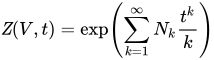
where V is a non-singularn-dimensional projective algebraic variety over the field Fq with q elements and Nk is the number of points of V defined over the finite field extension Fqk of Fq.[1]
Equivalently, the local zeta function is sometimes defined as follows:
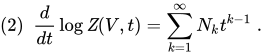
In other words, the local zeta function Z(V,t) with coefficients in the finite fieldFq is defined as a function whose logarithmic derivative generates the number Nk of solutions of the equation defining V in the degree k extension Fqk.
Formulation
Given a finite field F, there is, up to isomorphism, only one field Fk with
,
for k = 1, 2, ... . When F is the unique field with q elements, Fk is the unique field with elements. Given a set of polynomial equations — or an algebraic varietyV— defined over F, we can count the number
of solutions in Fk and create the generating function
.
The correct definition for Z(t) is to set log Z equal to G, so
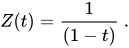
For example, assume all the Nk are 1; this happens for example if we start with an equation like X = 0, so that geometrically we are taking V to be a point. Then
is the expansion of a logarithm (for |t| < 1). In this case we have
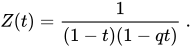
To take something more interesting, let V be the projective line over F. If F has q elements, then this has q + 1 points, including the one point at infinity. Therefore, we have
For the definition and some examples, see also.[4]
Motivations
The relationship between the definitions of G and Z can be explained in a number of ways. (See for example the infinite product formula for Z below.) In practice it makes Z a rational function of t, something that is interesting even in the case of V an elliptic curve over a finite field.
The local Z zeta functions are multiplied to get global zeta functions,
These generally involve different finite fields (for example the whole family of fields Z/pZ as p runs over all prime numbers).
In these fields, the variable t is substituted by p−s, where s is the complex variable traditionally used in Dirichlet series. (For details see Hasse–Weil zeta function.)
The global products of Z in the two cases used as examples in the previous section therefore come out as and after letting .
Riemann hypothesis for curves over finite fields
For projective curves C over F that are non-singular, it can be shown that
with P(t) a polynomial, of degree 2g, where g is the genus of C. Rewriting
the Riemann hypothesis for curves over finite fields states
For example, for the elliptic curve case there are two roots, and it is easy to show the absolute values of the roots are q1/2. Hasse's theorem is that they have the same absolute value; and this has immediate consequences for the number of points.
Here is a separated scheme of finite type over the finite field F with elements, and Frobq is the geometric Frobenius acting on -adic étale cohomology with compact supports of , the lift of to the algebraic closure of the field F. This shows that the zeta function is a rational function of .
An infinite product formula for is
Here, the product ranges over all closed points x of X and deg(x) is the degree of x.
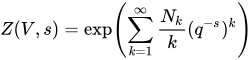
The local zeta function Z(X, t) is viewed as a function of the complex variable s via the change of
variables q−s.
In the case where X is the variety V discussed above, the closed points
are the equivalence classes x=[P] of points P on , where two points are equivalent if they are conjugates over F. The degree of x is the degree of the field extension of F
generated by the coordinates of P. The logarithmic derivative of the infinite product Z(X, t) is easily seen to be the generating function discussed above, namely


![{\displaystyle [F_{k}:F]=k\,}](https://wikimedia.org/api/rest_v1/media/math/render/svg/a6ba55234b230354ae5fdd5ca7d81502ebc862c7)