| Name |
Image |
Location of discovery |
Date of discovery |
Age of remains in
radiocarbon years BP |
Comments |
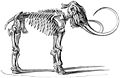
| Adams mammoth |
 |
Mouth of the Lena River, Siberia[1] |
1799[1][2] |
35,800[1][3] |
It is the first complete mammoth skeleton ever to be reconstructed. Originally, it was an entire mummified mammoth carcass.[2] |
| Beresovka Mammoth |
 |
Berezovka River, Siberia[4] |
1900[4] |
44,000[4] |
Except for the head, it is an almost wholly preserved, mummified mammoth carcass.[4] |
| Effie / Fairbanks Creek Mammoth[5][6] |
|
Fairbanks Creek near Fairbanks, Alaska |
1947[5][6] |
21,300±1,300 (1948),
>28,000 (1951), 31,400±2,040 (1965)[6] |
It consists of the mummified head, trunk, and left forelimb of a mammoth calf.[5] Soaked in glycerine during collection. As a result, it required redating in 1951 and 1965.[6] |
| Fishhook Mammoth[7] |
|
Shoreline banks of the estuary of the Upper Taimyra River, Taymyr Peninsula, Siberian Federal District.[7] |
1990-1992[7] |
20,620±70[7] |
Partial woolly mammoth carcass[7] |
| Jarkov Mammoth[8][9] |
|
Taymyr Peninsula, Siberian Federal District[9][8] |
July 1997[8] |
20,000[8] |
Found by members of the Jarkov family, who are Dolgan reindeer herders.[8] |
| Kirgilyakh (Magadan) Mammoth (Dima)[8][10] |
 |
Northeast Siberia, near Kirgilyakh Creek in the Upper Kolyma basin[8][10] |
June 23, 1977[10] |
40,000[10] |
The discovery of the frozen carcass of the Kirgilyakh (Magadan) Mammoth or Dima provided the first opportunity for a detailed study of the anatomy of a mammoth calf.[10] |
| Lyuba Mammoth[11][12] |
 |
Near the Yuribei River on the Yamal Peninsula in northwest Siberia.[11][12] |
May 2007[11] |
42,000[11] |
Lyuba was formerly regarded as the most complete and best-preserved mammoth calf discovered, prior to the discovery of Yuka. It is nicknamed Lyuba after the diminutive of the name of the wife of the reindeer herder who discovered it.[11][12] |
| Malolyakhovsky Mammoth[13] (Buttercup)[14] |
|
Maly Lyakhovsky Island of the New Siberian Islands archipelago[13] |
2012[13] |
28,610±110[13] |
While many mammoths found in permafrost are dried up and mummified, “this was really juicy,” said Herridge, who likened the appearance of the muscle to a “piece of steak — bright red when you cut into the flesh and then as it hit the air, it would go brown.”[15] |
| Yuka Mammoth[16][17] |
 |
Oyagossky Yar coast, 30 km west from the mouth of the Kondratieva River near Yukagir, Siberia.[17] |
August 2010[17] |
34,300+260/−240[17] |
The Yuka mammoth corpse consists of about 95% of its hide, and soft tissues around limbs were preserved in articulated position. This male mammoth calf was nicknamed ‘Yuka’ after the village of Yukagir, whose local people discovered it. Initially misclassified as female, it was determined to be male by later RNA testing.[16][17] |
| Sopkarga Mammoth (Zhenya)[18][19] |
|
Taymyr Peninsula, Siberian Federal District[18] |
August 28, 2012[18][19] |
43,350±240[19] |
The Sopkarga Mammoth (Zhenya) was found on the right bank of the Yenisei River about 3 km north of the Sopochnaya Karga Meteorological Station on Sopochnaya Karga Cape. Zhenya is the diminutive of the name of the 11-year-old boy who discovered it.[18][19] |
| Khroma Mammoth[20] |
|
Allaikhovskii District, Yakutia, Khroma River[20] |
October 2008[20] |
greater than 45,000[21] |
Khroma is very well preserved excepting the absence of trunk.[20] |
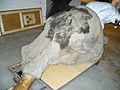
| Yukagir mammoth |
 |
Northern Yakutia, Arctic Siberia, Russia |
2002 (autumn) |
22,500 cal. BP [22] |
Notably well-preserved head, which revealed that woolly mammoths had temporal glands between the ear and the eye[22] |
| Nun cho ga mammoth |
|
Yukon, Trʼondëk Hwëchʼin First Nation, Canada |
June 21, 2022 |
greater than 30,000.[23][24][25] |
Considered the most complete mummified mammoth found in North America, and only the second such find of a calf since Effie (1948). Also roughly same size as Lyuba (2007).[23][25] |


