In mathematics, homological conjectures have been a focus of research activity in commutative algebra since the early 1960s. They concern a number of interrelated (sometimes surprisingly so) conjectures relating various homological properties of a commutative ring to its internal ring structure, particularly its Krull dimension and depth.
The New Intersection Theorem. Let denote a finite complex of free R-modules such that has finite length but is not 0. Then the (Krull dimension) .
The Improved New Intersection Conjecture. Let denote a finite complex of free R-modules such that has finite length for and has a minimal generator that is killed by a power of the maximal ideal of R. Then .
The Direct Summand Conjecture. If is a module-finite ring extension with R regular (here, R need not be local but the problem reduces at once to the local case), then R is a direct summand of S as an R-module. The conjecture was proven by Yves André using a theory of perfectoid spaces.[1]
The Canonical Element Conjecture. Let be a system of parameters for R, let be a free R-resolution of the residue field of R with , and let denote the Koszul complex of R with respect to . Lift the identity map to a map of complexes. Then no matter what the choice of system of parameters or lifting, the last map from is not 0.
Existence of Balanced Big Cohen–Macaulay Modules Conjecture. There exists a (not necessarily finitely generated) R-module W such that mRW ≠ W and every system of parameters for R is a regular sequence on W.
Cohen-Macaulayness of Direct Summands Conjecture. If R is a direct summand of a regular ring S as an R-module, then R is Cohen–Macaulay (R need not be local, but the result reduces at once to the case where R is local).
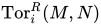
The Vanishing Conjecture for Maps of Tor. Let be homomorphisms where R is not necessarily local (one can reduce to that case however), with A, S regular and R finitely generated as an A-module. Let W be any A-module. Then the map is zero for all .
The Strong Direct Summand Conjecture. Let be a map of complete local domains, and let Q be a height one prime ideal of S lying over , where R and are both regular. Then is a direct summand of Q considered as R-modules.
Existence of Weakly Functorial Big Cohen-Macaulay Algebras Conjecture. Let be a local homomorphism of complete local domains. Then there exists an R-algebra BR that is a balanced big Cohen–Macaulay algebra for R, an S-algebra that is a balanced big Cohen-Macaulay algebra for S, and a homomorphism BR → BS such that the natural square given by these maps commutes.
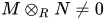
Serre's Conjecture on Multiplicities. (cf. Serre's multiplicity conjectures.) Suppose that R is regular of dimension d and that has finite length. Then , defined as the alternating sum of the lengths of the modules is 0 if , and is positive if the sum is equal to d. (N.B. Jean-Pierre Serre proved that the sum cannot exceed d.)
Small Cohen–Macaulay Modules Conjecture. If R is complete, then there exists a finitely-generated R-module such that some (equivalently every) system of parameters for R is a regular sequence on M.