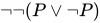
Harrop formulae are more "well-behaved" also in a constructive context. For example, in Heyting arithmetic, Harrop formulae satisfy a classical equivalence not generally satisfied in constructive logic:[1]
But there are still -statements that are -independent, meaning these are Harrop formulae for which excluded middle is however not -provable. The standard example is the arithmetized consistency of (or -equivalently that of ). So
but
And a plain disjunction is never Harrop itself, in the syntactic sense. So the above is compatible with the fact that intuitionistic logic itself already proves indeed for any .
Note that Harrop formulea in the syntactic sense are equivalent to non-Harrop formulas, for example through explosion as .
Hereditary Harrop formulae and logic programming
A more complex definition of hereditary Harrop formulae is used in logic programming as a generalisation of Horn clauses, and forms the basis for the language λProlog. Hereditary Harrop formulae are defined in terms of two (sometimes three) recursive sets of formulae. In one formulation:[4]
Rigid atomic formulae, i.e. constants or formulae , are hereditary Harrop;
is hereditary Harrop provided and are;
is hereditary Harrop provided is;
is hereditary Harrop provided is rigidly atomic, and is a G-formula.