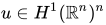
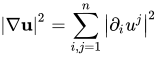
Given a domain and a once-weakly differentiable vector field which represents a fluid flow, such as a solution to the Navier-Stokes equations, its enstrophy is given by:[1]
where . This quantity is the same as the squared seminormof the solution in the Sobolev space.
Incompressible flow
In the case that the flow is incompressible, or equivalently that , the enstrophy can be described as the integral of the square of the vorticity:[2]
In the context of the incompressible Navier-Stokes equations, enstrophy appears in the following useful result:[1]
The quantity in parentheses on the left is the kinetic energy in the flow, so the result says that energy declines proportional to the kinematic viscosity times the enstrophy.
12Navier-Stokes equations and turbulence. Ciprian Foiaş. Cambridge: Cambridge University Press. 2001. pp.28–29. ISBN0-511-03936-0. OCLC56416088.{{cite book}}: CS1 maint: others (link)
↑Doering, C. R. and Gibbon, J. D. (1995). Applied Analysis of the Navier-Stokes Equations, p. 11, Cambridge University Press, Cambridge. ISBN052144568-X.