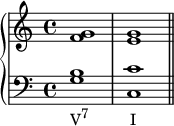
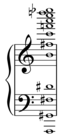
In music theory, a dominant seventh chord, or major minor seventh chord,[a] is a seventh chord composed of a root, major third, perfect fifth, and minor seventh; thus it is a major triad together with a minor seventh. It is often denoted by the letter name of the chord root and a superscript "7".[3] Dominant seventh chords are typically built on the fifth degree (the dominant) of the major scale.[4] An example is the dominant seventh chord built on G, written as G7, having pitches G–B–D–F:
The leading note and the major third combined form a diminished fifth, also known as a tritone. The clashing sound produced by playing these two notes together gives the dominant seventh chord its dissonant quality (i.e. its harmonic instability).[5]
Dominant seventh chords are often built on the fifth scale degree (or dominant) of a key. For instance, in the C major scale, G is the fifth note of the scale, and the seventh chord built on G is the dominant seventh chord of this scale, G7 (shown above). In this chord, F is a minor seventh above G. In Roman numeral analysis, G7 would be represented as V7 in the key of C major.
This chord also occurs on the seventh degree of any natural minor scale (e.g., G7 in A minor).
The dominant seventh is perhaps the most important of the seventh chords. It was the first seventh chord to appear regularly in classical music. The V7 chord is found almost as often as the V, the dominant triad,[6] and typically functions to drive the piece strongly toward a resolution to the tonic of the key.
A dominant seventh chord can be represented by the integer notation {0, 4, 7, 10} relative to the dominant.
History
The majority of Renaissance composers conceived of harmony in terms of intervals rather than chords; "however, certain dissonant sonorities suggest that the dominant seventh chord occurred with some frequency."[7]Monteverdi (usually credited as the first to use the V7 chord without preparation[8]) and other early Baroque composers begin to treat the V7 as a chord as part of the introduction of functional harmony.
An excerpt from Monteverdi's "Lasciatemi Morire", Lamento d'Arianna (1608) is shown below. In it, a dominant seventh chord (in red) is handled conservatively, "prepared and resolved as a suspension, clearly indicating its dissonant status."[7]
An excerpt from Chopin's Mazurka in F minor (1849), Op. 68, No. 4, mm. 1–4 is shown below with dominant sevenths in red: "the seventh factor had by this time achieved nearly consonant status."[7]
Use
Inversions
Inversion
Bottom note
Roman numerals
Macro analysis
Root position
root: 5
V7
in C: G7
First
3rd: 7
V6 5
in C: G6 5
Second
5th: 2
V4 3
in C: G4 3
Third
7th: 4
V4 2 or V2
in C: G4 2 or G2
Inversions of the Dominant Seventh ChordInversions of the Dominant Seventh Chord
The opening bars of Mozart’s Piano Sonata in C, K545 features dominant seventh chords in both second and first inversions:
Mozart Piano Sonata in C , K545 opening barsMozart Piano Sonata in C , K545 opening bars 02
The concluding cadence of the same movement features the chord in root position:
Mozart Piano Sonata in C, K545, end of first movementMozart Piano Sonata in C, K545, end of first movement 02
A striking use of inversions of the dominant seventh can be found in this passage from the first movement of Beethoven’s String Quartet Op. 127. Here, the second and third inversions contribute to the "magnificently rich harmony" [9]:
Beethoven Quartet Op. 127 first movement, bars 135–139Beethoven Quartet Op. 127 first movement, bars 135–139
The function of the dominant seventh chord is to resolve to the tonic note or chord.
... the demand of the V7 for resolution is, to our ears, almost inescapably compelling. The dominant seventh is, in fact, the central propulsive force in our music; it is unambiguous and unequivocal.
This dominant seventh chord is useful to composers because it contains both a major triad and the interval of a tritone. The major triad confers a very "strong" sound. The tritone is created by the co-occurrence of the fourth degree and seventh degree (e.g., in the G7 chord, the interval between B and F is a tritone).
In a diatonic context, the third of the chord is the leading-tone of the scale, which has a strong tendency to pull towards the tonic of the key (e.g., in C, the third of G7, B, is the leading tone of the key of C). The seventh of the chord acts as an upper leading-tone to the third of the scale (in C: the seventh of G7, F, is a half-step above and leads down to E).[11] This, in combination with the strength of root movement by fifth, and the natural resolution of the dominant triad to the tonic triad (e.g., from GBD to CEG in the key of C major), creates a resolution with which to end a piece or a section, often in a cadence.
Because of this original usage, it also quickly became an easy way to trick the listener's ear with a deceptive cadence. The dominant seventh may work as part of a circle progression, preceded by the supertonic chord, ii.
A non-diatonic dominant seventh chord (sometimes called a chromatic seventh) can be borrowed from another key, and this can provide a way for the composer to modulate to that other key. This technique is extremely common, particularly since the Classical period, and it has led to further innovative uses of the dominant seventh chord such as secondary dominant (V7/V, shown below), extended dominant (V7/V/V), and substitute dominant (♭V7/V) chords.
In the V7–I resolution, the dominant, leading note, and supertonic resolve to the tonic, whereas the subdominant resolves to the mediant.
In the other resolutions, the dominant remains stationary, the leading note and supertonic resolve to the tonic, and the subdominant resolves to the mediant.
All four tones may be present, though the root may be doubled and the fifth omitted.[12][13][14]
The diminished fifth (if the seventh is above the third, as in the first measure below) resolves inwards while the augmented fourth (if the seventh is below the third, as in the second measure below) resolves outward. This means that the seventh resolves stepwise downwards[13][14] while the third resolves upwards to the tonic[12] though in such cases the root of the tonic chord may need to be tripled.[13]
The root of the V7, when in the bass, resolves to the root of the I, in the bass.[12]
In an incomplete V7, with a missing fifth, the doubled root remains stationary.[12]
The "free resolution of the seventh" features the seventh in an inner voice moving stepwise upwards to the fifth of I[12]
According to Heinrich Schenker, "The dissonance is always passing, never a chord member (Zusammenklang),'"[15] and often (though by no means always) the voice leading suggests either a passing note:
The dominant seventh is enharmonically equivalent to the German sixth. For example, the German sixth A♭–C–E♭–F♯ (which typically resolves to G) is equivalent to the dominant seventh A♭–C–E♭–G♭ (which typically resolves to D♭):
Just harmonic seventh chord on C. 7th: 968.826 cents, a septimal quarter tone lower than B♭.
The dominant seventh chord is frequently used to approximate a harmonic seventh chord, which is one possible just tuning, in the ratios 4:5:6:7[1]Playⓘ, for the dominant seventh. Others include 20:25:30:36 Playⓘ, found on I, and 36:45:54:64, found on V, used in 5-limit just tunings and scales.[2]
Today, the dominant seventh chord enjoys particular prominence in the music of barbershop quartets, with the Barbershop Harmony Society describing the chord as the "signature" of the barbershop sound. A song may use the chord type (built on any scale degree, not just ), for up to 30 percent of its duration.[18] As barbershop singers strive to harmonize in just intonation to maximize the audibility of harmonic overtones, the practical sonority of the chord tends to be that of a harmonic seventh chord. This chord type has become so ingrained into the fabric of the artform that it is often referred to as the "barbershop seventh chord" by those who practice it.[19][20]
↑Bruce Benward & Marilyn Nadine Saker (2003). Music in Theory and Practice, seventh edition (Boston: McGraw-Hill), vol. 1: p. 77. ISBN978-0-07-294262-0.
↑Schenker, Heinrich. Jahrbuch II, p. 24 cited in Jonas, Oswald (1982). Introduction to the Theory of Heinrich Schenker (1934: Das Wesen des musikalischen Kunstwerks: Eine Einführung in Die Lehre Heinrich Schenkers), p. 20. Translator: John Rothgeb. ISBN0-582-28227-6.
12Stephenson, Ken (2002). What to Listen for in Rock: A Stylistic Analysis, p. 82. ISBN978-0-300-09239-4.


![{
\new PianoStaff <<
\new Staff <<
\new Voice \relative c'' {
\clef treble \key f \minor \time 3/4
\override DynamicLineSpanner.staff-padding = #2
c4~(_\markup { \italic "sotto voce" } c8[ des] des[ c]
b\trill ais \once \override NoteHead.color = #red b4\< g')\!
bes,!~( \once \override NoteHead.color = #red bes8[ c] c[ bes]
a8\trill gis \once \override NoteHead.color = #red a4\< f')\!
}
>>
\new Staff <<
\new Voice \relative c' {
\clef bass \key f \minor \time 3/4
r4 <aes c f> <aes c f>
r \once \override NoteHead.color = #red <g d' f> <g des' f>
r \once \override NoteHead.color = #red <ges des' fes> <ges c es>
r \once \override NoteHead.color = #red <f c' es> <f ces' es>
}
>>
>> }](http://upload.wikimedia.org/score/2/a/2av2vc4mya7kerez3dvg54z3acshq5r/2av2vc4m.png)


![{
\override Score.SpacingSpanner.strict-note-spacing = ##t
\set Score.proportionalNotationDuration = #(ly:make-moment 1/12)
\new PianoStaff <<
\new Staff <<
\relative c' {
\clef treble \key bes \major \time 2/4
r8 <es a>-.\p <d bes'>-.[ <c' es a>-.] <bes d bes'>-.\ff r
}
>>
\new Staff <<
\new Voice \relative c {
\clef bass \key bes \major \time 2/4
\stemUp <d bes'>8 \stemNeutral <f c'>-.[_\markup { \concat { "V" \raise #1 \small "7" \hspace #1.2 "I" \hspace #2 "V" \raise #1 \small "7" \hspace #1.7 "I" } }
bes-.] <f, f'>-. <bes, bes'>-. r \bar "|."
}
\new Voice \relative c, {
\clef bass \key bes \major \time 2/4
\stemDown bes8
}
>>
>> }](http://upload.wikimedia.org/score/n/r/nrtne076fj9ifewpzneq23z01plqie0/nrtne076.png)