Cayley–Menger determinants
Cayley–Menger determinants, named after Arthur Cayley and Karl Menger, are determinants of matrices of distances between sets of points.
Let  be n + 1 points in a semimetric space, their Cayley–Menger determinant is defined by
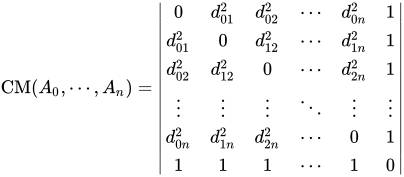
If  , then they make up the vertices of a possibly degenerate n-simplex
  in
in  . It can be shown that[6] the n-dimensional volume of the simplex satisfies

Note that, for the case of  , we have
 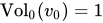 , meaning the "0-dimensional volume" of a 0-simplex is 1, that is, there is 1 point in a 0-simplex.
are affinely independent iff 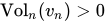 , that is,
  . Thus Cayley–Menger determinants give a computational way to prove affine independence.
If  , then the points must be affinely dependent, thus
  . Cayley's 1841 paper studied the special case of
  , that is, any five points
  in 3-dimensional space must have
  .
.
Characterization via Cayley–Menger determinants
The following results are proved in Blumethal's book.[12]
Embedding n + 1 points in the real numbers
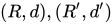
Given a semimetric space  , with
  , and
, and  ,
,  , an isometric embedding of into
  is defined by
  , such that
 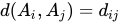 for all .
Again, one asks whether such an isometric embedding exists for .
A necessary condition is easy to see: for all  , let
, let  be the k-simplex formed by
  , then

The converse also holds. That is, if for all ,

then such an embedding exists.
Further, such embedding is unique up to isometry in . That is, given any two isometric embeddings defined by  , and
, and  , there exists a (not necessarily unique) isometry
  , such that
  for all
  . Such
  is unique if and only if
  , that is, are affinely independent.
Embedding n + 2 and n + 3 points
If  points
 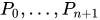 can be embedded in as
  , then other than the conditions above, an additional necessary condition is that the
  -simplex formed by
  , must have no -dimensional volume. That is,
  .
.
The converse also holds. That is, if for all ,
and

then such an embedding exists.
For embedding  points in , the necessary and sufficient conditions are similar:
- For all ,
 ;
;



Embedding arbitrarily many points
The case turns out to be sufficient in general.
In general, given a semimetric space  , it can be isometrically embedded in if and only if there exists
  , such that, for all , , and for any
  ,
,
And such embedding is unique up to isometry in .
Further, if , then it cannot be isometrically embedded in any  . And such embedding is unique up to unique isometry in .
Thus, Cayley–Menger determinants give a concrete way to calculate whether a semimetric space can be embedded in , for some finite  , and if so, what is the minimal .