In differential geometry, the Cotton tensor on a pseudo-Riemannian manifold of dimension n is a third-order tensor concomitant of the metric tensor. The vanishing of the Cotton tensor for n = 3 is necessary and sufficient condition for the manifold to be locally conformally flat. By contrast, in dimensions n ≥ 4, the vanishing of the Cotton tensor is necessary but not sufficient for the metric to be conformally flat; instead, the corresponding necessary and sufficient condition in these higher dimensions is the vanishing of the Weyl tensor, while the Cotton tensor just becomes a constant times the divergence of the Weyl tensor. For n < 3 the Cotton tensor is identically zero. The concept is named after Émile Cotton.
The proof of the classical result that for n = 3 the vanishing of the Cotton tensor is equivalent to the metric being conformally flat is given by Eisenhart using a standard integrability argument. This tensor density is uniquely characterized by its conformal properties coupled with the demand that it be differentiable for arbitrary metric tensors, as shown by Aldersley (1979). The Cotton tensor is a component of the full Cartan conformal curvature in all dimensions , the other component being the Weyl curvature.
In coordinates, and denoting the Ricci tensor by Rij and the scalar curvature by R, the components of the Cotton tensor are
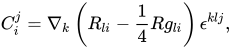
The Cotton tensor can be regarded as a vector valued 2-form, and for n = 3 the Hodge star operator converts this into a second-order trace-free tensor density:














![{\displaystyle C_{[ijk]}=0.}](https://wikimedia.org/api/rest_v1/media/math/render/svg/6c3c881f84b5665847548ee7afa14362118299c1)

