Let us notate a formal grammar as  , with
  a set of nonterminal symbols,
  a set of terminal symbols,
  a set of production rules, and
  the start symbol.
A string 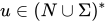 directly yields, or directly derives to, a string
 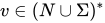 , denoted as
  , if v can be obtained from u by an application of some production rule in P, that is, if
  and
and  , where
 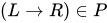 is a production rule, and
  is the unaffected left and right part of the string, respectively.
More generally, u is said to yield, or derive to, v, denoted as
is the unaffected left and right part of the string, respectively.
More generally, u is said to yield, or derive to, v, denoted as  , if v can be obtained from u by repeated application of production rules, that is, if
  for some n ≥ 0 and some strings
  . In other words, the relation
  is the reflexive transitive closure of the relation
  .
.
The language of the grammar G is the set of all terminal-symbol strings derivable from its start symbol, formally:  .
Derivations that do not end in a string composed of terminal symbols only are possible, but do not contribute to L(G).
.
Derivations that do not end in a string composed of terminal symbols only are possible, but do not contribute to L(G).
Context-sensitive grammar
A formal grammar is context-sensitive if each rule in P is either of the form  where
where  is the empty string, or of the form
- αAβ → αγβ
with A ∈ N,[note 1]  ,[note 2] and
  .[note 3]
The name context-sensitive is explained by the α and β that form the context of A and determine whether A can be replaced with γ or not.
By contrast, in a context-free grammar, no context is present: the left hand side of every production rule is just a nonterminal.
The string γ is not allowed to be empty. Without this restriction, the resulting grammars become equal in power to unrestricted grammars.[10]
(Weakly) equivalent definitions
A noncontracting grammar is a grammar in which for any production rule, of the form u → v, the length of u is less than or equal to the length of v.
Every context-sensitive grammar is noncontracting, while every noncontracting grammar can be converted into an equivalent context-sensitive grammar; the two classes are weakly equivalent.[12]
Some authors use the term context-sensitive grammar to refer to noncontracting grammars in general.
The left-context- and right-context-sensitive grammars are defined by restricting the rules to just the form αA → αγ and to just Aβ → γβ, respectively. The languages generated by these grammars are also the full class of context-sensitive languages.[13] The equivalence was established by Penttonen normal form.[14]






















![{\displaystyle S\rightarrow [ACaB]}](https://wikimedia.org/api/rest_v1/media/math/render/svg/30e1325ff5cb595ef63a3000fa67f4be1624b29a)
![{\displaystyle {\begin{cases}\ [Ca]a\rightarrow aa[Ca]\\\ [Ca][aB]\rightarrow aa[CaB]\\\ [ACa]a\rightarrow [Aa]a[Ca]\\\ [ACa][aB]\rightarrow [Aa]a[CaB]\\\ [ACaB]\rightarrow [Aa][aCB]\\\ [CaB]\rightarrow a[aCB]\end{cases}}}](https://wikimedia.org/api/rest_v1/media/math/render/svg/b610fa908a8e0403fc0a7eb45e1ba5c76bab3499)
![{\displaystyle [aCB]\rightarrow [aDB]}](https://wikimedia.org/api/rest_v1/media/math/render/svg/6e25ba01ca202a0593ae858b2335f6b3881b2cf0)
![{\displaystyle [aCB]\rightarrow [aE]}](https://wikimedia.org/api/rest_v1/media/math/render/svg/98f17ab26d272cb6566a18836d482b3c81572352)
![{\displaystyle {\begin{cases}\ a[Da]\rightarrow [Da]a\\\ [aDB]\rightarrow [DaB]\\\ [Aa][Da]\rightarrow [ADa]a\\\ a[DaB]\rightarrow [Da][aB]\\\ [Aa][DaB]\rightarrow [ADa][aB]\end{cases}}}](https://wikimedia.org/api/rest_v1/media/math/render/svg/a2fc2d6c3fc3f52b8311f08c191aba7aea9cbc40)
![{\displaystyle [ADa]\rightarrow [ACa]}](https://wikimedia.org/api/rest_v1/media/math/render/svg/097b569ac1aa3d95e00d63c289ec763cda71aa0d)
![{\displaystyle {\begin{cases}\ a[Ea]\rightarrow [Ea]a\\\ [aE]\rightarrow [Ea]\\\ [Aa][Ea]\rightarrow [AEa]a\end{cases}}}](https://wikimedia.org/api/rest_v1/media/math/render/svg/8c820f37471166abbed493f05c837857e8bd8918)
![{\displaystyle [AEa]\rightarrow a}](https://wikimedia.org/api/rest_v1/media/math/render/svg/979381ab73dede3da0427e33a316b592582cfcf0)


![{\displaystyle [ACaB]}](https://wikimedia.org/api/rest_v1/media/math/render/svg/ebc718787aa2b63d4df784709390e91dcdb0cef3)