ENSIKLOPEDIA
Consumer-resource model
In theoretical ecology and nonlinear dynamics, consumer-resource models (CRMs) are a class of ecological models in which a community of consumer species compete for a common pool of resources. Instead of species interacting directly, all species-species interactions are mediated through resource dynamics. Consumer-resource models have served as fundamental tools in the quantitative development of theories of niche construction, coexistence, and biological diversity. These models can be interpreted as a quantitative description of a single trophic level.[1][2]
A general consumer-resource model consists of M resources whose abundances are 




Originally introduced by Robert H. MacArthur[3] and Richard Levins,[4] consumer-resource models have found success in formalizing ecological principles and modeling experiments involving microbial ecosystems.[5][6]
Models
Niche models
Niche models are a notable class of CRMs which are described by the system of coupled ordinary differential equations,[7][8]
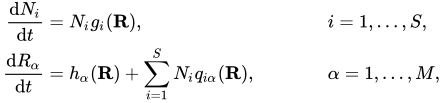
where 


MacArthur consumer-resource model (MCRM)
The MacArthur consumer-resource model (MCRM), named after Robert H. MacArthur, is a foundational CRM for the development of niche and coexistence theories.[9][10] The MCRM is given by the following set of coupled ordinary differential equations:[11][12][8]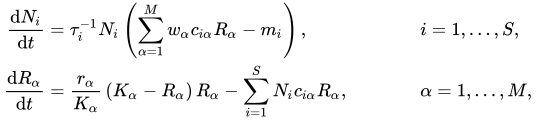


Externally supplied resources model
The externally supplied resource model is similar to the MCRM except the resources are provided at a constant rate from an external source instead of being self-replenished. This model is also sometimes called the linear resource dynamics model. It is described by the following set of coupled ordinary differential equations:[11][8]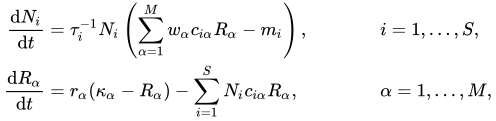


Tilman consumer-resource model (TCRM)
The Tilman consumer-resource model (TCRM), named after G. David Tilman, is similar to the externally supplied resources model except the rate at which a species depletes a resource is no longer proportional to the present abundance of the resource. The TCRM is the foundational model for Tilman's R* rule. It is described by the following set of coupled ordinary differential equations:[8]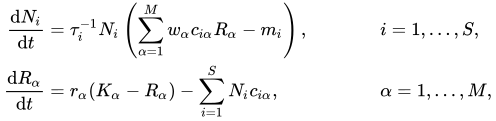
Microbial consumer-resource model (MiCRM)
The microbial consumer resource model describes a microbial ecosystem with externally supplied resources where consumption can produce metabolic byproducts, leading to potential cross-feeding. It is described by the following set of coupled ODEs:


Symmetric interactions and optimization
MacArthur's Minimization Principle
For the MacArthur consumer resource model (MCRM), MacArthur introduced an optimization principle to identify the uninvadable steady state of the model (i.e., the steady state so that if any species with zero population is re-introduced, it will fail to invade, meaning the ecosystem will return to said steady state). To derive the optimization principle, one assumes resource dynamics become sufficiently fast (i.e., 


![{\displaystyle {\frac {\mathrm {d} N_{i}}{\mathrm {d} t}}=\tau _{i}^{-1}N_{i}\left[\sum _{\alpha \in M^{\ast }}r_{\alpha }^{-1}K_{\alpha }w_{\alpha }c_{i\alpha }\left(r_{\alpha }-\sum _{j=1}^{S}N_{j}c_{j\alpha }\right)-m_{i}\right],}](https://wikimedia.org/api/rest_v1/media/math/render/svg/6d3b0a79ab9959a41deafe64fe80f965850aad57)

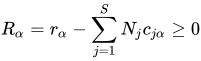


At un-invadable steady state 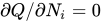
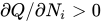
Minimum Environmental Perturbation Principle (MEPP)
MacArthur's Minimization Principle has been extended to the more general Minimum Environmental Perturbation Principle (MEPP) which maps certain niche CRM models to constrained optimization problems. When the population growth conferred upon a species by consuming a resource is related to the impact the species' consumption has on the resource's abundance through the equation,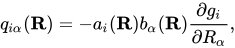


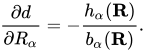

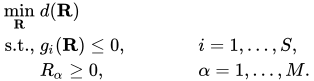
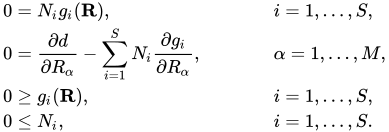


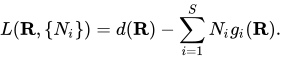

Geometric perspectives
The steady states of consumer resource models can be analyzed using geometric means in the space of resource abundances.[16][17][8]
Zero net-growth isoclines (ZNGIs)
For a community to satisfy the uninvisibility and steady-state conditions, the steady-state resource abundances (denoted 


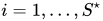

Coexistence cones
The structure of ZNGI intersections determines what species can feasibly coexist but does not determine what set of coexisting species will be realized. Coexistence cones determine what species determine what species will survive in an ecosystem given a resource supply vector. A coexistence cone generated by a set of species 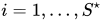
To see the cone structure, consider that in the MacArthur or Tilman models, the steady-state non-depleted resource abundances must satisfy,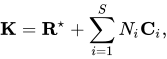



Complex ecosystems
In an ecosystem with many species and resources, the behavior of consumer-resource models can be analyzed using tools from statistical physics, particularly mean-field theory and the cavity method.[18][13][19] In the large ecosystem limit, there is an explosion of the number of parameters. For example, in the MacArthur model, 
MacArthur consumer resource model cavity solution
In the MCRM, the model parameters can be taken to be random variables with means and variances:

With this parameterization, in the thermodynamic limit (i.e., 
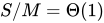




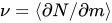
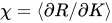
This mean-field framework can determine the moments and exact form of the abundance distribution, the average susceptibilities, and the fraction of species and resources that survive at a steady state.
Similar mean-field analyses have been performed for the externally supplied resources model,[11] the Tilman model,[12] and the microbial consumer-resource model.[19] These techniques were first developed to analyze the random generalized Lotka–Volterra model.
See also
References
- ↑ Chase, Jonathan M.; Leibold, Mathew A. (2003). Ecological Niches. University of Chicago Press. doi:10.7208/chicago/9780226101811.001.0001. ISBN 978-0-226-10180-4.
- ↑ Pimm, Stuart L. (September 1983). "TILMAN, D. 1982. Resource competition and community structure. Monogr. Pop. Biol. 17. Princeton University Press, Princeton, N.J. 296 p. $27.50". Limnology and Oceanography. 28 (5): 1043–1045. Bibcode:1983LimOc..28.1043P. doi:10.4319/lo.1983.28.5.1043.
- ↑ MacArthur, Robert (1970-05-01). "Species packing and competitive equilibrium for many species". Theoretical Population Biology. 1 (1): 1–11. Bibcode:1970TPBio...1....1M. doi:10.1016/0040-5809(70)90039-0. ISSN 0040-5809. PMID 5527624.
- ↑ Levins, Richard (1968). Evolution in Changing Environments: Some Theoretical Explorations. (MPB-2). Princeton University Press. doi:10.2307/j.ctvx5wbbh. ISBN 978-0-691-07959-2. JSTOR j.ctvx5wbbh.
- ↑ Goldford, Joshua E.; Lu, Nanxi; Bajić, Djordje; Estrela, Sylvie; Tikhonov, Mikhail; Sanchez-Gorostiaga, Alicia; Segrè, Daniel; Mehta, Pankaj; Sanchez, Alvaro (2018-08-03). "Emergent simplicity in microbial community assembly". Science. 361 (6401): 469–474. Bibcode:2018Sci...361..469G. doi:10.1126/science.aat1168. ISSN 0036-8075. PMC 6405290. PMID 30072533.
- ↑ Dal Bello, Martina; Lee, Hyunseok; Goyal, Akshit; Gore, Jeff (October 2021). "Resource–diversity relationships in bacterial communities reflect the network structure of microbial metabolism". Nature Ecology & Evolution. 5 (10): 1424–1434. Bibcode:2021NatEE...5.1424D. doi:10.1038/s41559-021-01535-8. hdl:1721.1/141887. ISSN 2397-334X. PMID 34413507. S2CID 256708107.
- 1 2 3 4 Marsland, Robert; Cui, Wenping; Mehta, Pankaj (2020-09-01). "The Minimum Environmental Perturbation Principle: A New Perspective on Niche Theory". The American Naturalist. 196 (3): 291–305. arXiv:1901.09673. Bibcode:2020ANat..196..291M. doi:10.1086/710093. ISSN 0003-0147. PMID 32813998. S2CID 59316948.
- 1 2 3 4 5 6 Cui, Wenping; Marsland III, Robert; Mehta, Pankaj (2024-03-08). "Les Houches Lectures on Community Ecology: From Niche Theory to Statistical Mechanics". arXiv:2403.05497 [q-bio.PE].
- ↑ "Resource Competition and Community Structure. (MPB-17), Volume 17 | Princeton University Press". press.princeton.edu. 1982-08-21. Retrieved 2024-03-18.
- ↑ Chase, Jonathan M.; Leibold, Mathew A. Ecological Niches: Linking Classical and Contemporary Approaches. Interspecific Interactions. Chicago, IL: University of Chicago Press.
- 1 2 3 Cui, Wenping; Marsland, Robert; Mehta, Pankaj (2020-07-21). "Effect of Resource Dynamics on Species Packing in Diverse Ecosystems". Physical Review Letters. 125 (4) 048101. arXiv:1911.02595. Bibcode:2020PhRvL.125d8101C. doi:10.1103/PhysRevLett.125.048101. PMC 8999492. PMID 32794828.
- 1 2 Cui, Wenping; Marsland, Robert; Mehta, Pankaj (2021-09-27). "Diverse communities behave like typical random ecosystems". Physical Review E. 104 (3) 034416. Bibcode:2021PhRvE.104c4416C. doi:10.1103/PhysRevE.104.034416. PMC 9005152. PMID 34654170.
- 1 2 Marsland, Robert; Cui, Wenping; Mehta, Pankaj (2020-02-24). "A minimal model for microbial biodiversity can reproduce experimentally observed ecological patterns". Scientific Reports. 10 (1): 3308. arXiv:1904.12914. Bibcode:2020NatSR..10.3308M. doi:10.1038/s41598-020-60130-2. ISSN 2045-2322. PMC 7039880. PMID 32094388.
- ↑ Arthur, Robert Mac (December 1969). "Species Packing, and What Competition Minimizes". Proceedings of the National Academy of Sciences. 64 (4): 1369–1371. doi:10.1073/pnas.64.4.1369. ISSN 0027-8424. PMC 223294. PMID 16591810.
- ↑ MacArthur, Robert (1970-05-01). "Species packing and competitive equilibrium for many species". Theoretical Population Biology. 1 (1): 1–11. Bibcode:1970TPBio...1....1M. doi:10.1016/0040-5809(70)90039-0. ISSN 0040-5809. PMID 5527624.
- ↑ Mancuso, Christopher P; Lee, Hyunseok; Abreu, Clare I; Gore, Jeff; Khalil, Ahmad S (2021-09-03). Shou, Wenying; Walczak, Aleksandra M; Shou, Wenying (eds.). "Environmental fluctuations reshape an unexpected diversity-disturbance relationship in a microbial community". eLife. 10 e67175. doi:10.7554/eLife.67175. ISSN 2050-084X. PMC 8460265. PMID 34477107.
- ↑ Tikhonov, Mikhail; Monasson, Remi (2017-01-27). "Collective Phase in Resource Competition in a Highly Diverse Ecosystem". Physical Review Letters. 118 (4) 048103. arXiv:1609.01270. Bibcode:2017PhRvL.118d8103T. doi:10.1103/PhysRevLett.118.048103. PMID 28186794.
- 1 2 Advani, Madhu; Bunin, Guy; Mehta, Pankaj (2018-03-20). "Statistical physics of community ecology: a cavity solution to MacArthur's consumer resource model". Journal of Statistical Mechanics: Theory and Experiment. 2018 (3): 033406. Bibcode:2018JSMTE..03.3406A. doi:10.1088/1742-5468/aab04e. ISSN 1742-5468. PMC 6329381. PMID 30636966.
- 1 2 Mehta, Pankaj; Marsland III, Robert (2021-10-10), Cross-feeding shapes both competition and cooperation in microbial ecosystems, arXiv:2110.04965
Further reading
- Cui, Wenping; Robert Marsland III; Mehta, Pankaj (2024). "Les Houches Lectures on Community Ecology: From Niche Theory to Statistical Mechanics". arXiv:2403.05497 [q-bio.PE].
- Stefano Allesina's Community Ecology course lecture notes: https://stefanoallesina.github.io/Theoretical_Community_Ecology/