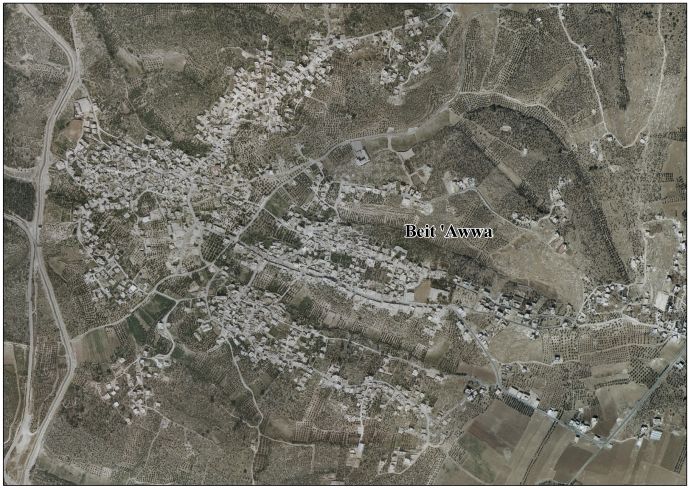
Beit Awwa saw ruins and artificial caves noted by various visitors throughout the 19th century. Following the 1948 Arab–Israeli War, it came under Jordanian rule, then Israeli occupation after the Six-Day War in 1967. Today, it is home to prominent clans, the Masalmea and Al Swaty.
In 1838, during the Ottoman era, Edward Robinson noted Beit 'Auwa as a place "in ruins or deserted," part of the area between the mountains and Gaza, but subject to the government of el-Khulil.[3] He further remarked that the ruins "covering low hills on both sides of the path, exhibiting foundations of hewn stones, from which all that can be inferred is, that here was once an extensive town."[4]
In 1863, Victor Guérin visited Beit Awwa, which he called Khirbet Beit el-Haoua. He described finding many artificial caves, some of which were large and had shaped domes, other smaller with square ceilings. Most entries were surrounded by piles of stones from old demolished buildings.[5]
"Khurbet es Sueity, Khurbet el Mehami, Khurbet el Kusah are all sites with foundations and caves. El Kusr is an ancient watch-tower, with drystone walls in ruins; el Keniseh seems to be a ruined church; foundations, capitals, shafts, and lintels with the Maltese cross on them, remain showing a Byzantine building. There is also a fine font fitted for immersion. In the centre a square basin, 2 feet 3 inches side, 7 inches deep; four steps lead down, 5 inches high, 9 inches broad; the whole surrounded by four segmental recesses, the external form of the font being that of a rounded cross, the longest measurement either way being 5 feet, and the total height outside 2 feet 4 inches."[6]
In November 1948, during the 1948 Arab-Israeli War soldiers from the Israeli5th Brigade attacked Beit Awwa, Idhna and Kh. Sikka. At Beit Awwa, the attackers were driven off.[8]
In March 1949, the 4th Brigade attacked Beit Awwa and surrounding villages. Their attack orders were to "hit every [adult male] Arab" they encountered. All in all, they drove out 7,000 people eastward. With UN the villagers were eventually allowed back.[9]
In 1961, the population of Beit Awwa was 1,368.[10]
1967, aftermath
After the Six-Day War in 1967, Beit Awwa has been under Israeli occupation.
The population in the 1967 census conducted by the Israeli authorities was 1,468.[11] After the 1967 six day war Beit Awwa was completely destroyed.[12]Moshe Dayan claimed the destruction was carried out under the orders of an officer who wished to expel the residents, Brigadier General Uzi Narkiss claimed the credit for the action.[13]
Its total land area is 470 dunams (0.47km2; 0.18sqmi), 30% of it lands before 1948; due to the town's proximity Green Line hundreds of dunams are a part of modern-day Israel.[14]
21st-century
On 18 March 2026, three Palestinian women were killed and eight others injured by the "direct impact of missile shrapnel" on a beauty salon during the 2026 Iran war, after an earlier report said that there had been four fatalities in the incident.[15][16] The origin of the projectile was initially undetermined, though the Israeli military attributed the incident to an Iranian cluster munition;[17][18][19] this claim was not confirmed by Palestinian officials and remained independently unverified.[15] Palestinian medics said the deaths were caused by "shrapnel falling".[20]
Economy
Beit Awwa is among the Hebron Governorate locations where almonds are cultivated.[21]
Population
The two prominent clans of Beit 'Awwa are Masalmea and Al Swaty.[22] The Al Swaty clan relocated to the region either from ar-Ramtha, Jordan,[23][24] or, according to another account, from what is today the northern West Bank, passing through the Judean Lowlands.[25] The Masalmea family originated from Beit Jala.[25]
↑UN Doc A/8389 of 5 October 1971 A/8389 of 5 October 1971. Para 57. in the Sunday Times (London) on 11 October 1970, where reference is made not only to the villages of Jalou, Beit Nuba, and Imwas, also referred to by the Special Committee in its first report, but in addition to villages like Surit, Beit Awwa, Beit Mirsem and El-Shuyoukh in the Hebron area and Jiflik, Agarith and Huseirat, in the Jordan Valley. The Special Committee has ascertained that all these villages have been completely destroyed. Para 58. the village of Nebi Samwil was in fact destroyed by Israeli armed forces on March 22, 1971.
↑Tian, Yang. "Three Palestinian women killed as missile debris hits West Bank beauty salon", BBC, March 19, 2026. Accessed March 19, 2026. "At least three Palestinian women have been killed and eight more injured when a beauty salon in the Israeli-occupied West Bank was hit during an Iranian missile attack. The Israeli military told the BBC the women were killed 'by a direct hit from a cluster munition missile'. The Palestinian Red Crescent Society (PRCS) said there was a 'direct impact of missile shrapnel'. The incident happened in the town of Beit Awwa, near Hebron, in the southern West Bank, on Wednesday night."
12Grossman, D. (1994). Expansion and Desertion: the Arab Village and its Offshoots in Ottoman Palestine (in Hebrew). Jerusalem: Yad Izhak Ben-Zvi. p.222.